ONE QUESTION · HYPERSONIC MHD · WORKING RESEARCH
How much energy
can we really recover?
Can we take energy from fast-moving air, turn it into electricity, and use it to help an engine?
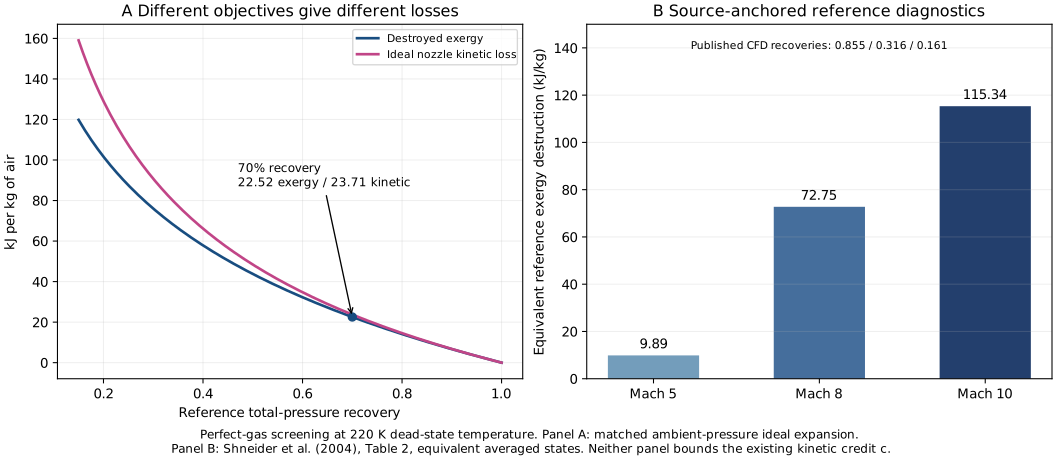
At 70% pressure recovery and a 220 K environment, the calculated exergy destruction is 22.52 kJ/kg. What that number can limit depends on the energy we count.
Think of exergy as the work energy could still do as the air settles into its surroundings. Slowing air can reduce that potential. But an engine also changes heat, electricity and exhaust motion, so all of them must be counted consistently.
Our second-law audit finds that this exergy number cannot directly cap the useful-energy credit in the earlier model. The five-page working note derives the conditional bound and shows the missing thermal-exergy term. The inlet model remains unvalidated.
What the second law actually bounds
With the same incoming exergy and matched external transfers, the improvement in exported work plus full outgoing flow exergy cannot exceed the reference exergy destruction. But the earlier credit c also contains retained Joule energy and a change in the exhaust’s remaining thermal exergy. Ignoring those terms gives the wrong bound.
c_equiv = (1 − K)d + T_env(S_gen,ref − S_gen,modified) − ΔX_thermal
For the specified passive reference, D_ref = T_env R ln(1/Π). At Π=0.70 and T_env=220 K, D_ref=22.524 kJ/kg while ideal-nozzle kinetic loss is 23.712 kJ/kg. The difference is residual thermal exergy. Combustion and changed nozzle recovery require a whole-cycle balance.
Published-case comparison and why the inlet is still unvalidated · Source-anchored calculations
The earlier recycling ledger, in plain terms and equations
Imagine taking 100 units of energy from the air. At 36% round-trip conversion, and after spending 5% of the electricity on ionization and other loads, only 34.2 useful units come back. An independent improvement must provide the missing 65.8 units just to break even.
Let d be extracted energy, g generator conversion, h useful accelerator conversion, s the share returned, e ionization cost, a other electrical loads, and c the separately evaluated cycle credit. Define x=e/d, α=a/d, χ=c/d and r=g·h·s.
Δ/d = χ − 1 + r − (r/g)(x + α)
x* = g[1 + (χ − 1)/r] − α, for r > 0
The e/d-versus-r map still needs g and α: round-trip conversion alone cannot determine how much electricity is available to pay the loads. Compare three generator-conversion assumptions.
For the main figure, use z=(e+a)/(g·d), the fraction of gross generation spent on electrical loads:
χ_required = 1 − r(1 − z)
Strict gain: χ > χ_required; affordable bus: 0 ≤ z ≤ 1.
This normalization needs d > 0 and g > 0; compatible components require 0 ≤ r ≤ g ≤ 1. If r=0, Δ/d=χ−1. Colors are accounting requirements, not proven hardware. The required normalized credit is 65.8%. The required normalized credit is 65.8%. The earlier 400 kJ/kg illustration gives the same 263.2 kJ/kg requirement because 263.2/400=0.658. Net thrust requires a matched engine and installation calculation. Open the dimensionless round-trip map.
Can we calculate the inlet benefit rather than assume it?
A new reduced model compares a normal shock and ideal expansion with a scalar Faraday generator placed before the shock. Both branches share their inlet state and final expansion pressure. This calculates an equivalent credit c from local Mach, conductivity σ and magnetic field B, conditional on gas state, duct length and electrical loading.
In one illustrative case, the calculated credit is 57.46% of extraction, below the 64% needed with free electrical overhead and 36% round-trip conversion. The useful-energy proxy is therefore negative: −0.509 kJ/kg. This is an uncalibrated comparison with a deliberately simple reference inlet, not a prediction for a real aircraft.
The model only sees the product σB². It does not determine Hall stability, controllable field, ionization cost, combustion or installed thrust. Of 27 numerical cases, one stops at a sonic validity guard; interrupted cases receive no invented final result. Inspect the numerical cases.
What the experiments establish
HVEPS Test 3 supports an electrical-output benchmark. Ames Runs 15 and 16 report approximate velocity increases of 27% and 38%. They are separate component studies, not a tested complete energy-bypass loop. The paper explains why these observations cannot calibrate this simple ledger into an engine prediction.
The often-compared 45% core-flow kinetic share and 81% isentropic efficiency use different definitions. Neither is silently substituted for the conversion axis above. The new reduced inlet calculation adds conditional local Mach, conductivity and field dependence; a validated flow/plasma/engine model is still missing.
See the working paper and scientific references or the existing MHD evidence collection.
What remains before a defensible preprint?
The targeted literature screen identifies close prior work. Four journal full texts still require access and comparison; originality has not been established. The author line uses DMGB — Independent researcher, so identity does not hold up calculations or writing. Final author review and submission requirements remain separate.
Research focus: the MHD audit continues alongside the wider subject archive. New chapters and updates are active again. The working paper is not submitted to arXiv and is not peer reviewed. Explore the subject archive. Updated 6 October 2026.