Imagine this
Imagine a line making lunch plates. If one step is slow, every plate must wait. A real process also needs the right ingredients, not just the right amounts.
THE FIELD GUIDE / 028 · AUTOMATION AND LOGISTICS
The mixer is ready, but the bowl is missing. The parcel has moved, but did it reach the correct station? Automation connects actions with resources, observations and decisions.
Imagine a line making lunch plates. If one step is slow, every plate must wait. A real process also needs the right ingredients, not just the right amounts.
The page's small models compare workflow timing with material amount and composition. Measuring a bottleneck may help improve a particular process.
These bounded models do not establish compatibility, heating, a safe pipeline or successful operation in a real facility.
Read-aloud starter; not yet tested with children. The fuller science, data, figures and sources follow below.
Imagine a system that dispenses an ingredient, mixes it and checks the result. Each step has prerequisites: a correctly identified container, the right contents and an available machine. A stored recipe records the intention. Sensors help determine whether the intended action actually happened.
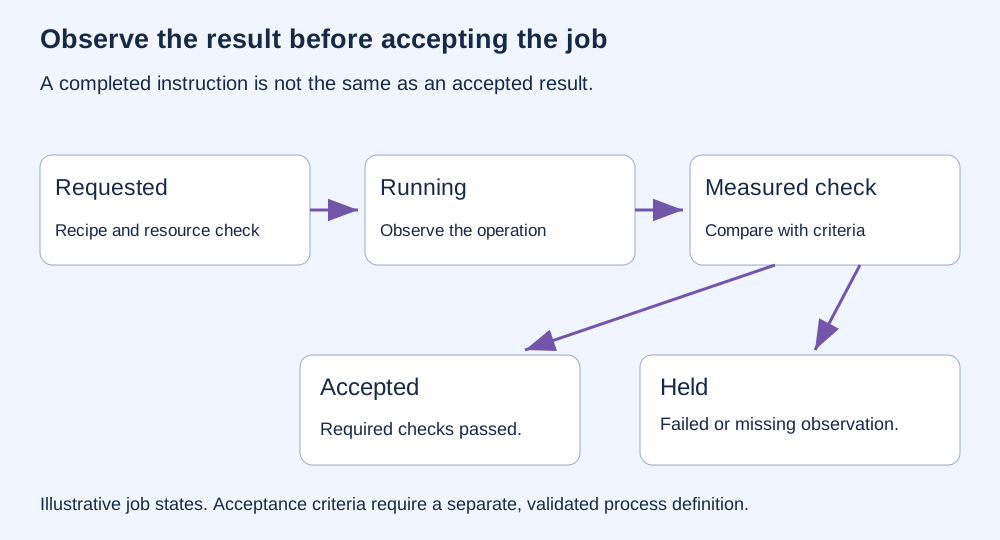
If a container or a completion measurement is missing, the job needs a defined held state and a recovery procedure. Moving to the next software instruction does not prove the previous operation succeeded. Command validation and feedback from observations address different parts of that problem.
Cooking adds cleaning, ingredient compatibility and validated processing conditions. Completing a timetable does not establish food safety or removal of an unwanted substance. An automatic-cooking patent is a documentary example of an apparatus concept, not independent proof of its performance. Our schedule uses hypothetical steps, not a cooking procedure.
IDENTICAL JOBS · THREE EXCLUSIVE RESOURCES
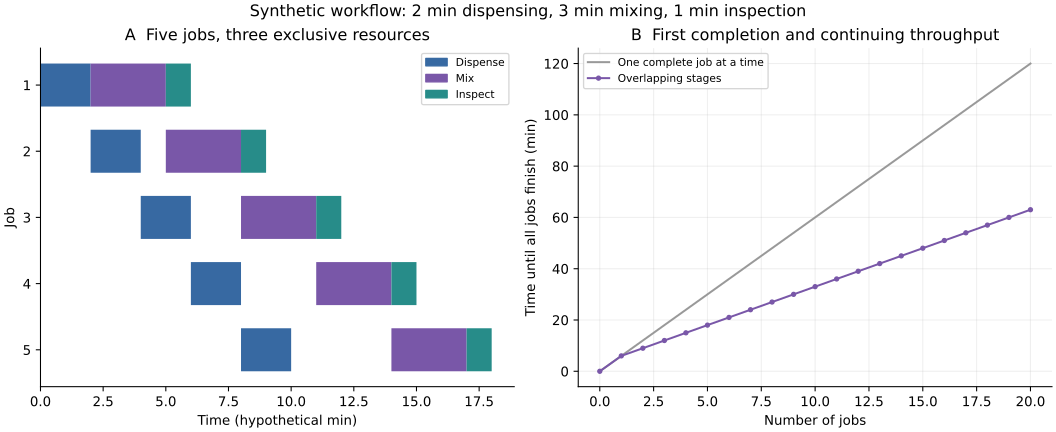
Each job must pass through dispensing, mixing and inspection, in that order. There is one machine for each stage, and each machine handles only one job at a time. Different machines can work on different jobs simultaneously.
Block numbers identify jobs. On small screens, scroll the chart horizontally or open the operation table below. The chart's time scale changes with the schedule.
Steady interval between completions: . Slowest stage(s): . With zero jobs, no completions occur; the interval describes the configured line, not an observed output.
| Job | Stage | Start | Finish |
|---|
At the starting settings, one job takes 6 minutes and five jobs take 18 minutes. Serial processing takes 30 minutes. Overlapping work on different machines saves time; it does not make any individual operation faster.
We assume unlimited waiting space, identical jobs and no setup, cleaning, failures, transport delay or rejected batches. Inspection is a scheduled step; its result is not simulated. Real constraints can change the schedule and the resource that limits capacity. NIST production-system modelling reference
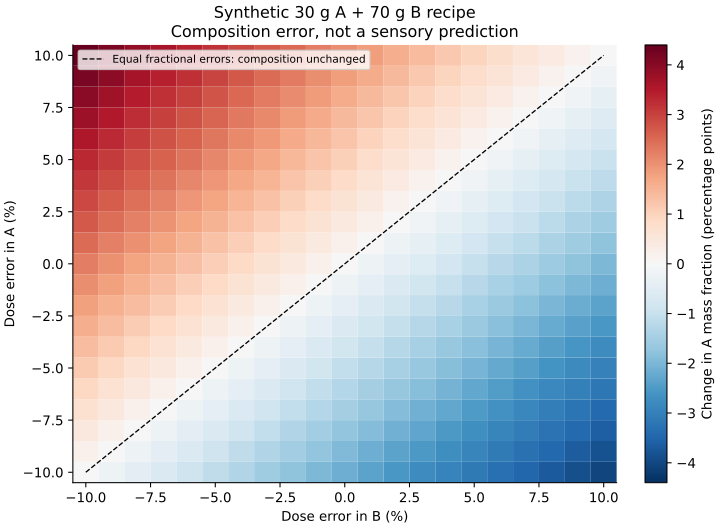
A mixture containing 30 g of A and 70 g of B is 30% A by mass. If both doses are 10% too large, the batch is heavier but the proportions stay the same. If only one dose is wrong, the composition changes.
A useful recipe record includes ingredient identity, requested mass, measured mass and conditions that can alter the material. Residue, evaporation and incomplete mixing matter in real equipment. Saving a recipe name is not enough to reproduce the result.
HYPOTHETICAL INERT CONSTITUENTS · MASS ACCOUNTING ONLY
The nominal batch contains 30 g of A and 70 g of B. Each slider assigns a fixed fractional dosing error; these are not random measurements or a real formulation.
Try +10% for both: the total becomes 110 g while the fraction remains 30%. Then set B to −10%: A's share rises to 34.375%. A change of 4.375 percentage points is different from a 4.375% relative change.
These ratios say nothing about chemical compatibility, stability, odour or preference. Sensory response need not be a weighted average of ingredient intensities. A primary dosing patent documents an equipment approach, not a demonstrated relationship between this model and a person's experience.
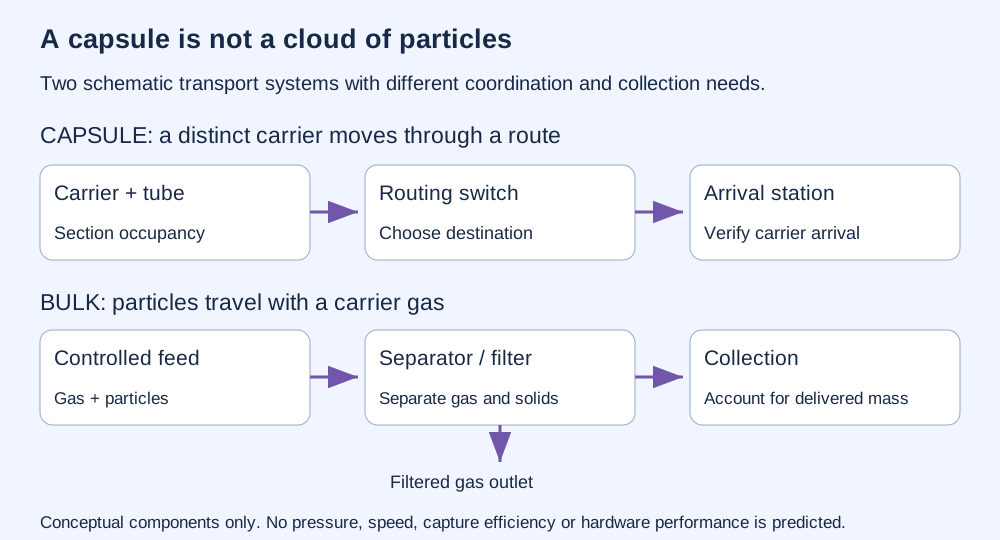
A carrier network moves distinct containers through tubes. It must route them to the right station, track which sections are occupied, confirm arrival and recover a stuck carrier. A short individual journey does not reveal the number of deliveries a busy network can complete. Batcheller's historical account describes pneumatic carrier systems; it does not establish performance for an unspecified new installation.
Bulk pneumatic conveying feeds particles into a gas stream and then separates collected material from the gas. Feeding, pressure loss, wear, retained material and escaping dust affect the process. It is not a capsule route with the container removed. Electrical charge does not automatically improve transport and can encourage deposits. NIOSH conveying and dust-control handbook
| Question | Useful observation |
|---|---|
| Did it arrive? | Destination identity and arrival confirmation, not only dispatch |
| How much arrived? | Delivered mass, retained material and losses accounted for separately |
| How does demand affect service? | Queue lengths, delivery-time distribution and completions per unit time |
| What happens after a stoppage? | Detection, isolation and recovery observations |
| What does the transport require? | Pressure difference, material properties, equipment geometry and energy measurements |
The diagrams show functions, not construction dimensions or operating settings. Neither predicts delivery speed, blockage risk or a safe pressure. No physical conveying test is reported.
Today: production scheduling coordinates shared machines; measured dosing records support repeatable composition; logistics systems distinguish dispatched items from confirmed deliveries. These are established engineering tasks, not validation of every proposed design.
A future direction: connect a traceable recipe to measured completion, calibration checks and recovery after interruptions. Compare schedules using actual cleaning times, rejected batches, maintenance and changing demand. Evaluate sensory quality separately from mass accuracy.
REPRODUCIBLE STUDIES
| Case | Result |
|---|---|
| No jobs | Zero elapsed production time |
| Five jobs, 2/3/1-minute stages | 18 minutes with separate resources; 30 minutes serially |
| Both doses +10% | 110 g total; 30% A by mass |
| A +10%, B −10% | 96 g total; 34.375% A by mass |
| A −10%, B +10% | 104 g total; approximately 25.962% A by mass |
For job j at stage s, start[j,s] is the larger of the previous stage's finish for this job and the previous job's finish on this machine. Finish equals start plus stage duration. Missing predecessors finish at time zero. An operation can begin exactly when the previous one finishes.
For N identical jobs and three positive stage durations, total elapsed time is their sum plus (N − 1) times the longest duration. For N = 0 it is zero. Serial time is N times the sum. This closed form relies on the stated identical-job and unlimited-buffer assumptions.
A = 30(1 + eA) g, B = 70(1 + eB) g, and A's mass fraction is A/(A+B). Composition error in percentage points is 100[A/(A+B) − 0.30]. Equal nonzero scaling of both nominal masses preserves the fraction. Negative masses are invalid; with zero total mass the fraction is undefined. The sliders remain within ±10%, so their masses stay positive.
The schedule predicts assigned start and finish times. The mixture model predicts mass fractions. Neither establishes food-process validity, a successful new formulation or the performance of a transport network.
Standard-sized containers may simplify routing, but equal diameter does not make their contents interchangeable. Food, chemicals and gases need appropriate containment, identification and separation. A routing diagram alone does not establish compatibility or prevent cross-contamination. The FDA Food Code 2022, sections 7-101 and 7-201 provides an official example of distinguishing chemical identification and separation from ordinary storage layout.
An instruction to warm an item does not specify how much heat reaches it. Induction heating depends on the load and how it interacts with the coil's electromagnetic field. Oak Ridge National Laboratory's induction-cooking project report distinguishes cookware materials and corresponding system designs. Power, temperature distribution and timing still need to be established for the intended load. No heating rate or food-treatment result follows from the recipe sequence here.
A drawing of a hot central stream surrounded by cooler gas does not establish a workable transport pipe. Temperatures alone leave the heat reaching the wall, confinement, material response and energy needed to maintain the arrangement unspecified. The heat-transfer chapter separates gas temperature, wall temperature and heat flow; it does not validate this proposed plasma pipeline.