An orbiting astronaut floats. A person inside a spinning wheel can stand on its floor. What makes the difference?
Gravity bends the spacecraft’s path, and everything inside falls with it. In a rotating room, the floor pushes a standing person toward the centre. That contact force can provide a weight-like sensation.
A satellite keeps falling toward Earth, but it moves sideways fast enough to keep missing the ground. A simple model can be checked on paper, but that does not prove a spacecraft flew the path. Real satellites also feel other pulls and air.
For curious readers: how it could help and what the evidence says
How it could help people
Today, orbit equations help compare satellite speed, height and travel time. Here they check a proposed path, not make a flight plan.
Evidence and limits
The simple orbit calculation can be checked by another person. The two heights are illustrative inputs, not verified orbital measurements; air drag, Earth’s uneven gravity and other pulls are left out.
Read-aloud starter; not yet tested with children. The fuller science, data, figures and sources follow below.
01 / CIRCULAR ORBIT
Gravity has not switched off.
Throw a ball sideways and gravity bends its path down. In an ideal orbit, it travels fast enough that the planet’s surface curves away beneath it.
A higher circular orbit has a longer route and a lower speed.
Animation: 5 simulated minutes per second. No automatic motion. Planet and orbit share a scale; the spacecraft dot is enlarged. With reduced motion enabled, this control steps between still positions.
The dot is the spacecraft. The blue arrow shows velocity, tangent to the orbit in the direction of travel. The pink arrow shows gravity, pointing inward toward Earth’s centre. The arrows show direction only; their lengths do not compare magnitudes.
Spacecraft position: rightmost point on the orbit.
Circular speed—
Orbital period—
Gravitational acceleration—
What an accelerometer feels: in ideal free fall it reads zero because there is no supporting contact force. This is different from the gravitational acceleration shown above.
A CHECKABLE EXAMPLE · ORB-001
Two heights can describe an ideal oval
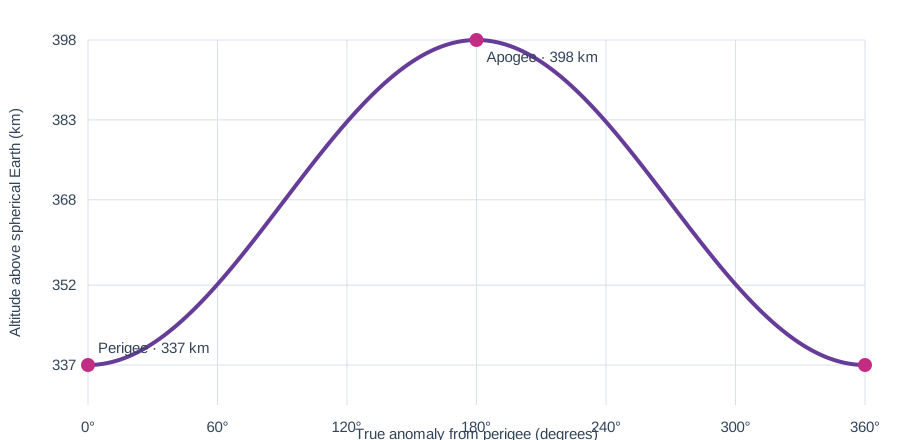
Imagine a satellite following a slightly oval path. At the nearest point it moves faster; at the farthest point it moves slower. For this idealized example, use assumed altitudes of 337 km and 398 km above Earth at the two turning points.
For a five-year-old: Like a ball going around a very big hill, it speeds up when it is closer and slows down when it is farther away. The numbers let us check whether that simple oval is possible on paper.
This is a consistency calculation only. The simple orbit calculation can be checked by another person. The cited heights have uncertain context; air drag, Earth’s uneven gravity and other pulls are left out. Matching classical orbital mechanics does not confirm a spacecraft, a sighting, a “helical” path, or a real flight.
Figure 3. A bounded two-body check. Altitude along the ideal ellipse defined by the two assumed heights. The horizontal axis is true anomaly, an angle from perigee; equal angle steps do not represent equal time steps.
The 61 km difference produces a small eccentricity of 0.00453, so this is close to a circular orbit. The closer point is faster in the calculation.
This control selects an angle, not an elapsed time. The model does not animate because angle does not advance uniformly with time on an ellipse.
How the numbers are calculated
Use a spherical Earth radius of 6,371 km and the JPL DE440 gravitational parameter μ = 398,600.435507 km³/s². The semimajor axis is a = (rₚ + rₐ)/2; eccentricity is e = (rₐ − rₚ)/(rₐ + rₚ). At true anomaly ν, r = a(1 − e²)/(1 + e cos ν), and speed follows v = √[μ(2/r − 1/a)].
The ideal result is a = 6,738.5 km, e = 0.004526, period = 91.750 min, 7.726 km/s at perigee and 7.656 km/s at apogee.
What this leaves out
The model assumes Newtonian two-body motion and omits drag, Earth's nonspherical gravity, other bodies, thrust and measurement uncertainty. It cannot establish that the assumed points came from an actual trajectory.
A separate claimed passage at only 5.394 km altitude is not modeled: the atmosphere, vehicle shape and mass, entry angle, speed history, thermal protection and control are unspecified. Two orbital heights cannot define an atmospheric passage.
To stay on a circular path, an object needs acceleration toward the centre. A rotating floor supplies that inward push through contact. Slower rotation requires a larger room for the same floor acceleration.
This model is independent of orbital altitude. It describes a rigid, steadily rotating ring, not a complete habitat design.
g₀ = 9.80665 m/s². rpm means revolutions per minute.
Required radius—
2 m head-to-foot decrease—
Coriolis at 1 m/s radial motion—
Why size matters
A person’s head is closer to the centre than their feet. Acceleration is therefore lower at head height. The percentage above compares a 2 m radial height with the floor’s acceleration.
Moving changes the picture
Radial movement introduces a Coriolis acceleration in rotating coordinates, perpendicular to that movement. The displayed magnitude assumes 1 m/s radial speed. It is not a dizziness score or a health recommendation.
03 / ANALYTICAL STUDIES
Two models. Two different questions.
DETERMINISTIC FORMULA EVALUATIONS · No experimental data or fitted uncertainty bars
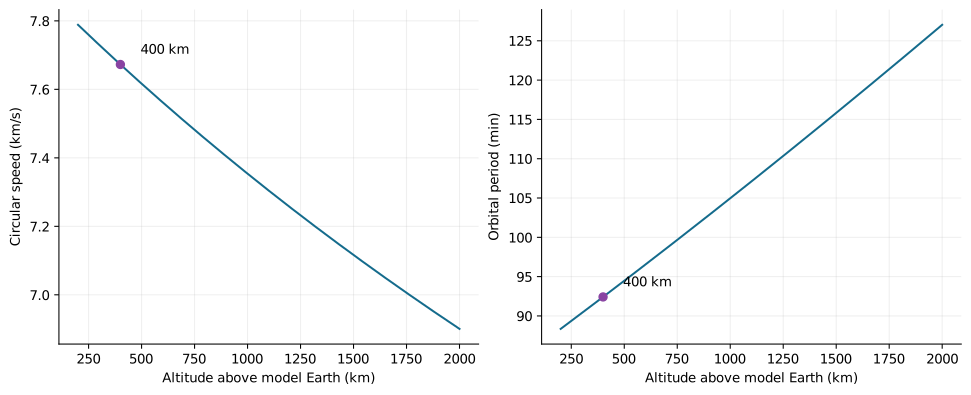
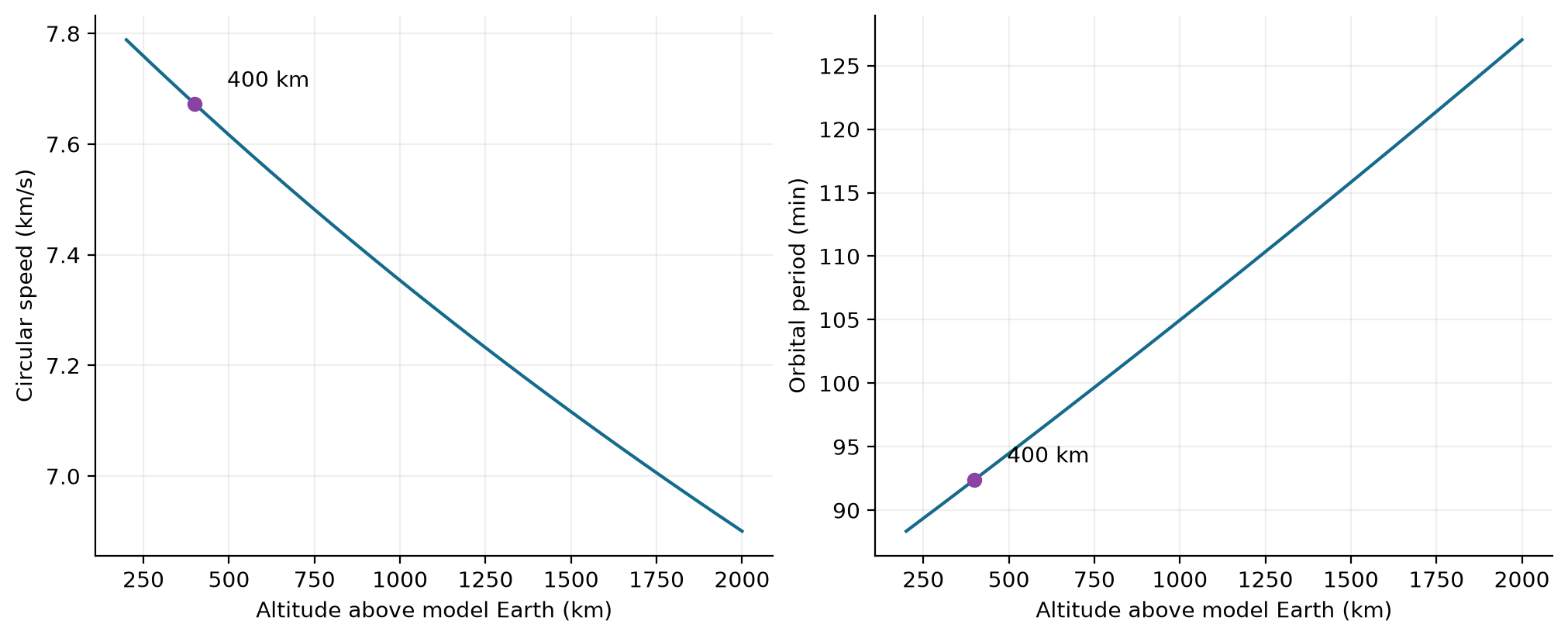
Figure 1. Altitude and orbital timing. 181 circular-orbit calculations at 10 km intervals. Earth is a sphere of radius 6371 km with gravitational parameter 398600.435507 km³/s². Speed and period use separate axes. The marker indicates 400 km, not measured satellite data.
Higher does not mean faster: a higher circular orbit moves more slowly and takes longer to complete.
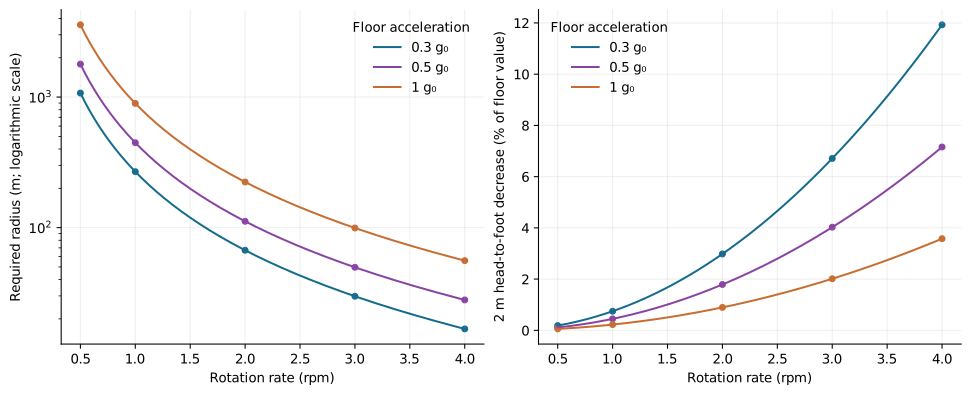
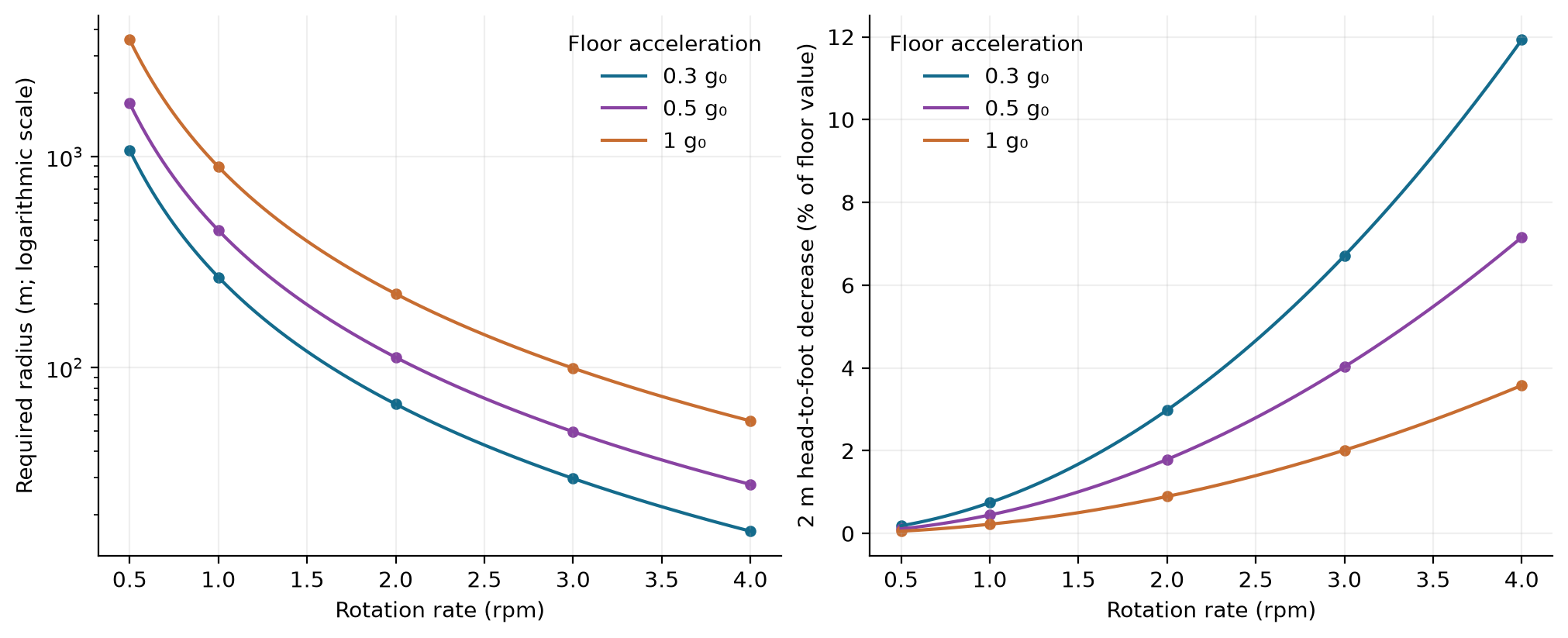
Figure 2. The size–rotation trade-off. Curves evaluate the exact formulas for three floor accelerations. Markers show 15 selected cases. Radius uses a logarithmic scale. The right panel assumes a 2 m radial height; percentages are relative to floor acceleration, not standard gravity. No comfort region is implied.
At fixed floor acceleration, doubling rpm quarters the radius and quadruples the relative head-to-foot difference. This saves geometric space while changing the acceleration environment.
Calculated rotation radius and 2 m height effect for selected floor-gravity settings
Floor (g₀)
Rotation (rpm)
Radius (m)
2 m decrease (%)
0.3
0.5
1073.11
0.186
0.3
1
268.28
0.745
0.3
2
67.07
2.982
0.3
3
29.81
6.709
0.3
4
16.77
11.928
0.5
0.5
1788.52
0.112
0.5
1
447.13
0.447
0.5
2
111.78
1.789
0.5
3
49.68
4.026
0.5
4
27.95
7.157
1
0.5
3577.04
0.056
1
1
894.26
0.224
1
2
223.56
0.895
1
3
99.36
2.013
1
4
55.89
3.578
Equations you can reproduce
For orbital radius r = R + h: v = √(μ/r), T = 2π√(r³/μ), and gravitational acceleration is μ/r². With kilometres as the length unit, multiply acceleration by 1000 to obtain m/s².
For angular rate ω = 2π × rpm / 60: radius = a/ω², rim speed = ωr, and the fractional acceleration decrease over height H is H/r. For radial relative speed u, the Coriolis magnitude is 2ω|u|.
Run the downloaded script with Python 3.12, NumPy and Matplotlib available. It writes CSV, JSON, SVG, PNG and PDF files into orbital-study beside the script.
What is left out
The orbit model omits atmospheric drag, Earth’s nonspherical shape, other gravitating bodies, propulsion and relativity. It does not predict orbital lifetime or give a launch plan.
The ring model omits structural loads, spin-up energy, fluids, transfers and biological adaptation. A radius and rpm are not enough to establish that a habitat is buildable or comfortable.
Numerical checks
Speed × period equals orbital circumference. Increasing altitude reduces speed and lengthens the period. Doubling rotation rate quarters the required radius; doubling target acceleration doubles it. These are mathematical consistency checks, not hardware tests.
04 / WHY IT MATTERS
Separate the physics before choosing a design.
SATELLITES
Understand timing
Simple orbital calculations explain how altitude affects a satellite’s speed and period before perturbations are added.
SPACE HABITATS
See the size trade-off
Rotation studies make the relationship between radius, rate and acceleration explicit. Engineering and human research must follow.
MEASUREMENT
Interpret the sensor
An accelerometer does not directly report gravitational field strength in free fall. Knowing what an instrument measures prevents a misleading conclusion.
Revised 27 September 2026. Figures are original analytical calculations, not images of built hardware.
Two heights do not describe the whole flight
The nearest and farthest distances can help specify the size and shape of an ideal ellipse when the central body and model are known. They do not by themselves specify its orientation, the craft's position at a stated time or powered manoeuvres. The circular calculation here does not model an additional helical path or a later descent. Those require a defined trajectory and forces over time.