Imagine this
A model is a set of rules about how something might work. A computer can follow those rules perfectly and still be wrong about the real world. We must compare the model with observations.
THE FIELD GUIDE / 032 · LOGIC AND MODELS
A simulation can follow its equations perfectly and still describe the wrong thing. A useful model makes its assumptions visible—and names the observations that could show where it fails.
Explore conflicting reports ↓A model is a set of rules about how something might work. A computer can follow those rules perfectly and still be wrong about the real world. We must compare the model with observations.
Model checks help expose missing information and assumptions before a decision. A validated model might compare choices only in its tested setting.
The examples follow math rules and computer-made cases; they do not predict every real situation. To trust a model, people check it against real observations for the job it is meant to do.
Read-aloud starter; not yet tested with children. The fuller science, data, figures and sources follow below.
Imagine instruments reporting whether a container is empty. Sometimes no answer arrives. Sometimes the reports say empty, sometimes not empty, and sometimes both. Those are four different information states.
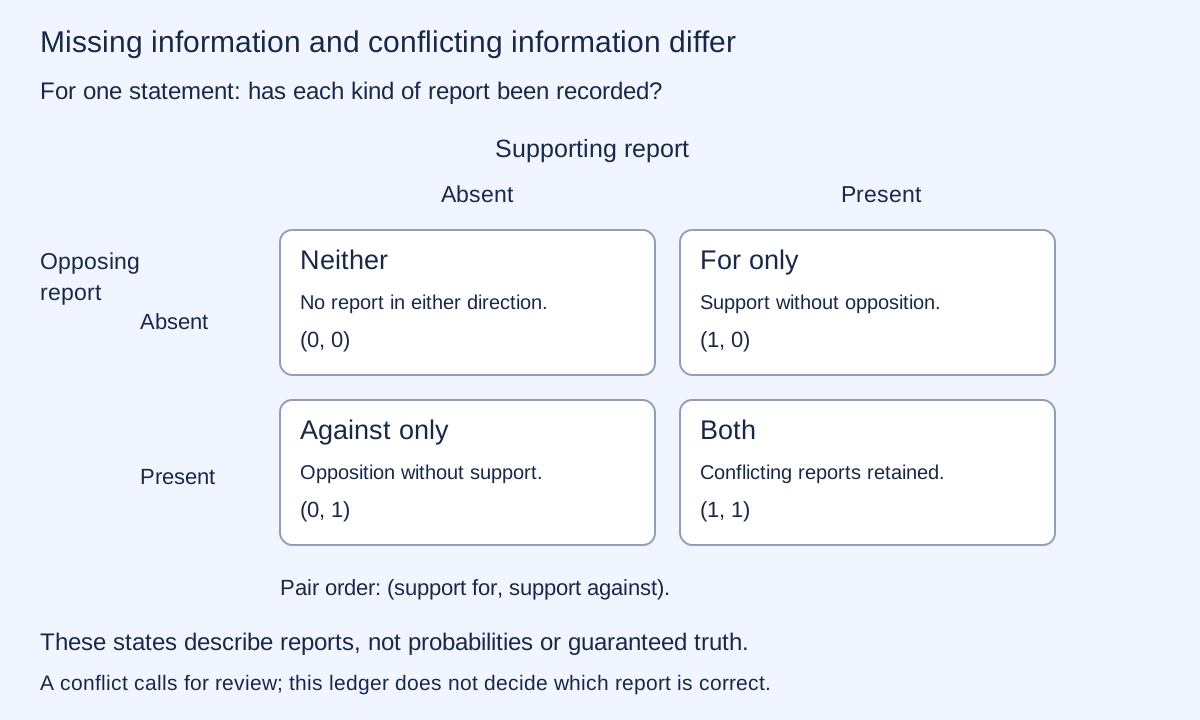
Both flags can be on. Keeping that conflict visible lets a system request another measurement instead of silently discarding a report. It does not identify which instrument is right, how independent the reports are or how probable the statement is.
The example uses deliberately chosen Belnap-style rules. It does not reconstruct an unspecified proposed logic, and it is not a probability scale. Repeating an identical report does not change these flags. An author research survey describes Belnap's four-valued logic.
EXPLICIT REPORT RULES · NOT A TRUTH DETECTOR
Choose the recorded support in each input. Start with merging two collections about the same statement: one supports “empty”, the other opposes it. The result keeps both.
“No reports” does not mean false. “Conflicting reports” does not make every other statement supported. Negation swaps the for and against flags: absence stays absence, and conflict stays conflict.
| Operation | For flag | Against flag |
|---|---|---|
| Merge collections about one statement | Either input has support | Either input has opposition |
| P AND Q | Both inputs have support | Either input has opposition |
| P OR Q | Either input has support | Both inputs have opposition |
| NOT P | P's against flag | P's for flag |
For AND/OR, a simple example is P = “the container is empty” and Q = “the door is closed”. These defined operations combine recorded assertions. They do not resolve unreliable sensors, timing mismatches or ambiguous language.
ONE EUCLIDEAN GEOMETRY · DIFFERENT ALLOWED PATHS
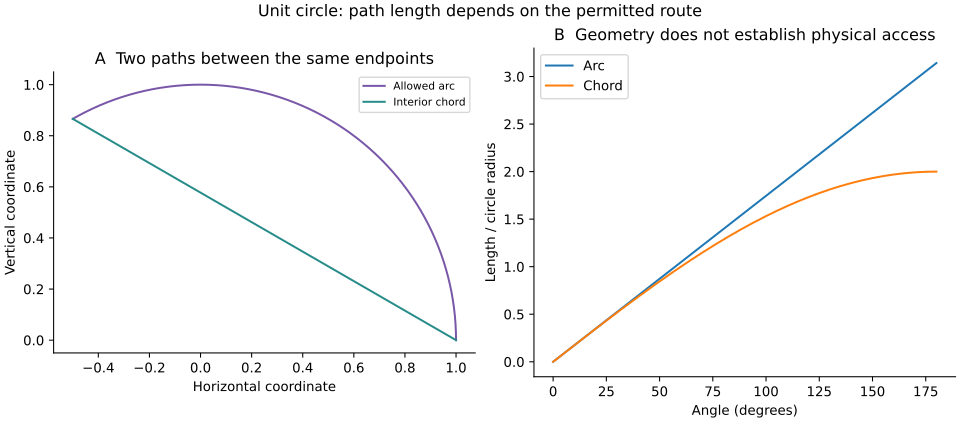
Two points lie on a circle of radius one arbitrary length unit. Compare the blue arc along the edge with the pink straight chord through the interior. A vehicle constrained to the edge cannot simply take the chord.
At opposite points, the arc is π units long and the chord is 2. At zero angle, both are zero. The chord is no longer than the arc, but drawing it does not create a tunnel.
Renaming coordinates does not shorten a physical route. This sketch does not simulate extra dimensions or a transport mechanism. Travel time also requires permitted motion, speed and physical constraints; path length alone does not determine it.
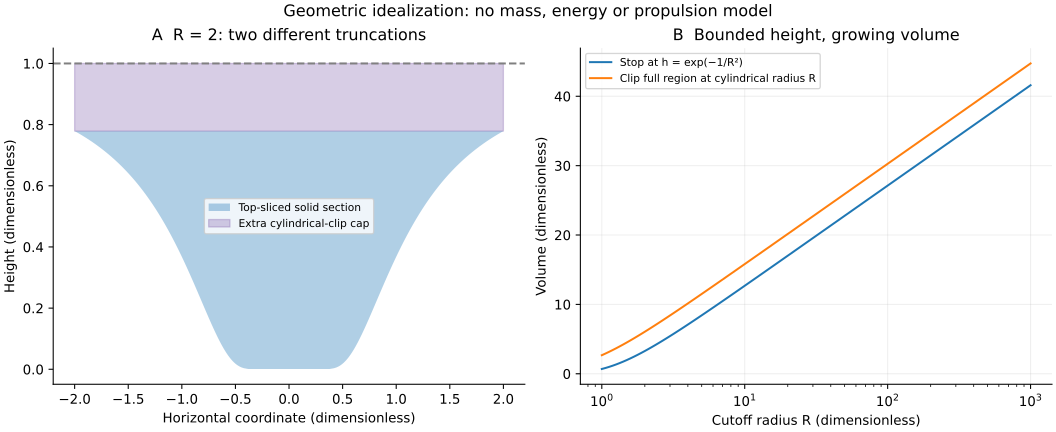
Consider a filled rotational region whose horizontal slice at height y is a disk of radius 1/√[−ln(y)], for 0 < y < 1. Near zero the radius tends to zero. As y approaches one, it grows without bound. The region's height is bounded, but its slices get wide enough for its total volume to diverge.
To make a finite object, we must say where to stop. A horizontal top slice at height h < 1 produces one object. Keeping all heights up to one but removing everything outside a vertical cylinder produces another. The distinction changes the volume.
DIMENSIONLESS GEOMETRY · TWO DIFFERENT CUTOFFS
Choose radius R at the top slice. Its height is h = exp(−1/R²). The horizontally truncated object contains only slices from zero to h. The cylinder-clipped object keeps those slices and adds a cylinder from h up to one, of radius R.
At R = 10, the horizontal cutoff is about 0.99005 and the volume below it is about 12.68553. The cylinder-clipped region adds about 3.12594. These numbers are dimensionless, not cubic metres or a mass estimate.
Increasing R brings the horizontal cutoff closer to one. The volume keeps growing, approximately in proportion to ln(R) at large R. A finite slider cannot prove the infinite limit; the slice-area argument in the methods explains why the growth has no finite ceiling.
Rotating the same plotted curve about a different axis defines a different solid. For rotation about the horizontal axis, radius exp(−1/x²) tends to one as x grows, and volume grows approximately with length. Neither orientation defines a material or propulsion law.
A geometric outline, or an asserted change in particle orientation, supplies no force law, trajectory or energy–momentum account. A transport proposal needs those ingredients and measurable predictions such as acceleration under specified conditions. Without them, the calculation tells us about a shape, not a machine's performance.
This missing specification prevents an engineering conclusion. It is not an experimental demonstration that every possible mechanism is impossible, nor does a finite-volume calculation establish an energy optimum.
A small unpredictable event can trigger a large response. Amplifying it makes the result easier to observe; it does not let an operator choose that result. Quantum theory supplies mathematical rules and outcome probabilities: “random” does not mean lawless.
NIST describes an experiment that certifies quantum randomness under stated conditions. That is separate from a biological mechanism for decisions or conscious experience. No intention-controlled microscopic interaction is established here. Large systems can also be unpredictable because of noise, incomplete knowledge or sensitivity to initial conditions.
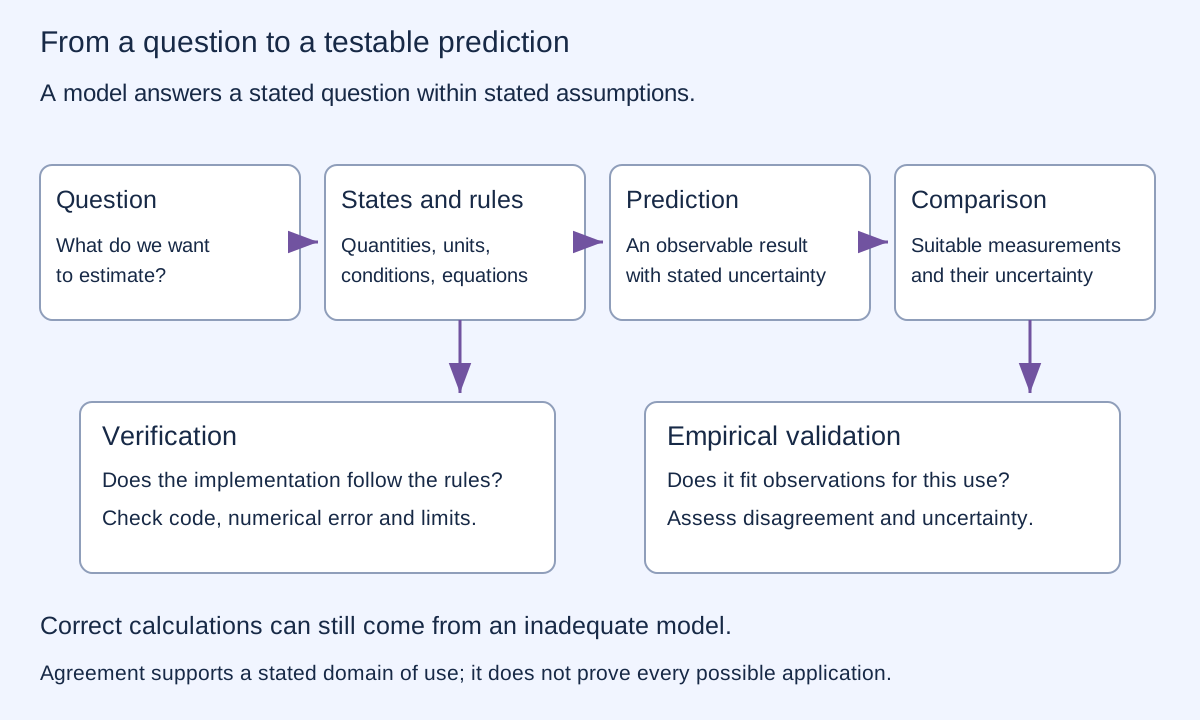
Start with an observable question. Which quantity will be measured, in what units and under which conditions? Specify the state, rules for change and starting conditions. State which prediction differs from an existing model and how measurement uncertainty affects the comparison.
A proposed microscopic or cosmological model must account for tested large-scale observations and give a discriminating prediction. Calling a world discrete supplies neither dynamics nor a distance rule. A grid alone does not establish a continuum limit or explain measured light propagation and particle properties. An animation built without those rules tests its author's choices.
Verification checks that a program follows its stated equations. Empirical validation compares the model with suitable measurements for a stated use. Neither is unlimited proof. NASA's modelling and simulation handbook explains this distinction.
A file's bit count describes its representation. Shannon entropy describes uncertainty in a stated probability model, commonly measured in bits. The meaning of a message is another question. Thermodynamic entropy is a physical state quantity measured in joules per kelvin. These quantities can be related in specified physical models; they are not interchangeable labels.
Bits per second describe transfer over a measured duration. Seconds measure duration; kilograms measure mass. Connecting them requires equations, a mechanism and defined conditions. Dividing data by zero elapsed time gives no ordinary finite rate and establishes no instantaneous communication channel.
Remembered experience also differs from clock measurement. A biological memory proposal needs identified storage and readout processes. Organisms exchange energy and matter with their surroundings; increased internal organization alone does not demonstrate a conversion of time into mass.
Today: keep contradictory database or sensor reports visible, check that a simulation implements its equations, and identify unbounded idealizations before estimating material. Explicit route constraints prevent a shorter drawing from being mistaken for an available journey.
A useful next step: turn a vague proposal into an explicit model with units, rules and a prediction that could distinguish it from alternatives. Only then can observations assess its stated application. Where those ingredients are absent, an attractive simulation would conceal the missing evidence.
REPRODUCIBLE MATHEMATICAL STUDIES · NO DEVICE MEASUREMENTS
Represent each status by (t, f), two Boolean flags for recorded support and opposition. Merge: (t₁ OR t₂, f₁ OR f₂). Conjunction: (t₁ AND t₂, f₁ OR f₂). Disjunction: (t₁ OR t₂, f₁ AND f₂). Negation swaps the flags. Enumerating all input states verifies these chosen tables, not the truth or reliability of their source reports.
For radius a and angle θ in radians, arc length = aθ and chord length = 2a sin(θ/2). Here a = 1 and 0 ≤ θ ≤ π. Because sin(u) ≤ u for u ≥ 0 in this range, chord ≤ arc. We report a difference, avoiding the undefined 0/0 ratio at zero angle.
The disk area at height y is π/[−ln(y)]. A horizontal cutoff at h gives volume V(h) = π E₁(−ln h), where E₁(a) = ∫ from a to infinity exp(−t)/t dt. With h = exp(−1/R²), this is π E₁(1/R²). NIST DLMF defines the exponential integral.
Clipping the full region by a vertical cylinder of radius R instead adds πR²[1 − exp(−1/R²)]. The browser uses a convergent series for E₁ over its declared R range 1–1,000, not an unrestricted special-function library. Independent quadrature and convergence checks are included in the downloads.
As y approaches one, −ln(y) behaves like 1 − y. The area therefore behaves like π/(1 − y), whose integral diverges logarithmically. Equivalently, the horizontal-cutoff volume grows like 2π ln R plus a constant. A bounded height alone says nothing about whether volume is finite.
If physical radial and axial scales Lᵣ and L𝓏 were supplied, dimensionless volume would be multiplied by Lᵣ²L𝓏. They have not been specified here. Earlier stored geometry calculations are compared as conventional mathematical results; their passing checks do not validate a transport mechanism. The unspecified cosmology, agency and biological information proposals have no faithful executable physical model in the inspected evidence.
Calling particles standing-wave nodes still leaves the wave quantity, its equation, boundaries and measurable consequences to be defined. Writing a sine expression without saying what varies does not supply those missing rules. Established wave behavior is not in doubt; the proposed explanation needs predictions that can be checked against observations.
For an ideal flat mirror in the plane z = 0, a point at (x, y, z) has an image at (x, y, −z). The coordinate perpendicular to the mirror changes sign; the two parallel coordinates do not. Saying that a mirror simply swaps left and right can therefore be misleading.

Download the coordinates (CSV) · Reproduce the figure (Python) · Reproduce the mobile figure
A separate question is whether a rigid object can be moved and rotated to fit its mirror image exactly. If it cannot, its shape is chiral, or handed. A sphere is not chiral; left and right hands illustrate handedness. IUPAC definition of chirality.
A field can have rotational symmetry about a centre while changing with distance from it. In a simple spherical gravity model, points at the same radius have the same inward acceleration magnitude. Closer points can have a different magnitude: this is not a uniform field everywhere. Force depends on the body's mass; speed depends on its previous motion and acceleration over time.
The geometry exercise supplies no thrust law, power supply or travel time. Return to the propulsion guide to see the missing momentum and energy balances.
A scanned mathematics sheet raises a useful question: when do two transform-related integrals have the same total, and what assumptions make the calculation valid? A separate study derives the answer for a simple exact example, shows its changing areas, and explains a missing weighting factor in the source prose.
Open the Laplace–Carson study · See the open record and evidence boundaries