Imagine this
Imagine guessing a secret word. If you try lots of guesses, one may match by luck. A match alone cannot tell us who chose the word.
THE FIELD GUIDE / 008 · CODES & MEANING
Receiving the marks is only the beginning. Someone still has to know how to read them.
The same byte can represent a number or a letter. Silence can separate letters. A pattern can appear by chance. Explore what changes when we change the rules of interpretation.
Read the same bits differently ↓Imagine guessing a secret word. If you try lots of guesses, one may match by luck. A match alone cannot tell us who chose the word.
Clear encoding rules help check how a signal becomes readable. The page's search example helps test whether a claimed match is surprising under stated rules.
The match chance depends on the allowed patterns and search width; meaning and intent need independent evidence.
Read-aloud starter; not yet tested with children. The fuller science, data, figures and sources follow below.
01 / A CODEBOOK IS AN AGREEMENT
The byte 01000001 has unsigned numerical value 65. Under ASCII it represents the letter A. Neither interpretation can establish the sender’s intention without an agreed convention.
Change group size or starting position. Incomplete groups stay visible; no zeros are silently added.
| Group | Bits | Unsigned value | Interpretation |
|---|
ASCII is a seven-bit character code; a common byte representation places zero in the high bit. This example does not interpret arbitrary eight-bit values as ASCII or pretend that every byte is a UTF-8 character. Values outside ASCII and control characters are identified explicitly.
Byte order matters for a multi-byte number. Ordered bytes 01 02 in hexadecimal mean 258 when the most significant byte comes first: 256 × 1 + 2. They mean 513 with the least significant byte first: 1 + 256 × 2. This changes byte significance, not the order of bits inside each byte.
The ASCII text “65” uses two bytes, hexadecimal 36 and 35. The unsigned number 65 can fit in one byte, hexadecimal 41. A bit count or proportion of ones describes a string; it does not identify its language, encryption or intended meaning.
02 / FOUR QUESTIONS BEFORE INTERPRETATION
What physical quantity was recorded, and with what timing and uncertainty?
Where do symbols, characters and messages begin and end?
Which rule maps those symbols to letters, numbers or fields?
Which units, context and shared knowledge make the result useful?
A candidate interpretation may be internally consistent while still failing to match what the sender intended. Additional evidence must distinguish it from alternatives.
03 / SILENCE CARRIES STRUCTURE
Here a short mark is followed by a long mark. In International Morse code, a dot lasts one unit and a dash three. The silence between them determines whether these marks belong to the same letter, two letters or two words.
The unit is the duration of a dot. The gaps are total durations, not extra time added to a shorter gap.
The full waveforms differ. Only the order of the marks remains the same. If we retain just “dot, dash”, the three examples can no longer be distinguished. Replacing dot with 0 and dash with 1 discards that timing information.
These are synthetic ideal signals, not a captured transmission. There is no noise, speed estimation, timing jitter or decoder tolerance. The selected ratios are the standard’s ideal durations; they do not by themselves define a robust receiver for distorted signals. No audio plays.
04 / ONE DISPLAY, SEPARATE FIELDS
This deliberately invented sensor display uses shape to identify a room and a number with a unit to express temperature. Its legend says circle = room A; square = room B. Hide information and inspect what can still be read.
The written legend is part of the codebook. Shape meanings are assigned here; they are not universal conventions.
A bare value of 20 does not establish a temperature: 20 °C is 293.15 K, whereas 20 °F is about 266.48 K. Those are different physical temperatures. Correct conversion changes the value and unit together.
Encoding two fields does not prove twice the useful information per second or twice the learning. Readers may miss a cue, confuse a legend or need more training. A claim about comprehension requires a separate task with defined scoring.
05 / HOW MANY CHANCES DID YOU GIVE A PATTERN?
Consider a string of 16 independent fair bits. There are exactly 65,536 equally likely strings. Before looking, specify which four-bit words count as a match and how many starting positions you will search.
Allowed words, in fixed order:
Positions are the first selected starts, from the left. Four-bit windows may overlap.
Try this: keep one word, increase positions from 1 to 13, then allow four words. The matching rule has become more permissive.
Blue curve: the selected set of words across all possible search widths. Pink dot: your selected width. The vertical axis is the probability of at least one match under the fair-bit model.
| Positions tested | Matching strings | Probability |
|---|
For k distinct four-bit words at one position, P(match) = k/16. Across w positions, exact probability is the number of matching 16-bit strings divided by 65,536. The expression 1 − (1 − k/16)ʷ would assume independent windows; overlapping windows share bits and generally violate that assumption.
For the single word 1010, one specified start gives 6.25%. Searching all 13 starts gives 35,789/65,536, approximately 54.6097%. The first four allowed words anywhere give approximately 94.2322%. Which words are allowed matters, not just their count.
The predetermined order starts with 1010, followed by all other four-bit words in numerical order. This is an exact finite calculation: there is no sample uncertainty and no confidence interval. A real search may try many more lengths, transformations and codebooks. These probabilities do not identify the origin or intention of an actual message.
06 / FIGURES WITH EXPLICIT METHODS
SYNTHETIC TIMELINES AND EXACT COMBINATORICS · NO DECODED UNKNOWN MESSAGE
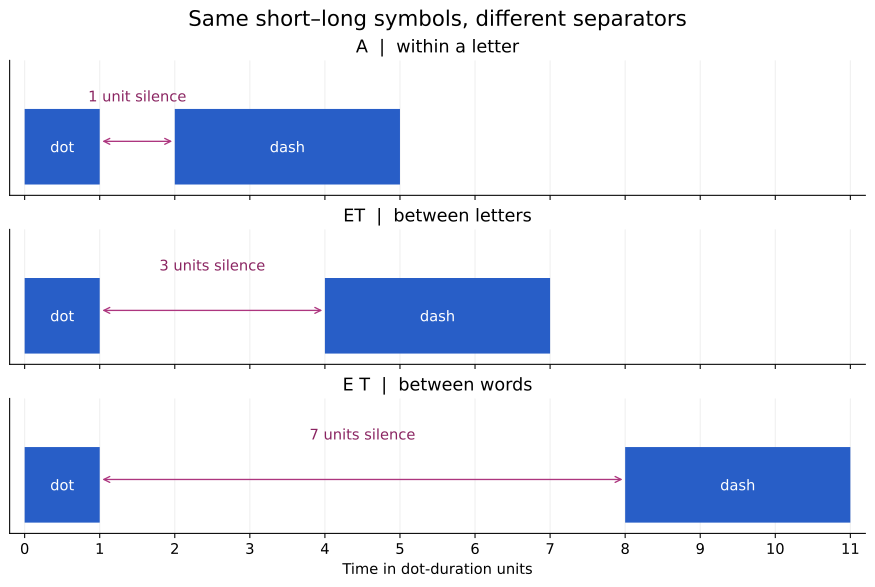
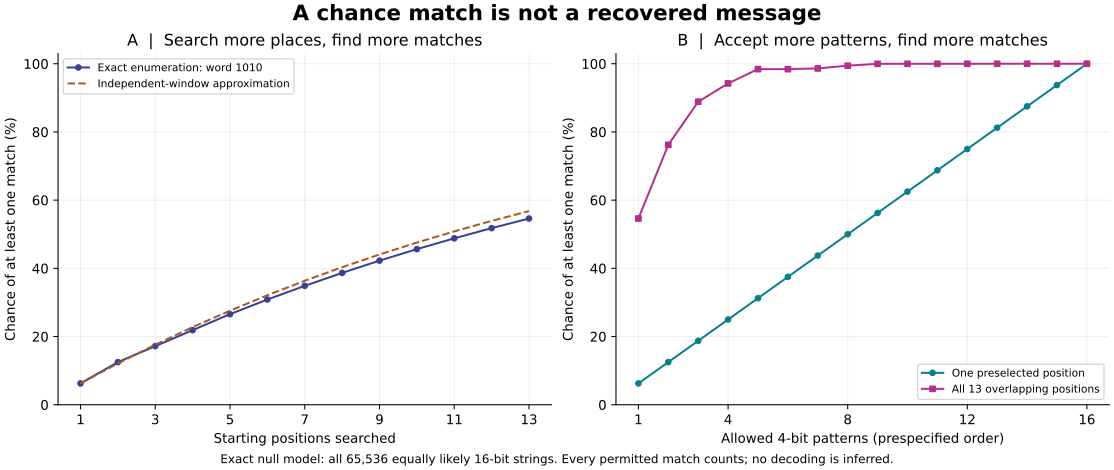
Run each reproduction script with Python 3, NumPy and Matplotlib in its own folder. The timing data contain nine on/off segments. The exact-search data cover 16 word-set sizes and 13 position counts. Neither dataset records physical transmissions or participant responses.
07 / TEST THE RULE ON SOMETHING NEW
Suppose a single example associates 01000001 with A. Both “decode each byte as ASCII” and “always answer A” fit that example. They disagree when the next byte is 01000010.
Under the independently specified ASCII codebook, the new answer is B. Success on the first example alone could not distinguish the two rules.
Specify alphabet, boundaries, units and scoring. Keep alternative interpretations and record how many choices were explored.
Have a separately specified encoder produce new examples whose answers are concealed until predictions are recorded. Do not adjust the decoder after seeing each answer and still call it an independent test.
For an unfamiliar-reader study, keep training and exposure time comparable and score each message field separately. Ask whether readers can use the instruction, not merely reproduce its symbols. This is a proposed study, not participant data.
08 / WHAT THIS COULD IMPROVE
Store units, byte order, encoding, timestamps and calibration context. A number that survives storage can still lose its meaning.
Combine explicit labels, examples and accessible cues. An arrow needs a clear start and destination; a symbol familiar to one audience may be unfamiliar to another.
Record discarded hypotheses as well as successful matches. Test a fixed interpretation on new examples before treating it as established.
READ FURTHER
RFC 20 · ASCII format for network interchange defines the historical character encoding used in the byte example.
Unicode Technical Report 17 · Character encoding model distinguishes characters, code points, code units and serialization.
ITU-R M.1677-1 · International Morse code, Annex 1, Part I, section 2, specifies the timing ratios used here.
NIST/SEMATECH · Multiple comparisons explains why repeated comparisons require attention to the overall search. It provides context, not validation of a particular interpretation.
Revised 27 September 2026. All demonstrations are explicitly constructed examples; no unknown message or learning benefit is claimed.
Morse timing can encode letters and symbols used to write messages in different languages. Recovering the letters does not mean understanding the words. A receiver still needs the relevant conventions, language and context. Choosing a familiar shape from several possible decodings is not independent confirmation of a message.
READING MARKS AND RECOGNIZING SPEECH
The simple story: Imagine copying a friend's sentence. You might change a word, miss one or add an extra one. We can count those changes. A microphone saves sound; a recognizer tries to turn that sound into words. A camera saves handwriting; a recognizer tries to read its letters.
Why this could help: Captions, dictation and searchable handwritten records can make information easier to use. Before trusting a transcript, compare it with a carefully checked reference. Names, numbers and the word “not” may deserve particular attention: equally sized text errors need not have equally serious effects.
This tool compares text you enter. It does not listen to audio, read an image or run a recognition system. All processing stays in this page.
| Reference | Transcript | Operation |
|---|
Try reference go with transcript go go go go: three added words divided by one reference word gives 300% error. Try a board and aboard, then switch units: our character rule removes spaces, so that difference disappears.

| Case | Edits / reference words | Error rate |
|---|---|---|
| Exact | 0 / 3 | 0% |
| Replace | 1 / 3 | 33.3% |
| Omit | 1 / 3 | 33.3% |
| Add | 1 / 3 | 33.3% |
| Repeat | 3 / 1 | 300% |
Levenshtein distance is the minimum number of insertions, deletions and substitutions with cost one each. Error rate = (S + D + I) / N, where N is the reference token count. An empty reference has no defined rate here. The interactive alignment prefers a diagonal step, then deletion, then insertion when costs tie. This fixes the displayed breakdown; the minimum total may have several alignments. This unit-cost teaching tool does not implement the full NIST OpenKWS/SCLITE protocol, whose documented alignment can use different costs for substitutions, deletions and insertions.
Our teaching protocol lowercases text, trims edges and collapses whitespace. Word tokens are space-separated; character tokens are Unicode code points with spaces removed, not grapheme clusters. Punctuation is retained. Use short English examples; these choices are not a universal language scoring standard. The figure uses the five fixed examples downloadable below and an independent Python edit-distance calculation.
A score measures agreement with a reference, not truth, understanding, accessibility or general accuracy. Reference errors and ambiguous speech can change scores. Real evaluations need representative material, documented normalization, checked references and task-specific assessment. These examples do not recover or validate the unspecified methods in ideas 013 and 014.
Example data · CSV · Figure · PDF · Reproduce figure and data · Python · Interactive model · JavaScript
Primary methods: NIST TRAIT, §6.2: character and word edit distance; NIST OpenKWS13, §6: transcript scoring; NIST SCLITE: reference ambiguity.
Handwriting proposal and missing evidence · Speech proposal and missing evidence