Imagine this
Wax can get soft when it warms. Jelly can wobble when you push it. Different materials change in different ways, so we must test the material for its exact job.
THE FIELD GUIDE / 012 · RESPONSIVE MATERIALS
A component can soften, a liquid surface can change focus, and a filter can darken. Each response has a cost and a limit.
A useful claim names the material, input, measured output and time scale. This chapter combines established mechanisms with explicitly hypothetical calculations. It does not report newly manufactured materials.
Start with the simple version ↓Wax can get soft when it warms. Jelly can wobble when you push it. Different materials change in different ways, so we must test the material for its exact job.
Today, material-response measurements inform work with soft parts, films, coatings and lenses; each job needs its own test.
These examples do not prove a product is ready to use. We still need to know what it is made of, how long the change lasts, and whether it changes back.
Read-aloud starter; not yet tested with children. The fuller science, data, figures and sources follow below.
THE SIMPLE VERSION · NO BACKGROUND NEEDED
Think of wax getting soft when warm, jelly wobbling when pushed, a drop of water bending what you see, glasses that darken in sunlight, or a packet that slows water getting through. Each change is useful for a different job—and each needs its own check.
Changing from solid to liquid takes heat. A small heat budget cannot tell us how stiff a whole part becomes.
See the heating exampleGels can hold liquid inside a network. How they feel depends on what they are made of and how quickly they are pushed.
Changing a curved surface can change how light bends. One curved surface is only part of a complete lens.
See the curved-surface modelSome glasses darken in bright light. How quickly they change depends on the material and the light.
A barrier can slow water getting through a package. It does not keep everything in forever or prove food will stay safe.
See the water-loss exampleKeeping dirt away, removing dirt and stopping germs are different jobs. A smooth-looking film does not prove that something is clean or safe.
See what barrier models leave outThese responses could help people make adjustable parts, optics, filters and better packages—if the chosen material works under real conditions. The examples below separate known mechanisms from simple calculations; they do not show that one new material can do every job.
01 / SOFTENING HAS AN ENERGY COST
A solid inclusion can help a composite resist deformation. Melting it can change that contribution. But a thermal calculation alone cannot tell us how stiff a particular composite becomes.
Chosen properties: heat capacity 500 J/(kg K), melting at 50 °C, latent heat 50,000 J/kg; initially 20 °C. These are teaching values, not an identified material.
At 20 g and 10 W, 300 J raises temperature and another 1,000 J completes melting: 130 seconds ideally. During the assumed sharp phase change, energy increases while temperature stays at 50 °C.
Q = m[cₛ(Tₘ−T₀)+L] · ideal time = Q/P
Heat loss, matrix heating, temperature gradients, cooling, leakage, fatigue and spatial control are absent. Real materials may melt over a range or supercool. Perfect coupling gives an ideal budget; no arbitrary efficiency is used to claim actual performance.
Geometry and interfaces determine how a phase change affects force versus deflection. Liquid fraction is not a stiffness measurement. Changing stiffness also does not automatically cancel vibration: that requires sensing, phase control and sufficient actuator bandwidth. See the cancellation lesson and structural monitoring.
02 / A GEL STORES AND LOSES ENERGY
A gel contains fluid within a connected structure. It may hold its shape while its fluid and network rearrange. Composition, temperature and how quickly it is deformed all affect the measured response.
The elastic component stores and returns energy during a small oscillating shear test. Its unit is the pascal.
The dissipative component describes energy lost during that same test. Its unit is also the pascal.
Frequency, strain amplitude, temperature and preparation history belong with the result. G′=G″ at one frequency is not a universal gelation temperature.
Potential uses include shape retention and cushioning, but mechanical stiffening does not establish electrical conductivity, acceleration protection or a usable lifetime. No identified formulation or measured rheology curve is available for the project proposal, so no numerical modulus curve is invented here.
03 / A CURVED LIQUID INTERFACE BENDS LIGHT
Containment, wetting, pressure and surface tension can shape an interface between two liquids. A controlled curved interface can help adjust focus. The model below describes one spherical interface, not a complete liquid lens.
Light travels left to right, from refractive index 1.33 to 1.50. Radius R is positive when its centre lies to the right. Interfacial tension is a hypothetical 0.030 N/m.
Curvature 100 m⁻¹ means R=10 mm. It gives +6 Pa and +17 m⁻¹ here. Positive optical power converges initially parallel paraxial rays; negative power diverges them. Zero curvature represents a flat interface.
p₂−p₁ = 2γ/R · Φ = (n₂−n₁)/R · Bo = |Δρ|ga²/γ
The centre-of-curvature side has higher pressure under this sign convention. Optical power uses the paraxial approximation with fixed aperture radius 0.05 mm, so a/|R|≤0.05 over this curvature range. Its reciprocal is not the focal length of a complete lens: other surfaces, thicknesses and surrounding media matter.
The separate Bond-number comparison uses hypothetical density contrast 200 kg/m³ and g=9.80665 m/s². It compares gravity with surface tension as aperture radius a grows. Aperture radius and curvature radius are different. Small Bo supports capillary dominance but does not prove a spherical shape; Bo=1 is a scale comparison, not a universal acceptance threshold.
A liquid still has weight. Pressure, containment and other forces must balance it; pressure does not cancel gravity. No voltage, speed, image quality or full-device performance follows from this example.
04 / LIGHT CAN CHANGE ABSORPTION
Activating light can change the molecular state of a photochromic material. Which wavelengths activate it depends on the material.
The changed state absorbs light differently. Transmission depends on wavelength, thickness, temperature and illumination history.
Reversal can occur after illumination changes. Recovery time and repeated-cycle durability need measurements for the specified material.
Documented commercial devices demonstrate photochromism; their specifications do not establish a new project film. No reusable measured kinetics dataset is available here, so these are qualitative stages, not timed performance curves. A material darkening does not establish eye safety or visual benefit. The educational example is an external filter, not a coating applied to an eye.
05 / AN INTACT FILM SLOWS A PARTICULAR TRANSFER
Water-vapour transmission rate, WVTR, is mass crossing unit area per day under specified conditions. This example holds an illustrative rate constant through an intact 0.1 m² film, with 2 g of available water.
With WVTR=1 g/(m² day), the idealized loss is 1 g after 10 days. At 20 days the 2 g reservoir is exhausted. Loss is capped rather than allowing negative remaining water; the constant-condition premise has ended.
Before exhaustion: transferred mass = area × WVTR × time
WVTR is not permeability. No measured humidity, temperature, thickness law or named film is supplied. A real reservoir can change humidity and transmission before exhaustion. Seals, defects, oxygen transfer, opening behaviour, food-contact suitability and microbial safety are outside this model. Moisture retention alone cannot predict shelf life.
06 / BARRIER, REPELLENCY AND CLEANING DIFFER
A barrier may reduce contact with some contaminants. Repellency affects wetting; cleaning removes material; disinfection concerns biological inactivation. These are different endpoints. A film may itself become contaminated.
Continuity, adhesion, wear, removal and compatibility must be measured for the intended surface. No formulation, hygiene efficacy or skin-safety evidence is established for the proposal. This illustration uses inert surfaces and does not imply replacement of washing. For packaging, an intact film also does not establish the quality of a seal or a controlled opening.
07 / ORIGINAL ANALYTICAL STUDIES
804 CALCULATION ROWS · HYPOTHETICAL PARAMETERS, NOT MATERIAL MEASUREMENTS
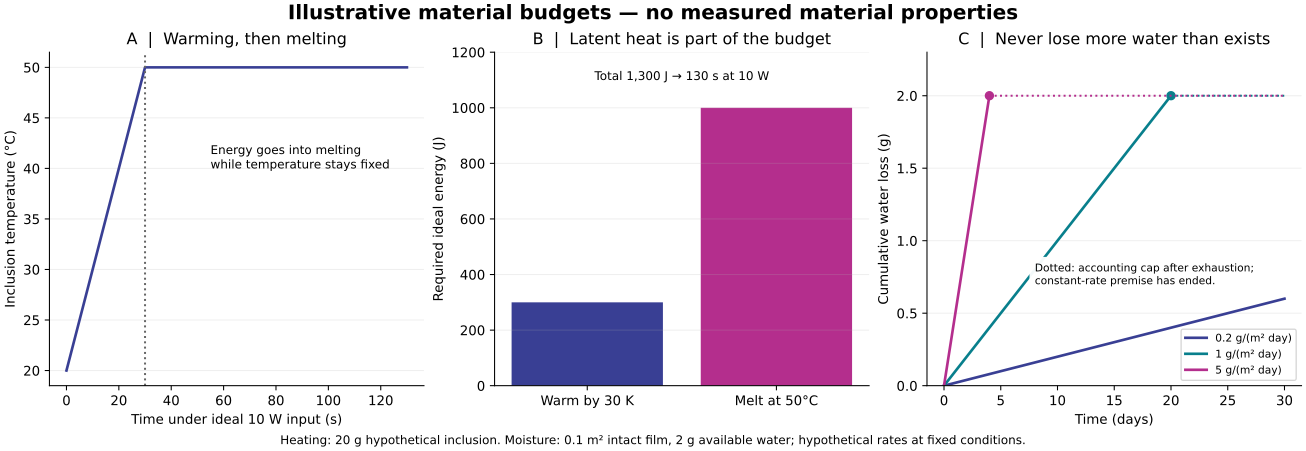
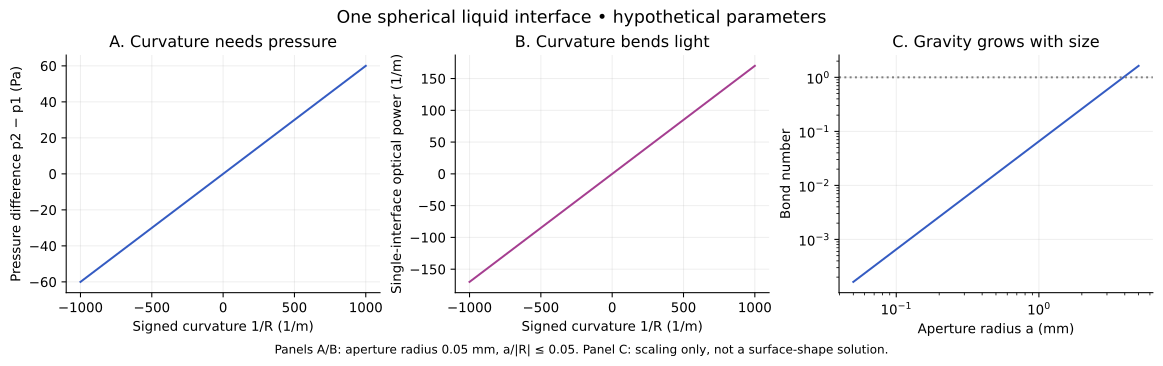
Budget reproduction requires Python, NumPy and Matplotlib; liquid-interface reproduction requires Python and Matplotlib. Independent checks use enthalpy, SI mass-flux conversion, conservation, hemisphere force balance and the small-angle limit of Snell refraction. These verify calculations, not material performance.
08 / TURN AN IDEA INTO A MEASURABLE QUESTION
Useful possibilities include reshaping a component then locking it, adjusting an optical interface, or reducing moisture loss. Each needs a defined material and operating conditions before performance can be assessed.
Examples: temperature versus force–deflection slope; pressure versus optical power; humidity difference versus transmitted mass. Keep units and test conditions with the result.
Record cooling or recovery time, repeated cycles, leakage, defects and irreversible changes. A single successful state change does not establish service life.
Compare equal tasks and conditions, including energy, mass, speed and manufacturing constraints. These are proposed measurements, not executed project results.
READ FURTHER
Poon and Hopkins (2019) · Phase-changing metamaterial report one fabricated gallium–silicone lattice. Its measured response belongs to that material and geometry; it does not establish the performance of the proposed branched membrane. Zappetti et al. (2020) · Variable-stiffness tensegrity report architecture-specific results for a different structure, not the project proposal.
IUPAC · Gel provides terminology. Winter and Chambon (1986), Journal of Rheology report a frequency-dependent criterion for a critical gel in a particular crosslinking polymer system; this supports the warning that a single-frequency G′=G″ crossing is not a universal gelation temperature.
OpenStax · Refraction at a spherical interface gives the paraxial framework.
MIT · Surface tension discusses pressure and capillary balance.
Guglielmetti et al. (2012) · The role of temperature in photochromic behaviour review system-dependent activation and thermal recovery. FDA (2018) · ACUVUE OASYS with Transitions photochromic contact lens documents one specific cleared contact-lens device; it does not describe spectacle glasses or the hypothetical external filter used as a teaching analogy here.
Carson (1937), NBS Miscellaneous Publication 127 · Water-vapour permeability of membranes for packaging supplies historical primary background; no measured film values from the report are used as our hypothetical inputs.
CDC · Key definitions for healthcare environmental cleaning distinguishes physical removal of soil from biological inactivation. It does not test or establish the performance of a coating.
Revised 2 October 2026. Independent conventional lessons; no new material, hygiene efficacy or device performance is validated.
A coloured material used near a surgical site needs a defined composition and evidence for its intended contact and procedure. Calling it inert does not establish sterility or compatibility. No such material or clinical result is supplied for this proposal.