Imagine this
A faraway planet can make a tiny change in the light we see. That clue can have more than one cause. Finding a gas or a warm place does not prove there is life.
THE FIELD GUIDE / 036 · PLANETARY OBSERVATION
A distant planet contributes a tiny signal beside its star. Learning about its surface or atmosphere means comparing explanations, not simply giving a familiar name to a pattern.
Change the viewing phase ↓A faraway planet can make a tiny change in the light we see. That clue can have more than one cause. Finding a gas or a warm place does not prove there is life.
Models help astronomers ask what a telescope might distinguish and which observation could reduce uncertainty.
The page discusses idealized observations and conditions, not a life detection; noise and competing explanations remain.
Read-aloud starter; not yet tested with children. The fuller science, data, figures and sources follow below.
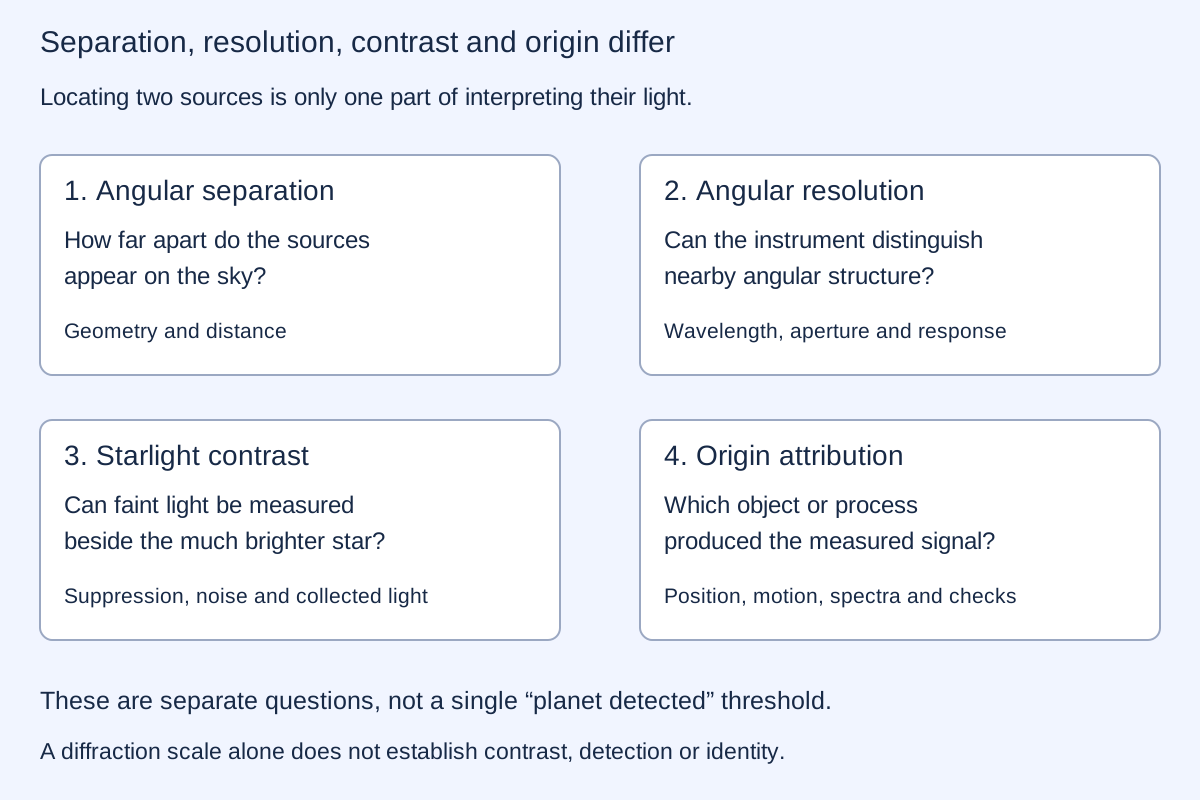
Knowing where to point does not necessarily separate two sources. Even when a planet and star lie far enough apart for a simple optical resolution rule, the star can overwhelm the planet's light. A separated point still needs reliable attribution through position, motion, spectra and instrument checks.
SMALL-ANGLE GEOMETRY · IDEAL CIRCULAR APERTURE
Set a projected separation on the sky plane and the observer's distance. One astronomical unit (AU) is about the Earth–Sun distance. A parsec (pc) is a distance unit defined through angular geometry. An arcsecond is 1/3600 of a degree.
Angular separation in arcseconds is projected separation in AU divided by distance in pc. The ideal Rayleigh scale is 1.22λ/D radians, converted to arcseconds. Wavelength λ is fixed at 550 nm. This circular-aperture comparison does not model contrast, photon noise, exposure, pointing, optical aberrations or a coronagraph.
A coronagraph's inner working angle describes how close to a star it can suppress light usefully; its achieved contrast is another constraint. Neither is supplied by the Rayleigh rule. Centroid precision, resolving two sources and identifying their origin also differ.
These are separate demonstrations, not one fitted orbit. In a circular edge-on orbit, projected separation varies from zero to its maximum. If tied to phase angle α it is (a/d)sinα in angular units; a full or new phase can have zero separation. The projected offset here is independently assigned.
UNIFORM DIFFUSE SPHERE · NO OCEAN OR CLOUD MODEL
A uniformly reflecting sphere appears bright at full phase and faint as the visible illuminated portion shrinks. This ideal baseline shows how geometry alone changes reflected light. It contains no ocean glint, cloud physics or atmospheric absorption.
For α in radians, Φ(α)=[sinα+(π−α)cosα]/π. Reflected planet/star flux ratio is Ag(Rp/a)²Φ, where Ag is geometric albedo, Rp planet radius and a planet–star distance in matching length units. We use 6371 km per Earth radius and 149597870.7 km per AU.
Geometric albedo compares full-phase brightness with a reference diffuse disk; it is not directly the fraction of all incoming energy reflected. For this passive Lambert sphere the upper geometric-albedo limit is 2/3. Controls stay below it, at 0.05–0.60.
A larger darker planet can have the same ratio as a smaller brighter planet. Doubling radius while reducing geometric albedo by four preserves the ratio, when both settings remain in the allowed range. One brightness value therefore does not identify radius, reflectivity or surface composition uniquely.
Moving the observer farther away reduces the apparent light from both star and planet. In this distant-observer idealization it does not add another inverse-distance factor to their flux ratio. Thermal emission and scattering by an atmosphere are omitted; zero reflected light is not zero total real light.
A smooth liquid surface can reflect a glint, as sunlight does on water. But clouds, ice, aerosols, viewing geometry and other scattering effects can complicate the interpretation. The diffuse curve above cannot predict or retrieve glint.
Lustig-Yaeger and colleagues studied multiphase ocean-glint inference using simulations. Combining phase, color and rotational variation can help compare competing explanations. That study is not a measured distant ocean or a salinity measurement by this project.
| Possible observation | What does not follow automatically |
|---|---|
| Atmospheric water feature | A liquid surface ocean or its area |
| Brightness consistent with a liquid-surface model | A unique ocean map, coastline or lake |
| Evidence supporting surface liquid | Its salinity, dissolved salts or biological activity |
Temperature, pressure, composition, available energy, radiation and their history affect whether an environment could support familiar biological processes. An atmosphere is one part of that context. Pressure, density and temperature are different quantities; connecting them also requires composition and a physical model.
Listing environmental factors does not create a calibrated predictor. Without a defined target, equation, units, comparative data and independent tests, a habitability percentage would be invented. The chapter therefore gives no numerical habitability score.
Different structures can solve similar functional problems. Similarity can reflect shared ancestry or independent evolution under similar constraints; distinguishing those possibilities needs comparative evidence. Planetary conditions alone do not determine an organism's anatomy, and one example would not establish a universal form.
Organic molecules participate in living systems, but nonbiological chemistry can make them too. A chemical feature may also involve contamination or an instrument effect. Evidence for molecules, cell-like structures and ongoing metabolism are distinct claims.
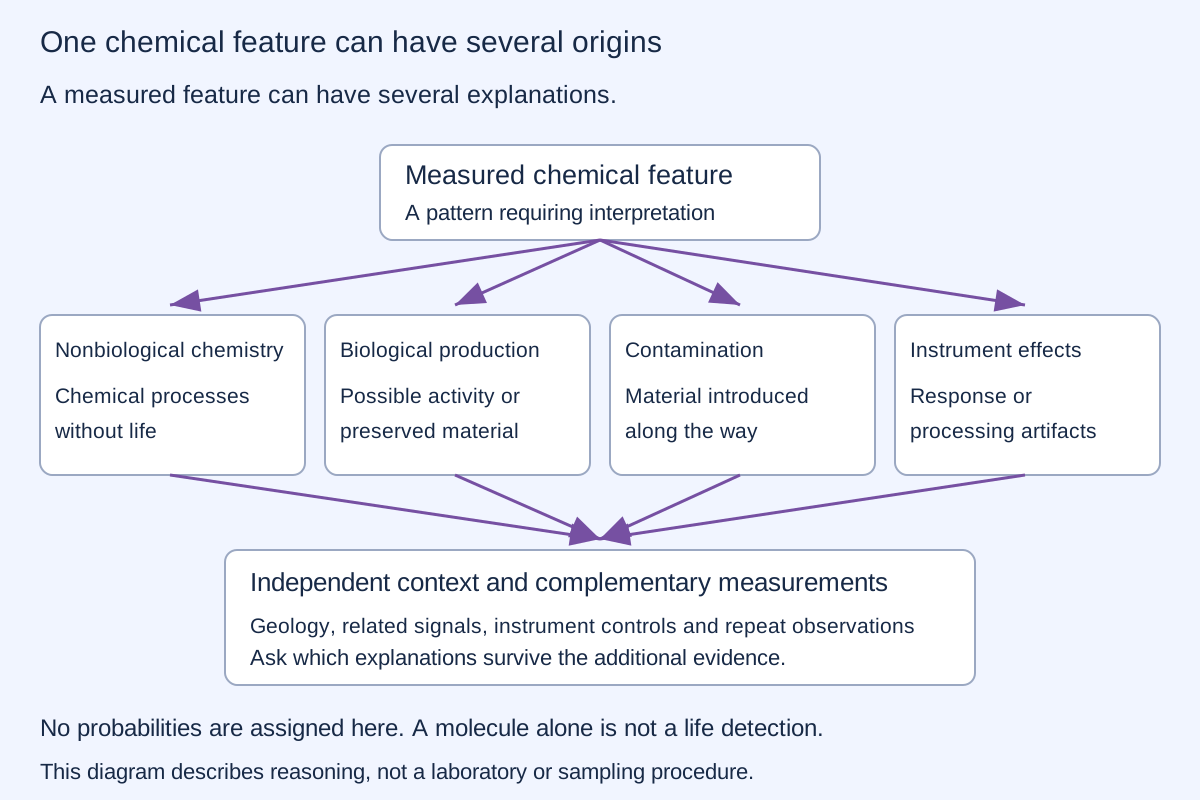
NASA's instrument-team report on Martian organic matter explicitly distinguishes its chemical finding from proof of biological origin. Geological context, complementary chemical patterns, instrument checks and independent observations can help test alternatives.
No biological classification trial was executed for this chapter. A proposed pilot remains a proposal; no accuracy, confusion matrix or laboratory outcome is supplied. These are explanations of evidence, not instructions for collecting or cultivating biological material.
A galaxy image can show warped arms, bridges or rings. Gravity, interactions and viewing direction can produce striking appearances. Hubble's Arp 273 image provides an observed example of interacting-galaxy structure.
A photograph alone does not establish a unique history or new force. A proposed mechanism needs equations and predictions beyond the shape that first suggested it. Motions, spectra and quantitative model comparisons can distinguish alternatives. This is a change of scale in the inference lesson, not evidence about planetary biology.
Today: planning observations at complementary phases and wavelengths, checking calibration and comparing alternative models help researchers avoid overinterpreting a single feature.
A possible next step: better phase coverage, stable instruments and independent observations may eliminate some explanations. An honest result can still leave several possibilities open; it need not promise an ocean map or life detection.
NEW ANALYTICAL TEACHING CALCULATIONS
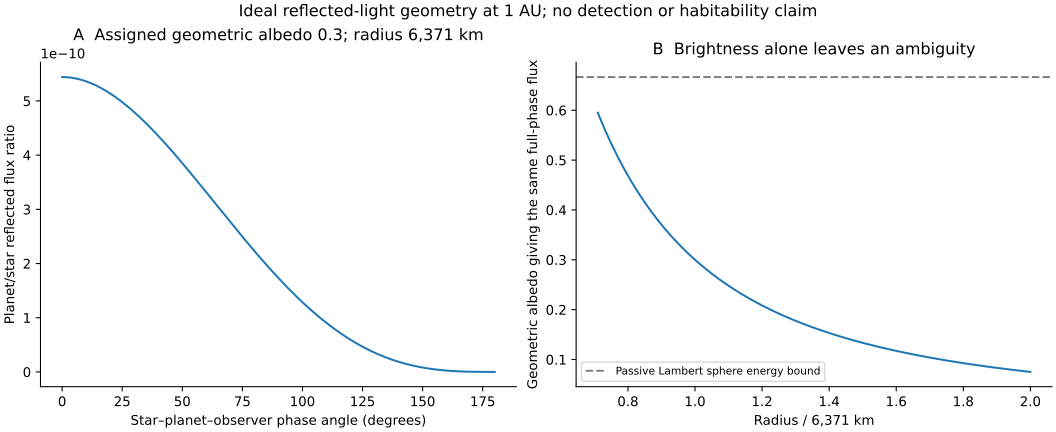
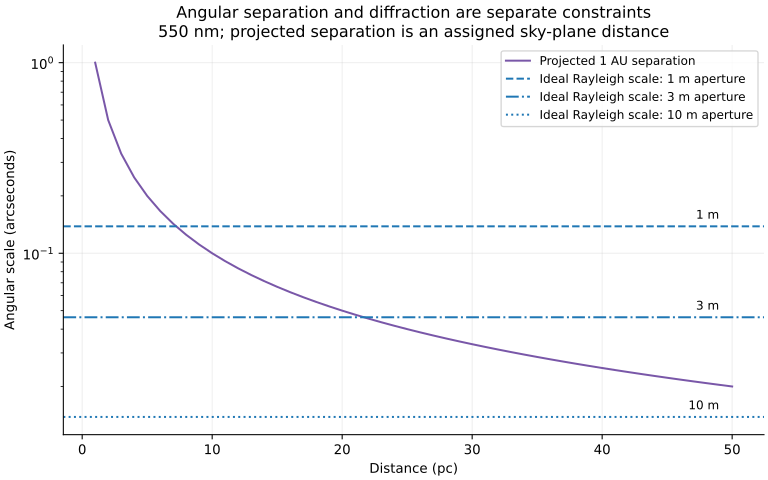
818 calculation rows: 181 phase points, 130 equal-brightness alternatives, 500 distance/aperture combinations and 7 independent sphere-integration checks. No measurements or inferred biological accuracy are supplied.
Run the script with Python, NumPy and Matplotlib. The generator hash and runtime are recorded. Independent numerical integration adds the visible, illuminated contributions across a sphere at seven angles, using 400×800 and 800×1600 midpoint grids. The finer grid differs from the analytical phase factor by at most 3.90×10⁻⁶. This is numerical integration error, not observational uncertainty.
NASA-hosted primary paper with reflected-light and Lambert equations · Cowan, Fuentes and Haggard: reflected-light surface kernel. These references support the model, not the assigned inputs or a detection claim.
These calculations were created for this chapter. They are not recovered observations, an ocean reconstruction or the result of a biological pilot. Model agreement and geometric resolution do not establish instrument detectability.
NASA: how planets are found and characterized · Primary ocean-glint simulation study
If a proposal explicitly keeps two systems from touching, describing what would happen if they touched does not test the proposed situation. Instead, ask what the systems are, how they could influence each other and which observation would distinguish that influence from alternatives. A folded-space drawing or an extra dimension needs mathematical definitions before it predicts a motion or spectrum. Claims about matter creation or a final cosmic state likewise need equations, energy accounting and observations. No such quantitative model is supplied here.
With an alphabet of four symbols and an exactly specified length n, there are 4ⁿ possible strings. Without a maximum length, that is not one finite count of every possible string. Even a count at fixed length is not a count of viable organisms or body plans: those require additional biological evidence. The proposal supplies neither a defined counting model nor observations establishing universal limits on living forms.