Imagine this
A moving platform may lift something, while a support keeps it from falling. Lifting needs energy, and doing it quickly needs more power. A changing room needs a tested way to carry its load.
THE FIELD GUIDE / 029 · DESIGN AND ACTUATION
A work surface rises. A partition moves. Furniture folds away. Adaptability is useful only when loads remain supported and people can still use the space.
A moving platform may lift something, while a support keeps it from falling. Lifting needs energy, and doing it quickly needs more power. A changing room needs a tested way to carry its load.
The page's geometry and energy models help compare support, slope and lifting needs. A reconfigurable space remains a design question until its mechanism is tested.
The calculations are ideal examples. They do not yet check where parts touch, whether the structure can hold the weight, how it stays balanced or how its controls work.
Read-aloud starter; not yet tested with children. The fuller science, data, figures and sources follow below.
An adjustable platform carries its own mass as well as its payload. Guides constrain its motion, an actuator supplies force, and a holding mechanism can support it after movement ends. Stopping a motor and holding up a load are separate requirements.
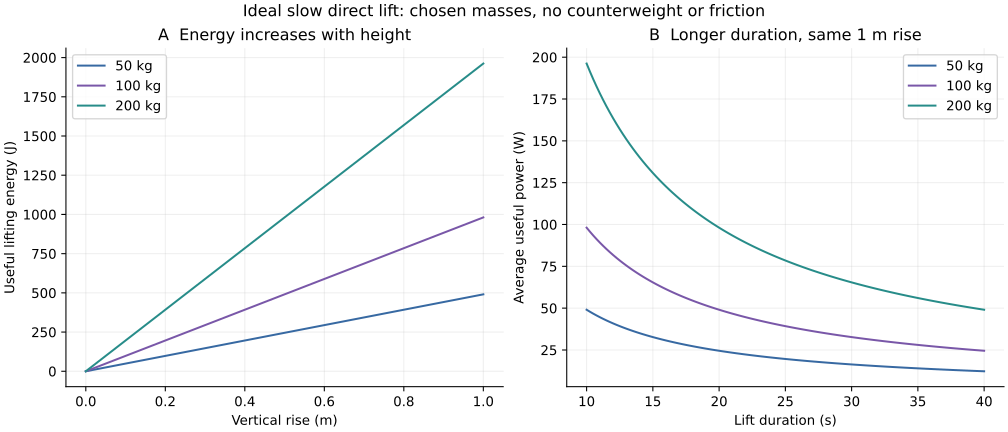
For an ideal slow vertical lift, the supporting force is mass times gravitational acceleration. Raising the load adds gravitational potential energy: mass × gravity × height. Taking twice as long halves the average useful power while leaving the useful lifting energy unchanged. NASA explanation of energy and work
The model below uses ordinary support and chosen inputs. It does not demonstrate a novel actuator or size a building lift. Moving an entire structure also involves foundations, lateral loads, drainage, waterproofing, utilities and evacuation. An unspecified heat-driven actuator needs its own defined physical cycle and measured evidence.
IDEAL DIRECT VERTICAL LIFT · NO ACCELERATION MODEL
Total mass includes both the moving platform and its load. Height is the change in elevation; duration is the assigned time for that change. The hypothetical efficiency relates useful lifting work to input energy.
At the starting settings, the ideal support force is 981 N and useful energy is 490.5 J. Increase the duration: energy stays the same, power falls. Set height to zero: travel work is zero, but the stationary load still needs support.
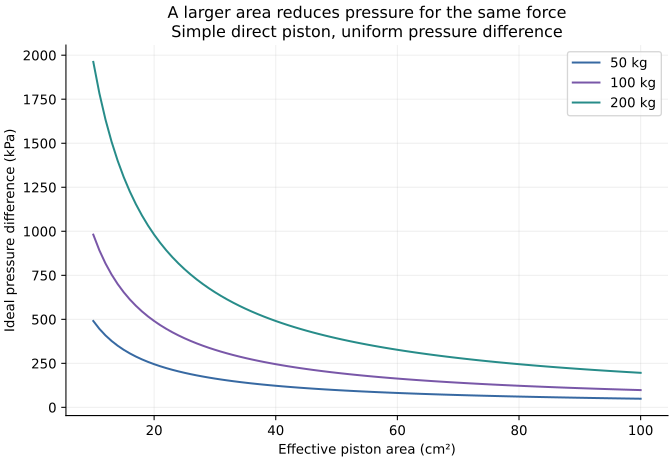
A larger effective piston area reduces the pressure difference required for the same ideal force. It does not remove the lifting work. Here 50 cm² equals 0.005 m². We assume a simple loaded piston against ambient or equal effective areas; rod geometry, backpressure, friction and leakage are omitted. NIST pressure measurement example
These outputs are not actuator specifications. The chosen efficiency is a simple energy allowance, not a friction or pressure-loss model. The lift begins and ends at the same speed; acceleration peaks, counterweights and elastic storage are not simulated. A mechanical lock can hold a stationary load with no ongoing ideal mechanical work, while electronics, leakage or active support may still consume energy.
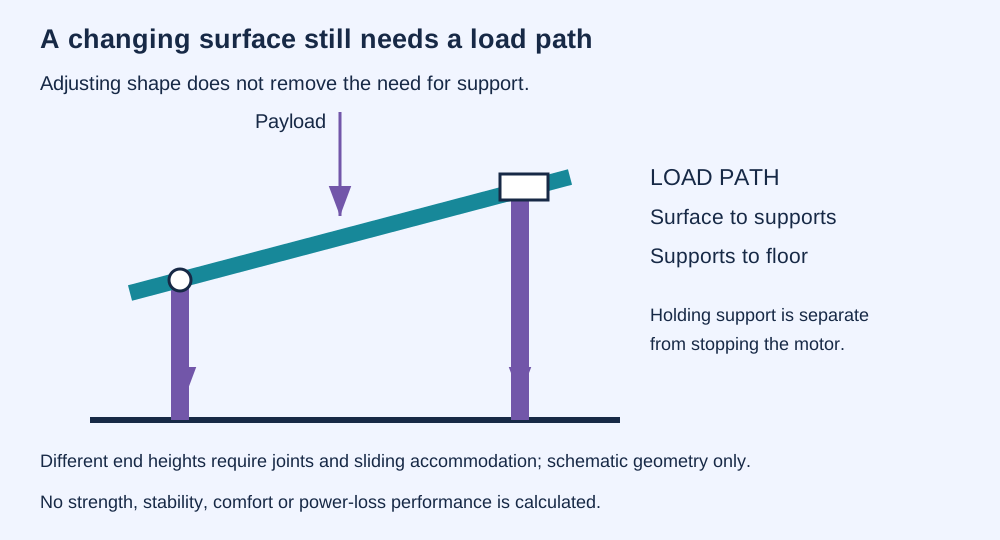
Follow the force from a surface through its supports to the floor. Then ask what preserves that path when power is lost. A useful adjustable surface needs more than an attractive shape: contact, guidance, locking, strength and stability must be considered together. The chapter on structures explains support and load distribution.
The illustration uses mechanical support. It demonstrates neither unsupported suspension nor a material created, shaped and removed on demand. Forming materials would require specified expansion, curing, exposure, structural properties and recovery. A material does not disappear without a defined process and an account of where its matter goes.
KINEMATIC GEOMETRY · NOT A RIGID MECHANISM
Two contact points are 1.20 m apart horizontally. The left height stays at 0.60 m. Change the right height and compare the angle and the distance between contacts.
The line length changes when one point rises. A fixed-length rigid board cannot remain attached to both fixed horizontal positions without another degree of freedom. A practical mechanism could need sliding contacts, joints or a different support path; none is designed here.
This is geometry only. It does not calculate force distribution, structural capacity, comfort or stability under a person's weight. The drawing omits surface thickness and mechanism details.
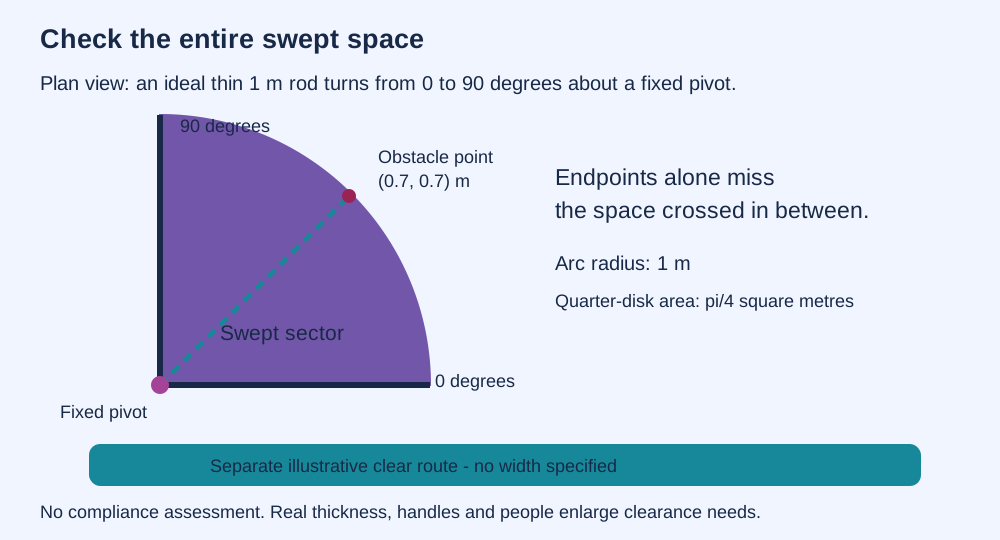
A partition can fit at its start and end positions yet cross an obstruction while moving. Its swept envelope is the whole region it passes through. In the schematic, a zero-thickness 1 m segment rotates through a quarter turn. A point at (0.7 m, 0.7 m) lies inside that swept sector even though it is clear of both endpoint segments.
A real partition has thickness. People and objects move too. Useful clearance must include those realities, the direction of movement and what happens after a fault. The planar sketch is not a collision detector or a clearance prescription.
Show the swept region alongside a clear access route, room to manoeuvre and reachable controls. The US Access Board guide illustrates why these practical details matter together. Its requirements are jurisdiction-specific; this page makes no code-compliance determination.
| Stage | Evidence needed |
|---|---|
| Before moving | The intended path and movement zone are clear |
| During movement | Position and unexpected resistance are monitored under a defined control strategy |
| After stopping | The holding support is engaged and the final position is confirmed |
| After power or sensor loss | A defined recovery preserves load support and access |
This sequence names engineering questions, not a complete safety architecture. An animation reaching the correct endpoint supplies none of those measurements.
Today: adjustable work surfaces, movable partitions and stage mechanisms adapt space to different tasks. The same room may support work, storage or maintenance at different times.
A future direction: reduce the effort people need to reconfigure a space while preserving usable controls, stable support and clear routes. Evaluate users' needs, movement space and recovery from failures together. Reconfiguration does not create floor area: storage, structure and travel paths still take room.
REPRODUCIBLE STUDY
| Assigned case | Calculated result |
|---|---|
| 100 kg, 0.5 m rise | 981 N support force and 490.5 J useful work |
| The same lift in 20 s | 24.525 W average useful power |
| The same lift in 40 s | 12.2625 W average useful power; useful work unchanged |
| 100 kg supported, no change in height | 981 N support force, zero gravitational travel work |
| 100 kg, effective area 50 cm² | 196.2 kPa ideal pressure difference |
F = mg; E = mgh; average useful power = E/t; input energy = E/η; ideal pressure difference = F/A. Gravitational acceleration is fixed at 9.81 m/s². Mass and height must be nonnegative, time and effective area positive, and efficiency must be greater than zero and at most one.
Pressure uses force divided by effective area, not total platform footprint. Efficiency changes assigned input energy; it does not independently model the required pressure. Zero height removes gravitational travel work while leaving the nonzero load's support force unchanged.
For horizontal spacing L = 1.20 m, angle = atan2(h₂ − h₁, L) and contact separation = √[L² + (h₂ − h₁)²]. The left height is fixed at 0.60 m. Those relationships specify a line between points, not an articulated mechanism or a structural design.
All inputs are hypothetical. The models do not validate a habitable moving structure, load-bearing furniture, an active suspension system or a material-forming process.