Imagine this
A person may react to a sound, smell or movement. That reaction does not always tell us exactly what they sensed. Careful comparisons help us find out.
THE FIELD GUIDE / 045 · SENSATION AND PERCEPTION
A phone vibrates while it rings. You notice it—but was it the sound, the vibration or both? When signals arrive together, a response alone may not reveal which signal mattered.
Separate two possible contributions ↓A person may react to a sound, smell or movement. That reaction does not always tell us exactly what they sensed. Careful comparisons help us find out.
Sensory tests help researchers separate a stimulus, a response and the meaning people give it. A new sensing tool needs comparison with other explanations.
No unfamiliar human sense is demonstrated; a force calculation alone cannot establish perception.
Read-aloud starter; not yet tested with children. The fuller science, data, figures and sources follow below.
A stimulus is a physical input. Transduction turns an interaction into a signal. Perception is sensory experience; interpretation is the meaning assigned to an observation. A sensor can respond without understanding anything, and an organism can respond reflexively without consciously interpreting a stimulus.
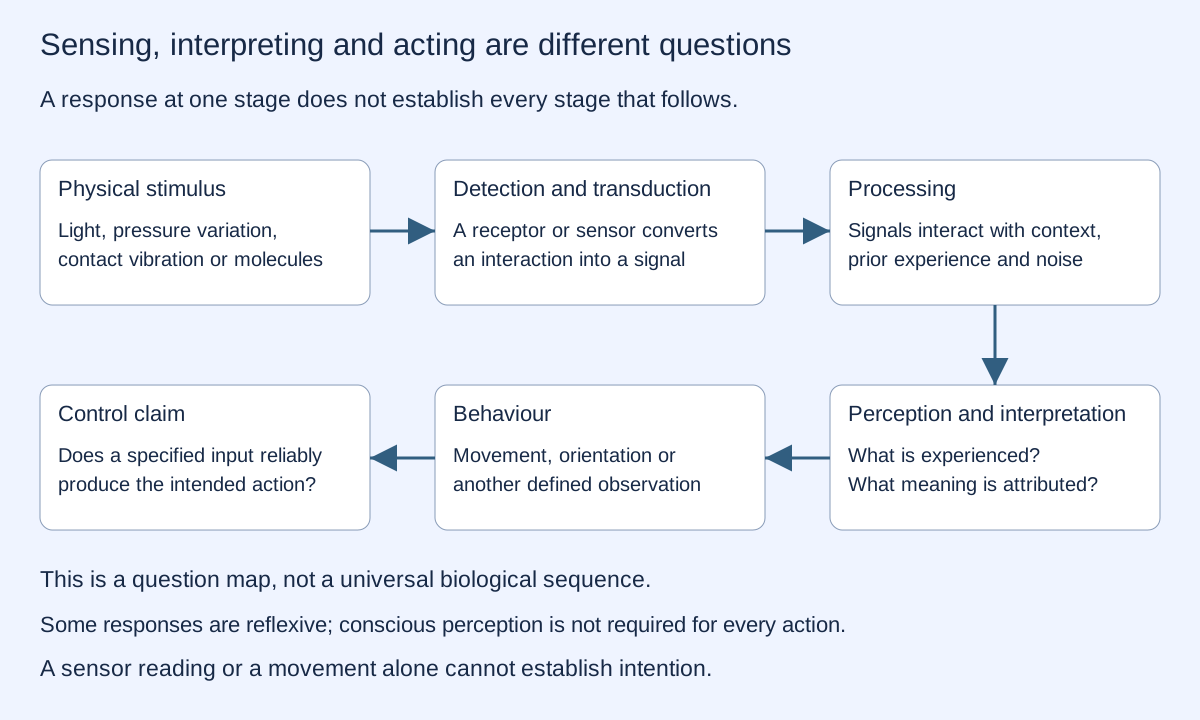
| Input | What to distinguish |
|---|---|
| Light | A local tissue response, a detector signal and a conscious colour judgment are different outcomes. |
| Pressure and vibration | Sound in air, contact vibration and motion transmitted through a support may occur together. |
| Molecules | Chemical detection, identifying an odour and its subjective description are different tasks. |
A threshold is a detection criterion for a specified task and conditions. Discrimination means telling specified inputs apart. Neither can be read directly from an anatomical cell count.
TOY INSTRUMENT · ASSIGNED VALUES · NO BIOLOGICAL DATA
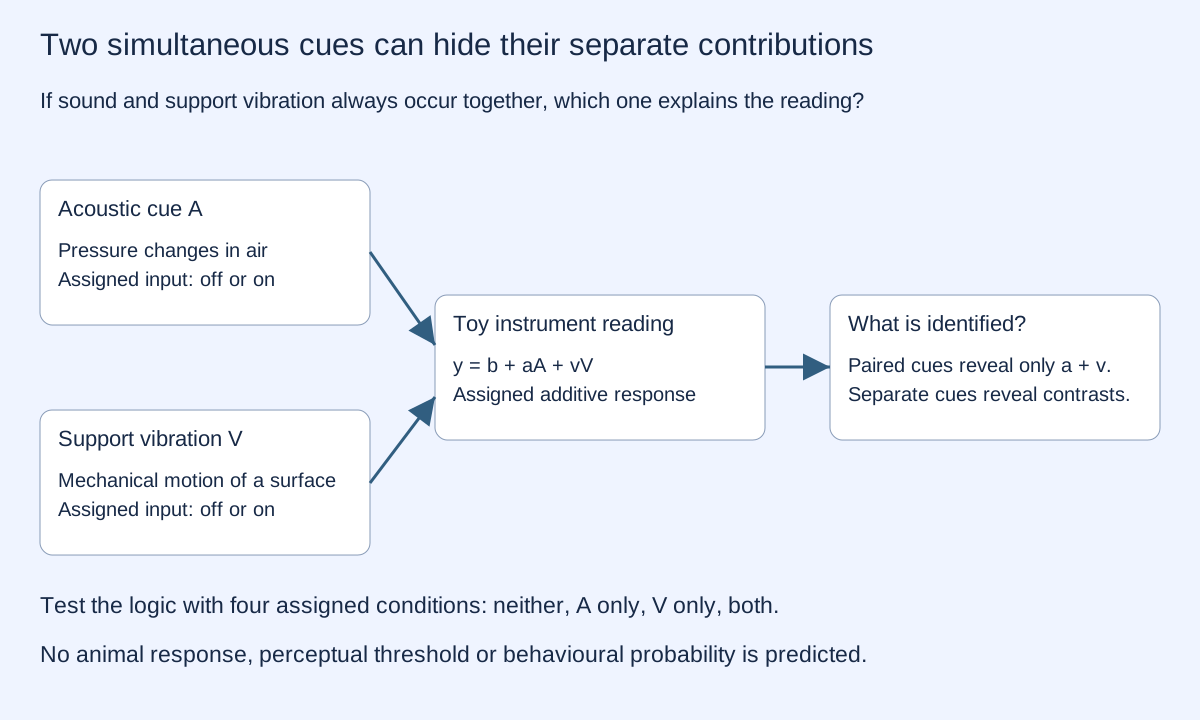
Imagine a fictional instrument affected by an acoustic cue and a vibration in its support. We assign how much each cue contributes. Its reading is a number in arbitrary units, not the probability that an animal responds.
| Condition | Reading (arbitrary units) |
|---|---|
| Neither cue | |
| Both cues | |
| Acoustic only | |
| Vibration only |
Try the three presets before revealing the separate conditions. All give the same paired readings: 0 with neither cue and 1 with both. The separate contributions differ, yet those two readings cannot distinguish them.
y = b + aA + vV. Here A and V are either 0 (absent) or 1 (present), b = 0 is the baseline, and a and v are assigned contributions between 0 and 1. The maximum reading is 2 arbitrary units; it is not 200% probability.
With only neither/both conditions, the change identifies a + v under this model. The separate contrasts y(1,0) − y(0,0) and y(0,1) − y(0,0) recover a and v. Additivity assumes no interaction: y(1,1) − y(1,0) − y(0,1) + y(0,0) = 0. Real observations could violate this assumption. Calibration, noise, other cues and appropriate comparisons would still matter; the chosen numbers do not demonstrate causality in nature.
Three questions need separate evidence: does a nervous system register a sound, does behaviour change, and can a specified signal reliably direct a movement? Different species and contexts can produce different answers.
Zdenek and colleagues' 2023 study compared sound conditions in freely moving snakes. Responses differed among the studied groups; one sound condition also produced ground vibration. Observers knew the sound condition. This study does not establish control by a 750 Hz whistle or a universal response across species. The 2025 correction concerns an author's name.
One claim links unexplained movement to a concealed animal and a sound signal. Without a verified recording, species identification and movement measurements, that explanation remains unresolved; a specific frequency is not itself a measurement.
The constructive application is careful interpretation of existing observations. If reliable recordings exist, a study could compare sound timing, visible movement and support vibration. No animal demonstration is needed for the lesson here.
A physical response in skin does not by itself show conscious vision through skin. A high-frequency electrical drive does not tell us exactly which vibration reached tissue. An olfactory cell count does not directly measure sensitivity or the number of smells someone can distinguish.
| Claim in the project | Missing evidence or inconsistency |
|---|---|
| Up to 37 skin receptor types | Anatomical definitions, localization, counting method and independent observations. |
| Colour detection at the wrist | Claimed wrist/palm differences, wavelength-independent monochromatic experience and inhibition above an intensity threshold have no verified task, controls or results. |
| Tactile sensitivity at 26.6 kHz | Measured tissue motion, thresholds and separation of auditory, contact and support-transmitted cues. |
| 38,000 olfactory cells per cm² | The supplied source states 38,000; an earlier audit incorrectly reduced this to 3,800. Cell type, tissue region and counting method remain unspecified. The claimed density is not an independently verified measurement and does not establish superior perception. |
| Four claimed olfactory receptor classes and timed scent compositions | Anatomical classification is different from perceived odour categories. Defined mixtures and repeatable discrimination are missing; this is not an established sensory alphabet. |
| Light-frequency labels | A printed 10⁴ Hz expression conflicts with its light label and must not be silently repaired. The stated 4.2–4.8 × 10¹⁴ Hz corresponds to roughly 625–714 nm, in the visible red region rather than ultraviolet. |
Reported discomfort or injury under strong impacts is an unsupported source claim, not an activity to reproduce. No new sensory device or human result has been demonstrated by these descriptions.
Imagine a dot approaching a square, pausing, then turning away. “The dot changed direction” describes its path. “The dot was afraid” adds an interpretation. The same coordinates do not establish the second claim.
Anthropomorphism means attributing human-like characteristics or intentions to nonhuman entities. Epley, Waytz and Cacioppo's theoretical account treats this as a research topic. Our dot example is an illustration, not a test of your psychology or evidence about an object's inner experience.
A separate claim in the project links religious anthropomorphism to anxiety or neurosis. It supplies no defined population, clinical measure, comparison or time sequence. Research on anthropomorphism does not establish that general clinical chain. Belief is not a diagnosis, and this chapter makes no judgment about a person's mental health.
Today: accessible interfaces often combine visible, audible and tactile information. Separating the physical signal from what a user notices and understands helps evaluate whether an interface communicates its intended message.
Possible next step: a tool could align recorded sound, visible motion and response timing so that competing explanations are easy to inspect. Reliable recordings, appropriate consent and explicit uncertainty would be essential. This would improve evidence review, not establish a new sense or a way to control behaviour.
REPRODUCIBLE ASSIGNED MODEL
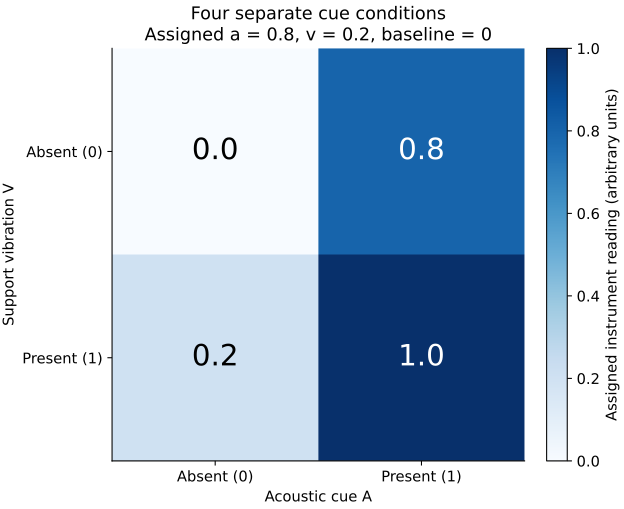
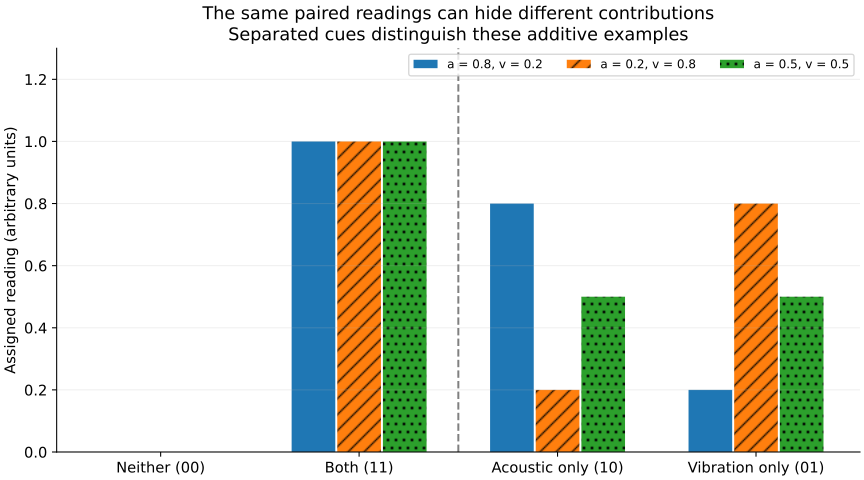
The study covers 441 pairs of coefficients, from 0 to 1 in steps of 0.05, with four conditions each: 1,764 rows. No people, animals or empirical responses were measured. The example changes the information available about a specified equation; it does not estimate a biological threshold or behavioural probability.
All assigned readings CSV · Standalone reproduction script · Methods and limits · Parameters and runtime · Validation
Run with Python, NumPy and Matplotlib. Checks recover the assigned contributions from separate contrasts, verify zero interaction and compare the number of independently identifiable coefficients. Invalid inputs are rejected. These checks verify the mathematics; they cannot test whether real sensing is additive.
Detecting an odour, distinguishing two odours and remembering one later are different tasks. NIDCD describes distinct detection and identification tests, while a primary familiarization study separately assessed discrimination and recognition memory. An anatomical count or an anecdote cannot establish superior olfactory memory or a difference between sexes. Those particular comparisons need defined tasks, participants and controls; none is supplied for this proposal.
Calculating a small change in supporting force does not tell us whether someone can sense it. Detection, balance responses and a soothing effect are different outcomes and need separate observations. No sensory threshold or therapeutic effect is established by the proposed analogy.
Vision, the inner-ear balance system and signals from the body contribute to orientation. Changing the gravity environment can change those cues. This does not establish the stronger proposal that gravity itself creates every experience of space. That proposal needs a defined pathway and observations that distinguish it from the combined sensory explanation.
NASA: visual orientation in unfamiliar gravity environments · Explore the unresolved spatial-perception claim