Imagine this
A bucket can lose water through a hole even when most of the water is used again. We must count what goes in, what comes out and what leaks away. Then we can check if the reused water or material is suitable.
THE FIELD GUIDE / 038 · RESOURCE SYSTEMS
Recycling reduces the supplies a system needs. It does not make losses, energy use or unwanted substances disappear. A useful loop has a clear boundary: what comes in, what is recovered, what leaves and what must be checked before reuse.
Follow the water ↓A bucket can lose water through a hole even when most of the water is used again. We must count what goes in, what comes out and what leaks away. Then we can check if the reused water or material is suitable.
A mass balance helps teams track water or material reused, lost or changed in quality. A closed-loop process might save resources after full-flow and product tests.
A recovery percentage needs a defined stream and boundary. Quantity does not establish suitability, safety or useful output.
Read-aloud starter; not yet tested with children. The fuller science, data, figures and sources follow below.
THE SIMPLE VERSION · NO BACKGROUND NEEDED
Imagine 100 cups’ worth of water being used each day. A cleaner can send some back around—but a little may slip away before it gets there, and a little more may leave with the leftover water.

A remote facility or space habitat needs several connected services: water treatment, air management, food supply, power and heat removal. Improving one does not automatically solve the others. A membrane that separates substances also needs suitable pressure support; permeability alone is not structural strength.
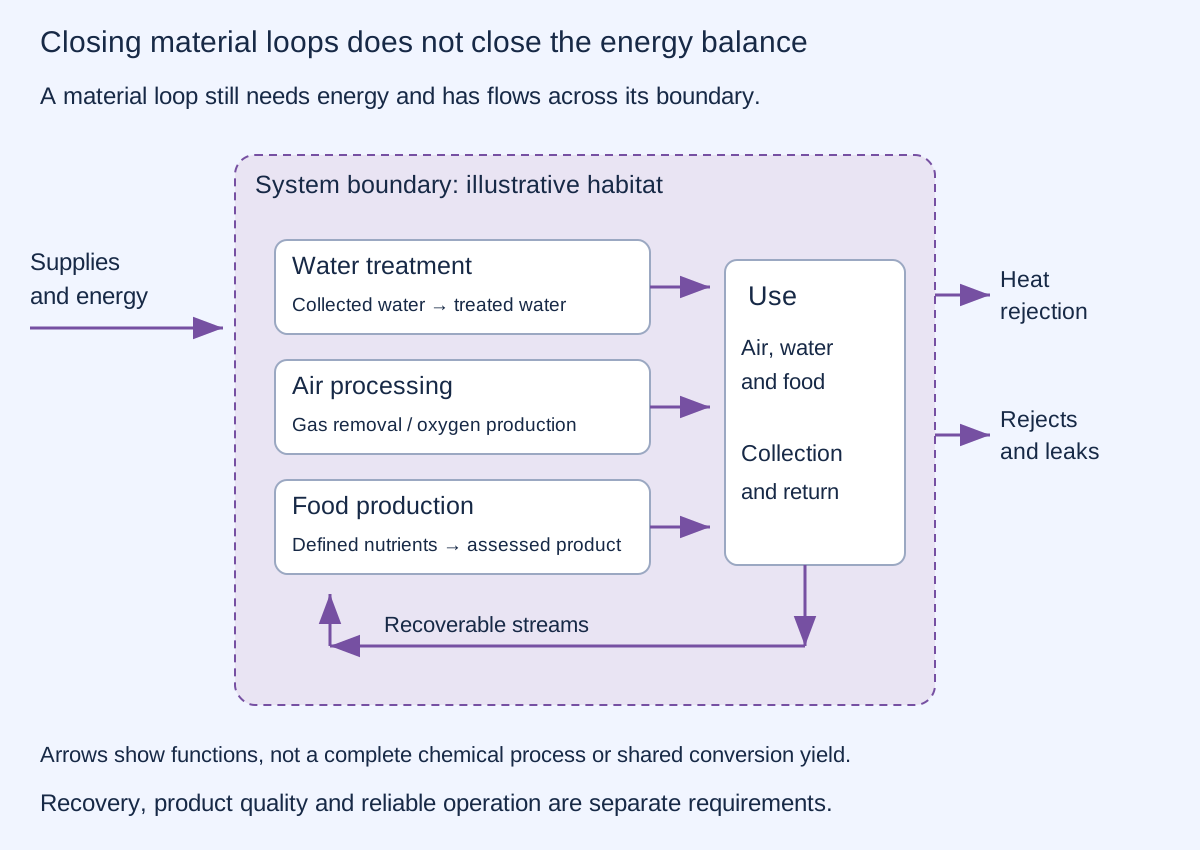
NASA's environmental control and life support overview describes distinct water recovery, air revitalization and oxygen-generation functions. Water electrolysis changes the water inventory while producing gases: the same water cannot also be counted as fully retained in a separate water balance.
ASSIGNED DAILY FLOW · NO NET ACCUMULATION
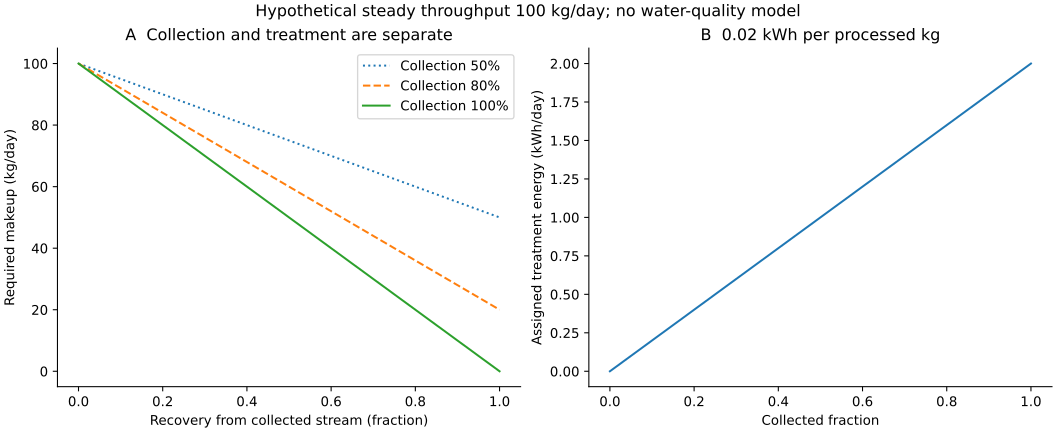
Start with a daily water throughput. Some water reaches the treatment unit; some escapes this collection boundary. The unit returns a fraction of what it receives. Change collection and treatment separately to see why a high treatment yield can still leave substantial replenishment.
Uncollected water and rejected water leave this loop boundary; they are not destroyed. The replacement calculation assumes constant throughput, no net storage change and no other water sources or sinks. Energy is assigned per kilogram entering treatment, not per kilogram recovered. Pumping, storage, supplies and maintenance outside this boundary are omitted.
For throughput Q, collection fraction c and treatment recovery r: recovered = Qcr; uncollected = Q(1−c); rejected = Qc(1−r); replacement = Q(1−cr). Processing energy = eQc for assigned intensity e. The sliders show hypothetical accounting values, not a treatment specification or water-quality result.
In June 2023, NASA reported a 98% water-recovery milestone for its demonstrated station configuration. That reported system boundary is not automatically the treatment-only fraction in this example, nor 98% recovery of every material in a habitat.
| Resource | Useful measurement | Additional questions |
|---|---|---|
| Air | Composition and flow | Total pressure, unwanted components and changing conditions. A gas fraction alone does not establish a suitable atmosphere. |
| Water | Recovered mass | Chemical and biological quality, process stability and storage. Recovery alone does not establish drinkability. |
| Food | Production mass | Composition, nutrition, digestibility, contaminants and assessment of the actual product. Molecular handedness alone does not establish suitability. |
These require different measurements and criteria. This page provides no exposure limits, drinking-water clearance or food-production procedure.
SYNTHETIC READINGS · ARBITRARY NORMALIZED SCALE
A majority can reject one bad reading when the other two remain trustworthy. If two channels fail together, agreement can hide the change. Select a case: the voting rule sees only the three displayed readings. The assigned true value is used afterwards to explain whether the answer was right.
The illustrative rule flags a value at or above 1.00, requires at least two readings and averages the two middle values when exactly two remain. Missing data are visible; the fault's cause is not. A decision from two disagreeing readings is not evidence that either channel is correct. This static exercise includes no time history, diagnostic learning, real sensor uncertainty or physical corrective action.
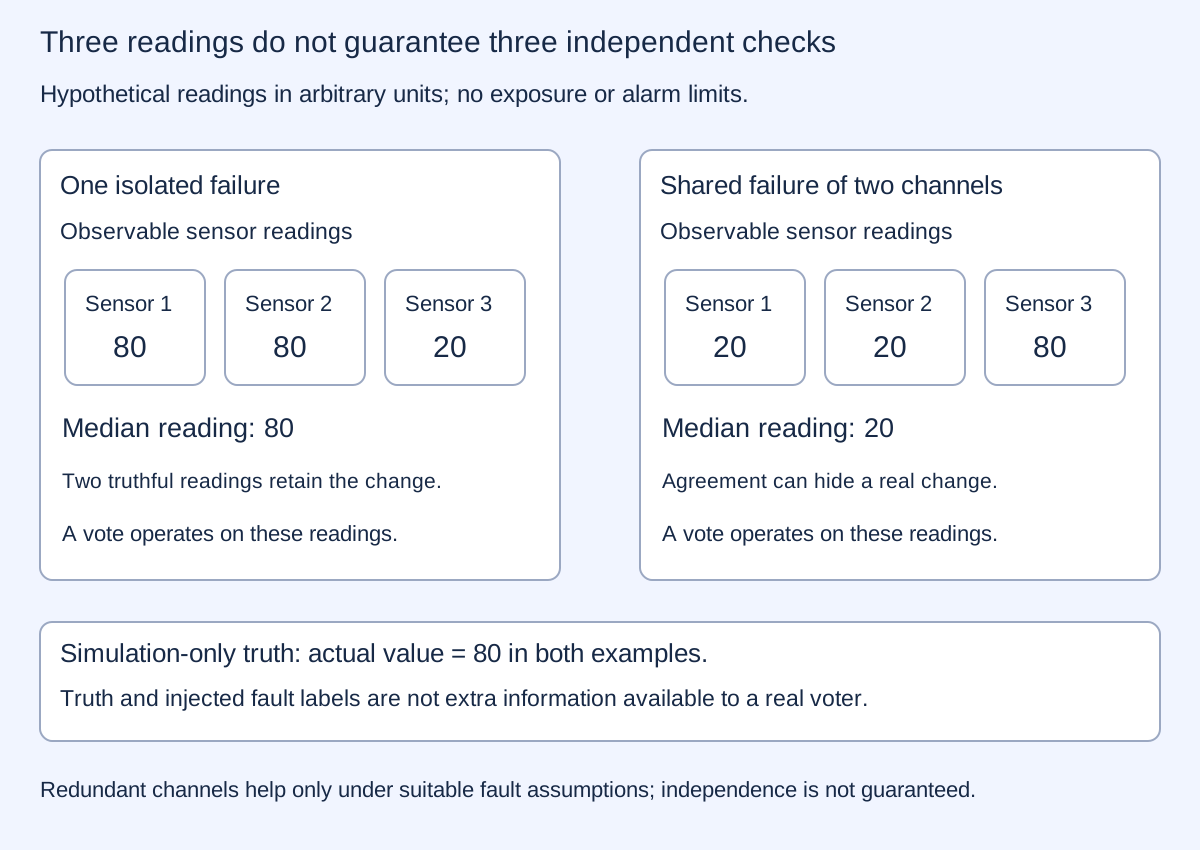
An earlier project benchmark ran 21 selected synthetic cases. It met its alarm timing condition in 12 of 13 hazard cases, flagged degradation in 10 of 11 single-fault cases and entered its software hold state in 2 of 3 multiple-fault cases. Its overall gate failed. These selected counts are not estimates of real reliability.
Inspection also found that some diagnosis consulted the injected fault labels. That gives the test logic information a real detector would not automatically have. A channel stuck at its normal value could go unnoticed, and two stuck channels could mask a changed environment. The new readings-only exercise above is separate and does not inherit those benchmark counts. A software label such as “hold” is not proof that a physical system reaches a safe condition.
ONE TRACKED CONSTITUENT · ASSIGNED PARTITION
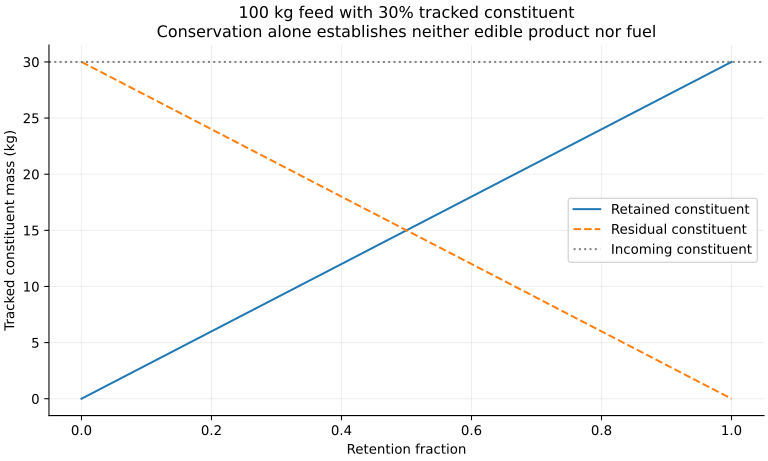
Imagine a feed containing a known fraction of one constituent, such as an element being accounted for. Assign how much ends in the desired stream. The remainder must appear elsewhere in the balance. This does not specify a reaction or tell us whether the stream is food, fuel or useful material.
For feed mass F, constituent fraction w and retained fraction y: incoming = Fw, retained = Fwy, residual = Fw(1−y). The units here are kilograms per batch, unlike the water example's kilograms per day. Only this constituent is tracked; total product mass, other ingredients, energy and quality remain unspecified.
Food production: a cultivation or manufacturing process needs specified inputs, energy, operating conditions, measured yield and assessment of the resulting product. Delivering food and producing it are different operations. A closed balance alone does not establish nutrition or safety.
Mixed waste: separation and treatment leave residual streams. Recovering water does not by itself demonstrate conversion of the remaining material into oxygen. Each proposed chemical route needs its own species and energy balance.
Discarded textiles: fibres, blends, dyes and finishes make different feedstocks. Breaking a material down, recovering hydrogen and recovering energy are separate claims. An unspecified acid treatment gives no defensible hydrogen yield. External reagents and their manufacture also belong in an honest process assessment. No chemical procedure or fuel yield is proposed here.
Today: reducing replacement-water demand can reduce supply needs in remote facilities and water-reuse systems. Loss accounting helps distinguish a collection problem from a treatment problem; independent sensing helps reveal faults that identical channels may share.
Research direction: ESA's MELiSSA programme studies linked resource recovery, using distinct process compartments. This is a research architecture, not evidence of unlimited autonomous closure. Useful progress requires measured quality, energy demand, losses and resilience together.
REPRODUCIBLE ACCOUNTING · ASSIGNED INPUTS
893 calculation rows: 441 water balances, 441 constituent balances and 11 synthetic sensor cases. The sensor table and seven interactive examples use the same rule with different assigned readings. In particular, the table's two-reading disagreement averages to exactly 1.00 and flags; the interactive example averages to 0.90 and does not. Neither resolves which channel is correct.
Water balances CSV · Constituent balances CSV · Synthetic sensor cases CSV · Standalone reproduction script · Methods and limits · Runtime and parameters · Execution checks
Run the standalone script with Python, NumPy and Matplotlib. Checks cover conservation, endpoints, missing readings, the inclusive threshold, permutation of sensor order and the shared-failure miss. Blank sensor-table entries mean missing or undefined, not zero. Selected test cases are not a statistical sample of equipment failures.
These calculations are teaching models, not measured treatment performance or qualification of life-support equipment. Numerical checks establish consistency within their stated assumptions. They do not establish product quality, equipment reliability or full self-sufficiency.
Describing an atmosphere as breathable or food as chemically similar does not establish compatibility with a particular organism. Molecular handedness is one property, not a complete explanation of digestion or nutrition. A proposal without composition measurements or physiological compatibility results cannot establish that the environment is usable. Carrying contingency supplies is a precaution, not evidence of compatibility.