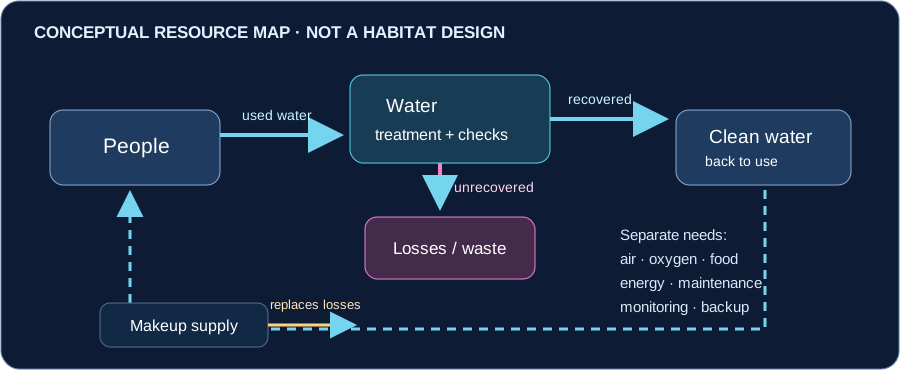
Reusing water can reduce what a crew must bring. A real life-support system also needs clean air, oxygen, food, energy, maintenance and safe ways to handle waste.
THE SIMPLE VERSION · NO EQUATIONS NEEDED
Cleaning and reusing water is like washing a cup
Suppose a group uses water, cleans most of it and uses it again. Each round saves some water, but a little can still be lost. The group must replace what leaks away, stays in waste, or cannot be cleaned well enough.
A water loop is only one part of keeping people alive. It does not make food, fix broken machines, remove every dangerous gas or prove that a sealed shelter is safe.
Conceptual map of resource accounting, not a habitat design. Separate loops share equipment, energy and failure risks.
A WORKING HUMAN SPACEFLIGHT EXAMPLE
The International Space Station reuses water, but it is not a fully closed world
NASA's Environmental Control and Life Support System treats wastewater, including urine and humidity condensate, and checks water quality. NASA reported a 98% total water-recovery milestone after adding processing for water remaining in concentrated brine. The ISS also cleans cabin air and generates oxygen by electrolysing recovered water.
NASA describes the station's water-recovery system as capable of recovering about 90% in its reference overview; the 98% result is a later total-recovery milestone under the upgraded system. These are system-specific figures and should not be treated as a universal rate for every water use or future shelter.
Food, spare parts, power, sensors, filters, microbial control, leaks, maintenance and failures still matter. Spaceflight life support is regenerative in important areas, yet crews and stations continue to depend on supplies and ground support. “Closed loop” is a direction of engineering effort, not a promise of zero inputs or zero waste.
This small model isolates one question. Enter crew size, duration, an illustrative clean-water throughput per person per day, and a recovery fraction. It calculates the unrecovered water that would need replacement if the same throughput repeated each day.
Water circulated over this period480 L
Estimated unrecovered makeup48 L
Estimated water returned432 L
Illustrative water-only accounting; this is not a survival or habitat estimate.
Calculated curve, not measured performance. It uses the assigned throughput shown above and applies the same recovery fraction to all of it.Equations, meaning and omissions
Assigned daily throughput (q), crew (n), duration (d), and recovery fraction (r) give total circulated water (V=qnd). Returned water is (rV); unrecovered makeup is ((1-r)V). These are accounting identities, not a model of any particular habitat.
The default (q=4) L/person/day is an illustrative dial, not an ISS measurement or a recommended allowance. Real systems have different uses, quality constraints and recovery paths. The model excludes energy, oxygen, carbon dioxide, food, hygiene, contaminants, crew activity, leaks, reserve tanks, waste storage, equipment mass, repair time, resupply logistics and failure probability. It cannot estimate how long a refuge can safely support people.
Water reuse, air treatment, monitoring and repairable equipment can support spacecraft, remote research stations, disaster shelters and places with unreliable supply. Each setting needs its own health standards, water source, energy supply and maintenance plan.
What must be tested
Measure water quality and losses over time; test failures and backup modes; account for power, filters, waste and replacement parts; and include independent safety review. A recycling percentage alone cannot certify a shelter.
Evidence labels: ISS ECLSS operation and NASA's reported recovery milestone — published operational evidence; slider outputs — exact calculations from assigned inputs; a 500-day refuge — unverified scenario; human safety or endurance of that proposed refuge — not established.