Imagine this
Getting an answer right today does not mean you will remember it tomorrow. Feedback may help, but we must check what a learner understands later. A score cannot tell us a person's worth.
THE FIELD GUIDE / 046 · LEARNING AND COGNITION
You follow a worked example and solve a problem. A week later, can you solve it without help? Can you use the idea when the problem looks different? These are three different questions.
Try an explicit feedback rule ↓Getting an answer right today does not mean you will remember it tomorrow. Feedback may help, but we must check what a learner understands later. A score cannot tell us a person's worth.
Teachers and software teams can distinguish immediate success from delayed learning. A transparent tool might suggest practice if learners show better understanding over time.
The computer-made study did not include learners and shows no education benefit. A real teaching tool needs studies of how people learn and of any harm it might cause.
Read-aloud starter; not yet tested with children. The fuller science, data, figures and sources follow below.
Immediate performance is what you can do during the activity. Retention is what remains available later. Transfer is using what you learned on a different task. A more enjoyable game, faster clicks and better scores during practice do not automatically establish retention or transfer.
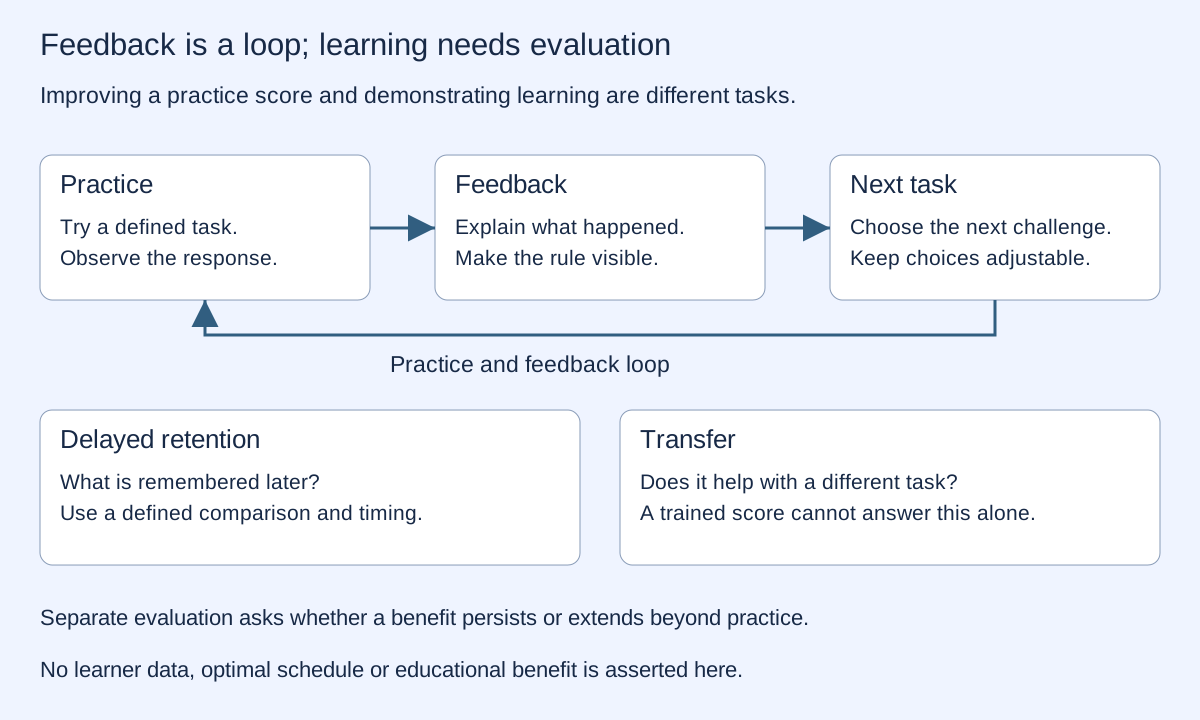
Feedback provides information about an action or result. It can explain an error, offer a hint or change the next task. Whether a particular kind helps depends on the task, the learner and what is measured.
ASSIGNED RULE · FICTIONAL OUTCOMES
Imagine a practice app with five difficulty levels. You supply invented outcomes; this is not a test of your ability. Our chosen rule raises the level after three successes without an intervening unsuccessful attempt, lowers it after one unsuccessful attempt, and leaves both level and success count unchanged when an activity is skipped. Levels stay between 1 and 5.
Level 3 of 5. Success count 0 of 3.
The example begins at level 3.
All 45 rule transitions · Inspect the rule · Rule checks
No learner records are collected by this demonstration. The rule has no evidence of being optimal. A real learner should be able to understand, adjust or decline a recommendation.
A wrong answer could reflect an unclear question, missing prior knowledge, distraction or an inaccessible interface. A success could follow a hint or a guess. The rule sees none of these differences. Fatigue, attention and understanding are distinct; background noise or poor audibility can also affect apparent understanding. No universal threshold or scheduling optimum follows from this example.
Spacing sessions, using short reading segments, discussing an idea, marking confusion and inviting quieter participants are separate choices. They can be investigated separately. Evidence for spacing does not establish that any complete teaching package is effective.
One proposal combines a fixed 21-day interval, half-page to two-page reading segments, discussion before moving on, a green-pencil confusion mark and shorter sessions when tired. These are proposed settings, not universal recommendations or a demonstrated neural mechanism. Its planned study of 192 adults in 32 groups was not an executed trial; it supplies no observed benefit or established statistical power.
Missing one session does not establish that all progress has been erased. Lally and colleagues' habit study followed self-chosen behaviours and self-reported automaticity; one missed opportunity did not materially change the fitted process in that study. That finding is bounded by its participants and measures, not a guarantee about every skill or schedule. The separate habit-formation proposal's missing opening pages have not been recovered, so they cannot supply the absent mechanism.
Organizational scheduling is another question: a seasonal change in dispatch frequency is not a measured model of cognition or an adaptive teaching algorithm.
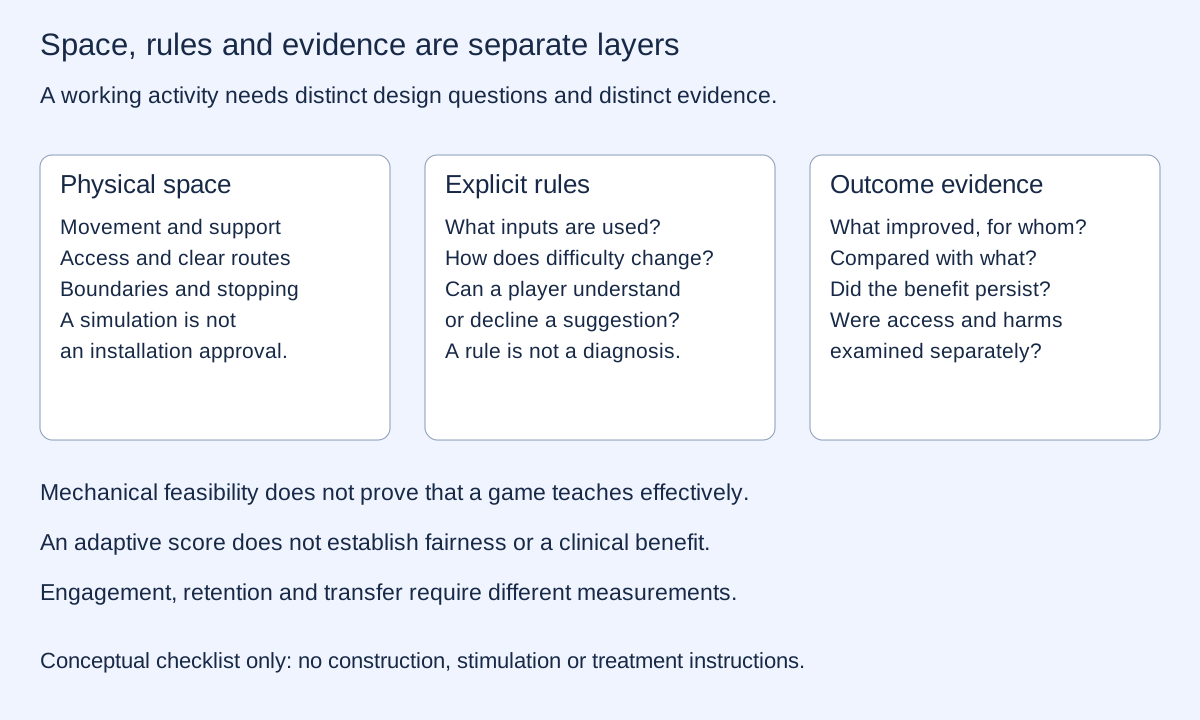
Before calling a game adaptive, specify its goal, available actions, observations and rule for changing difficulty. A missing gameplay description cannot be reconstructed from claims of motor, reasoning or social benefits. Hidden strategy and unequal information do not by themselves make a game fair or effective.
A proposed space with moving or floating obstacles also lacks essential geometry, support and failure details. Its missing image prevents verification of the layout. A software demonstration does not make that physical design feasible or suitable for participants.
Combining movement with thinking is a design aim, not proof of whole-person improvement. Improvement on a practised task is different from broad transfer. Neither “chess always improves other skills” nor “chess can never help them” is justified by the material here. No preventive, therapeutic or individualized physiological benefit is established.
A probability needs a defined event: probability of what, for whom, over which period? A learning response cannot establish moral character or social worth. Conditioning claims do not validate an entire education system.
An audiovisual tutor, a claim about maturation, a central record system and a compatibility score are different proposals. A functional diagram connecting terminals and memory does not specify an implemented architecture. Consent, access, correction, deletion, retention and appeal still need explicit rules. A nominally optional recommendation linked to loss of assistance is not an unconstrained choice.
The base-twelve number 0.0084 equals approximately 0.00482253 in decimal. As a proportion it would be about 0.482253%; as an already-percent value it would be 0.00482253%. Neither interpretation identifies the event or denominator behind a cited set of 144 cases. Correct arithmetic cannot turn an undefined score into a validated probability.
An immature visual system does not imply an absence of colour or spatial perception. Development varies with age and context. The proposed multisensory environment lacks specified signal levels, timing, controls and responses to distress; it establishes no infant stimulation schedule, diagnostic profile or replacement for responsive human care. This chapter provides no exposure instructions or parenting prescription.
SOFTWARE STUDY · ENTIRELY SYNTHETIC DATA
If a model repeatedly says “70% chance”, outcomes near 70% within a comparable group would support calibration for that group. This does not show that the model distinguishes individuals well, explains causes or improves learning.
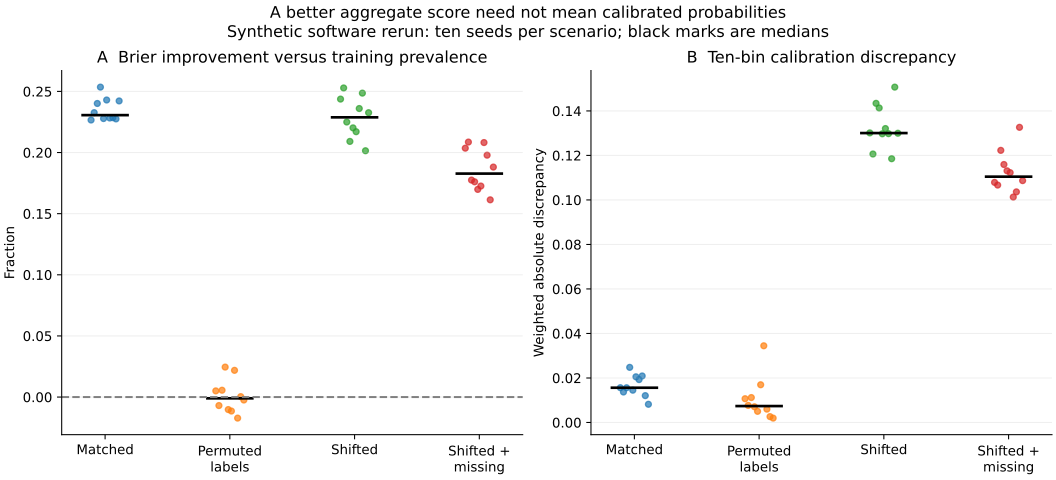
| Scenario | Brier improvement over baseline | Calibration discrepancy |
|---|---|---|
| Matching training and test conditions | 23.06% | 0.0156 |
| Shuffled training labels | −0.10% | 0.0074 |
| Changed test conditions | 22.88% | 0.1300 |
| Changed conditions and missing features | 18.28% | 0.1105 |
Read the counterexample: the shuffled-label control has a small calibration discrepancy yet no useful improvement over the constant baseline. A nearly constant forecast can be calibrated without distinguishing cases. Changed test conditions retain better average probability error than baseline while showing much larger calibration discrepancy.
Ten seeds each generate 5,000 training and 5,000 test rows with six normally distributed features. Binary outcomes follow a known logistic equation. The fitted logistic model deliberately matches that family, with slope penalty 0.01 and an unpenalized intercept. This is a favourable software test, not observations of learners.
Stress examples change feature means to 0.75, scale to 1.25 and the outcome intercept by −0.8. One version independently removes 15% of feature entries in both training and test data and replaces them with training-set feature means. Every constant baseline uses training prevalence and is evaluated on the corresponding test outcomes.
The Brier score averages squared differences between probability and binary outcome. Improvement is 1 minus candidate Brier score divided by baseline Brier score. Calibration discrepancy is the weighted absolute gap between mean prediction and outcome frequency in ten equal-width bins. It depends on binning and sample size; it does not prove calibration everywhere.
The matching case passed its predefined software checks: all ten seeds improved on baseline, median improvement exceeded 5%, and median discrepancy was at most 0.05. Shifted cases are descriptive stress examples, not newly passed gates. Reproduction matches 180 stored numeric comparisons; this does not validate fairness, partner compatibility, clinical use or educational benefit.
All 40 seed/scenario rows · Four summaries · Reproduction script · Numeric baseline · Methods and limitations · Numeric checks
Today: a teacher can distinguish solving an exercise with help from remembering the method later. A software team can check whether probabilities remain meaningful when its data changes. These are different evaluations, with different evidence.
Possible next step: a transparent learning dashboard could explain why it suggests an activity, let a learner change or decline it, and evaluate delayed understanding rather than clicks alone. Comparisons across the intended learners would be needed to establish its benefit. A pleasant activity, a calibrated score and improved learning remain separate achievements.
A reported waking routine does not establish a claim of neural injury from an alarm. The proposal supplies no comparative physiological measurements for that claim. It is therefore left unvalidated here, rather than turned into advice about how to wake.
Grouping learners by an assessed aptitude and assigning the same training duration does not establish that they need or benefit from the same instruction. The assessment, grouping rule and learning outcomes would need to be evaluated separately. No comparative outcome evidence for this proposal is supplied here.
A claim that laboratory testing occurred needs the methods and results that would let others assess it. None is supplied for the proposed game's claimed benefits. A change during play also does not establish an inherited genetic effect or show that social planning could eliminate mental disorders. The further claim that childhood difficulties make later recovery impossible is unsupported here and should not be treated as advice about a person's future.
In classical conditioning, an initially neutral cue can acquire a response through association. The response to that learned cue is called conditioned; a response that does not depend on that learning is called unconditioned. For example, salivation to food and salivation to a previously learned food cue have different roles in the explanation. This distinction does not show that every aspect of thought, learning or personality reduces to conditioned responses. Historical primary account: Pavlov’s Nobel lecture (1904).