Imagine this
DNA is information passed from parents to children. A song is learned and taught to someone else. These are different ways for information to continue.
THE FIELD GUIDE / 043 · INHERITANCE AND EVOLUTION
Both carry information across generations, through different routes. Understanding the route helps us distinguish a genetic finding, an acquired skill and an unsupported claim about inherited memories.
Explore a simple transmission rule ↓DNA is information passed from parents to children. A song is learned and taught to someone else. These are different ways for information to continue.
Inheritance and evolution models help explain how traits and learned information can spread in different ways.
The page distinguishes established mechanisms from an extra-memory claim that remains unverified; no mechanism is established by a precise-looking forecast.
Read-aloud starter; not yet tested with children. The fuller science, data, figures and sources follow below.
DNA sequence inheritance passes genetic variants between generations. Genes influence development; they do not contain a recording of everything a parent learned. Learning depends on experience, teaching and surroundings. Gene–culture interactions can connect these processes without making them the same process.
Epigenetic regulation involves changes associated with gene activity without changing the underlying DNA sequence. Some effects can persist under particular conditions; many are reset or depend on continued exposure. A resemblance across generations may reflect shared environment, learning or direct exposure, rather than inherited regulation.
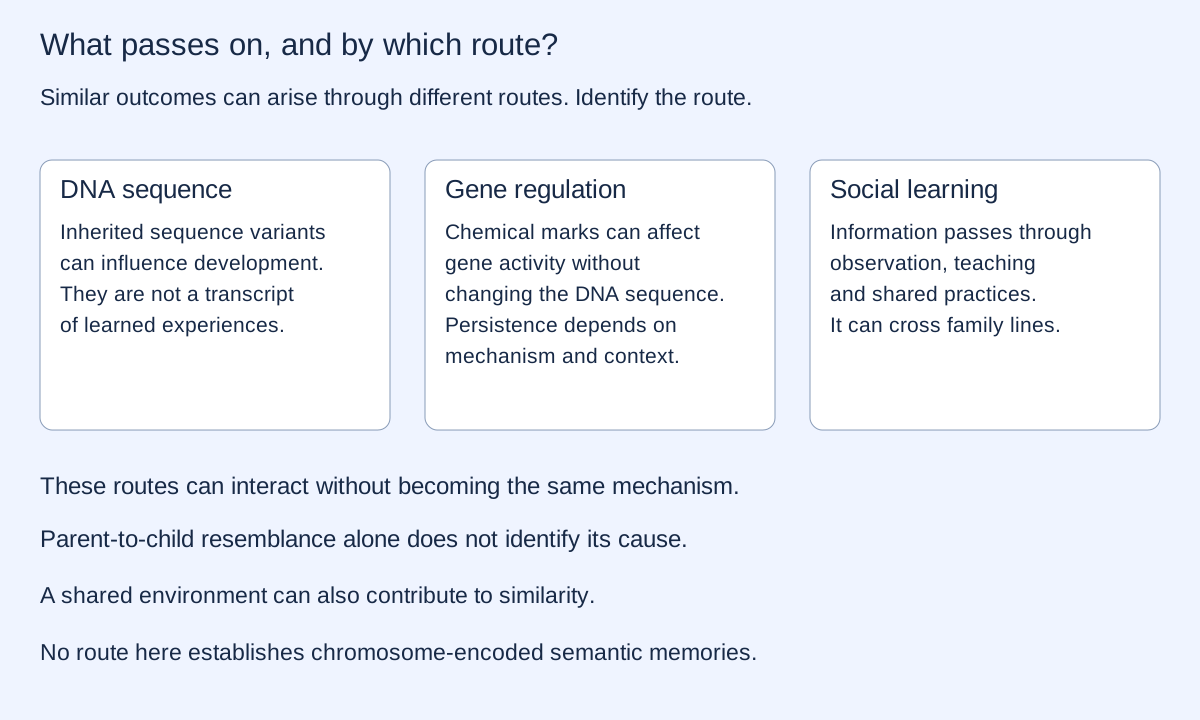
NHGRI explains epigenetics. Heard and Martienssen's review discusses limits of transgenerational epigenetic interpretation; Whitehead and colleagues review gene–culture interactions. These are scientific frameworks, not evidence that parental vocabulary is stored in a child's sex chromosomes.
A newborn reflex does not demonstrate inherited cultural memories. Nor does acquired aggression automatically become genetically encoded in descendants. Shared behaviour alone cannot separate inheritance, environment and learning; it supplies no basis for ranking families or predicting someone's character.
ABSTRACT TOKEN MODEL · NO ORGANISMS OR PERSONAL TRAITS
Each box contains two labeled positions. Draw one position from each box with equal probability, independently. Combine their labels. A and a are simply two labels; neither means better, dominant or harmful.
The four equally likely position combinations are:
For Aa with Aa, the exact probabilities are 25%, 50% and 25%. A probability is not a promise that every four draws contain exactly one AA, two Aa and one aa.
If the left and right A-token fractions are u and v, P(AA)=uv, P(Aa)=u(1−v)+(1−u)v and P(aa)=(1−u)(1−v). For n independent repetitions with fixed p=P(AA), the probability of exactly k AA outcomes is C(n,k)pᵏ(1−p)ⁿ⁻ᵏ. Here C(n,k) counts the ways to place k successes among n repetitions. The expected count is np.
This is an abstract illustration of simple one-locus segregation assumptions. An allele is a version of a DNA sequence at a genomic location. Real inheritance includes mechanisms not represented here. There is no phenotype, dominance, linkage, mutation, selection, development, environmental effect or population trajectory. This is neither a whole-evolution model nor a prediction about people or learned knowledge.
Mutation changes genetic sequence and supplies new variation. Inheritance transmits variants. Selection changes their representation when they contribute differently to reproduction in a particular setting. Genetic drift changes variant frequencies through chance. Movement between populations can also carry variants.
A variant can be favoured in one setting and not another. Mutation can be biased and biological stress responses exist; that does not establish that mutations foresee a future need. Selection is not moral worth or a compulsory march toward greater complexity.
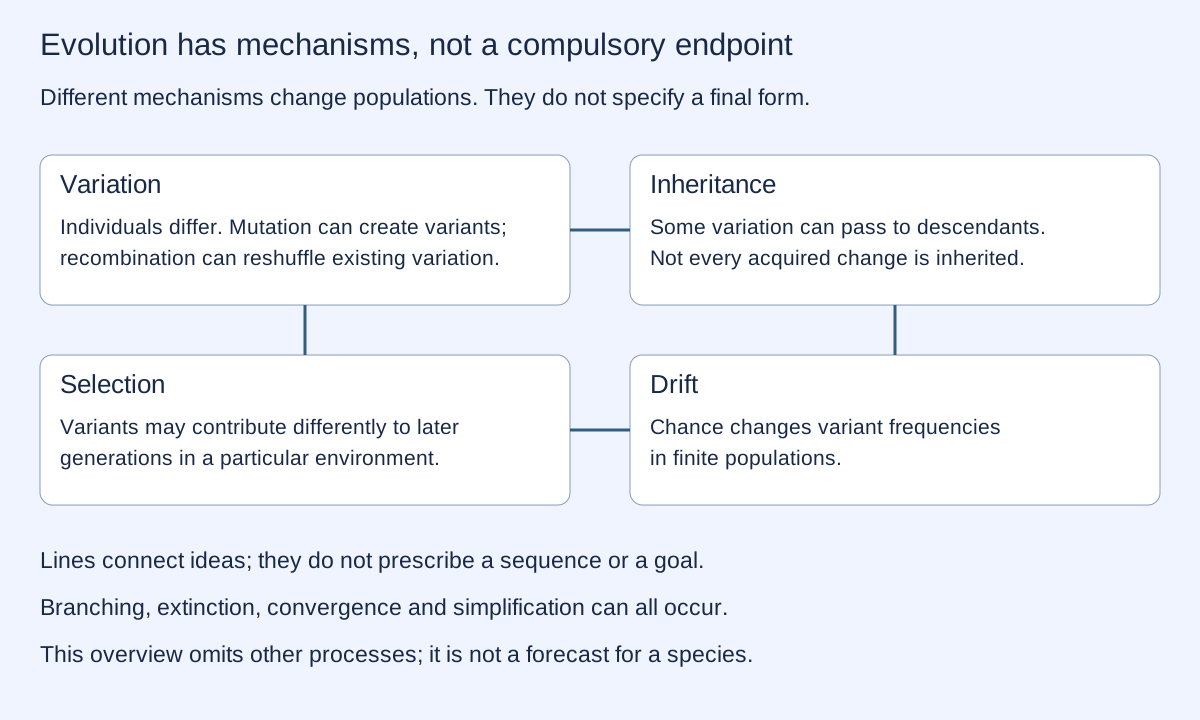
NHGRI explains genetic drift. The token exercise above isolates transmission and finite sampling; it does not simulate these mechanisms together. Evolution can involve branching, extinction, convergence and simplification. A branching drawing is not a measured evolutionary tree.
One hypothesis proposes an additional information-storage mechanism associated with chromosomes, predetermined body plans and, in one version, a collective memory that directs useful mutations. No measured pathway links experience to a targeted genetic change. Repeating a claim does not provide independent evidence.
What remains unverified: No measured binding site, identified electronic states, storage capacity, retrieval result or independent validation establishes this mechanism. A related memory hypothesis is a separate claim and supplies no additional evidence.
| Claim | What remains undefined or unsupported |
|---|---|
| A proposed paired atomic storage mechanism, with unresolved counts | Measured location, binding, electronic states, information storage and retrieval. Detecting an element would not establish chromosome binding or a memory. |
| A 21 cm astronomical hydrogen signal supplies information | Cellular reception, coupling, storage and genetic action. A real astronomical signal does not demonstrate any of these links. |
| Huge branch counts encode possible forms | Defined counting units, sample, equations and independent checks. Large claimed numbers are not verified combinatorics or measured phylogenies. |
| Universal biological endpoints | Claims of identical simple organisms everywhere, one final body form, millions of predetermined human forms, inevitable larger brains or rare simplification lack a defined sample and predictive model. |
DNA, RNA and proteins have established roles; not all RNA encodes protein. Those facts do not support an additional atomic storage mechanism. Previously proposed analytical comparisons were not executed, so there are no new assay results to present here.
| Quantity | Question it addresses |
|---|---|
| Resistance | How susceptible is an organism to a specified antimicrobial? |
| Virulence | How much harm does it cause in a defined host and setting? |
| Transmissibility | How readily does it spread under stated conditions? |
| Fitness | How successfully does a variant contribute to reproduction in this environment? |
The relationships depend on the organism, mechanism, host and environment. None is a universal substitute for the others. WHO distinguishes antimicrobial resistance and antimicrobial classes. Antibiotics do not treat viral infections; antivirals are a different class within the broader antimicrobial category.
A historical forecast in the project gives 72% over about 180 years ±10%, comparing future virulence with a pre-antibiotic reference. It does not demonstrate a cycle of virulence first disappearing and then returning. Its species list, denominator, measured endpoint, reference period, model and forecast validation are missing. The nominal ±18 years is arithmetic, not a confidence interval.
A fragmentary source and unrelated instrument mentions cannot supply those missing definitions. This is an unvalidated claim, not a current forecast or treatment recommendation.
What remains unverified: A claim of 72% longer average lifespan (roughly 180 years) lacks the definitions, model, data and validation needed to evaluate it. It should not be treated as a forecast or treatment recommendation.
Today: they help readers interpret genetic findings, family resemblance and microbial-surveillance reports. They prevent a population probability from becoming a personal prediction and a resistance statistic from becoming a claim about every kind of harm.
Possible next step: an evidence map could connect each evolutionary claim to its transmission route, observations and uncertainty. Its value would be clearer comparison of explanations, conditional on reliable data—not prediction of a person's character or a medical decision.
EXACT PROBABILITIES · REPRODUCIBLE STUDY
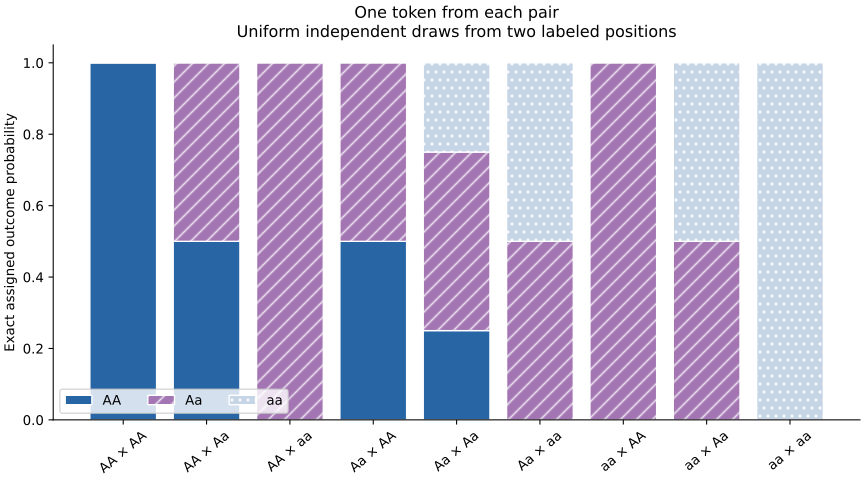
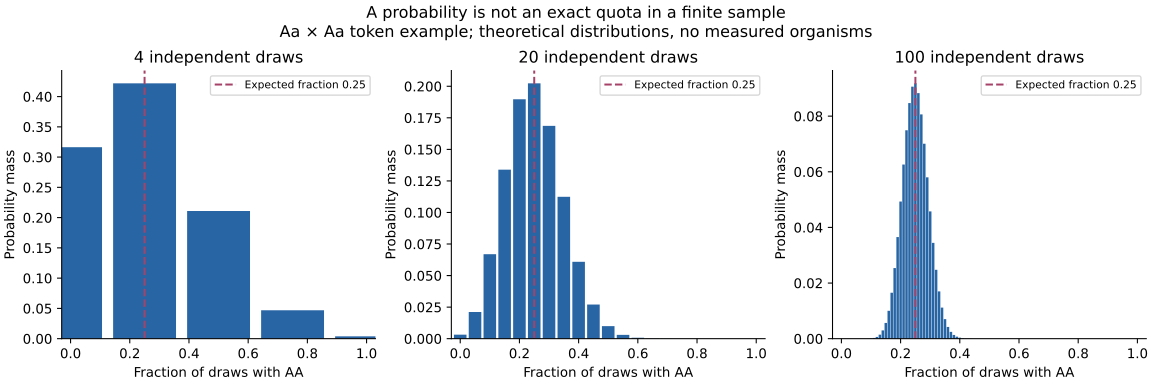
Nine exact cross rows and 1,143 sampling rows: 1,152 exported rows. All nine pair combinations are evaluated at 4, 20 and 100 independent repetitions. For the four-repetition example, an independent enumeration of 256 equally likely sequences checks the binomial calculation.
Pair probabilities CSV · Finite-sample probabilities CSV · Standalone reproduction script · Methods and limits · Parameters and runtime · Checks
Run with Python, NumPy and Matplotlib. Checks include reversal symmetry, normalization, means and variances of all 27 distributions, independent small-case enumeration and invalid inputs. Mathematical agreement validates this construction, not an empirical biological forecast. No organisms or human traits were measured.
The number of species in a place reflects their origins, arrivals and losses over time. It cannot be read directly from one proposed source of mutation. A claim that atmospheric shielding caused low biodiversity needs comparative observations and consideration of other explanations; no such evidence is supplied here. Primary island-colonization research and a fossil-based study of regional diversification illustrate why species gains, losses and environmental history need separate examination.
The descriptions alternate between 86 pairs and 86 atoms. Later static and dynamic roles may explain some counts, but do not settle every earlier statement. None is supported here by a measured location, reliable state readout or demonstrated memory.
A change in an individual's colour, a signal in its nervous system, a change in cell chemistry and an inherited change in descendants are different observations. Naming a chain between them does not demonstrate each transfer. The proposed pathway supplies no measured links from sensory input through cellular changes to an inherited outcome. It should not be treated as established epigenetic memory or as a recording of learned ideas.

READING RESEARCH / FOUR DIFFERENT EVIDENCE QUESTIONS
The very simple version: Imagine copying a book. Checking a page can tell you whether its letters match. It does not tell you whether every page is there, what all the words mean, or what happens when somebody uses the information. DNA evidence has different questions too. A living system is much more complicated than a book.
DNA sequencing reads the order of bases. A result needs a defined scope: which material was examined, what was compared, and what remains uncertain. A digital sequence or genome assembly is a representation of information; it is not, by itself, evidence that a physical genome was synthesized.
The four questions below are not a manufacturing sequence or a progress score. Evidence addressing one does not automatically answer the others. Open each question to see its limits.
Simple: Does this checked passage match the stated reference?
Scientific: A comparison can support agreement over the region actually examined, subject to coverage and uncertainty. Agreement alone does not establish all genomic material, biological function or an organism-level outcome. A reference match also is not a claim that the reference represents every individual.
Simple: Are the expected pages present, and is their arrangement supported?
Scientific: An assembly claim concerns the scope, continuity and arrangement of a sequence representation. Remaining gaps and excluded regions matter. Completeness within a stated scope is different from knowing every part's function or physically constructing the represented material.
Simple: What evidence shows what this part does?
Scientific: Distinguish a computational prediction, an annotation linked to evidence, and a direct functional observation. Interpret each in its biological context. An annotation does not automatically establish the same effect in every setting or the outcome of a whole organism.
Simple: What happened, and under which conditions?
Scientific: Observable traits reflect genetic and environmental influences. A stated organism-level result needs evidence about that result and its conditions. Neither a sequence description nor a narrow functional observation guarantees an outcome for other individuals or environments.

The 2022 T2T-CHM13 paper reported a gapless human genome assembly for all chromosomes except Y. It also described newly identified genes as predictions. Those are different kinds of statements: the assembly has a stated scope, and gene predictions require their own supporting evidence. This particular reference is not every person's genome, and the assembly result does not describe the construction or development of an organism.
Nurk et al., The complete sequence of a human genome (2022), Science, DOI 10.1126/science.abj6987. This is a historical example with its own scope, not a claim that no later reference has addressed other regions.
Clear evidence labels help readers interpret genome headlines, distinguish observations from predictions, and ask what a research claim actually measured. Better communication can help researchers and the public discuss promising work without turning limited evidence into a universal promise.
The record provides no sequence identity, length, verification record or demonstrated complete-genome result. The sequence claim, broader genome claim and hypothetical organism outcome therefore remain separate unresolved assertions. This lesson does not establish their feasibility or propose a construction procedure.
Evidence diagram · PDF · Evidence questions · CSV · Reproduce the diagram · Python · Scope and sources · JSON
Primary and official reading: NHGRI: DNA sequencing; NHGRI: Human Genome Project and assembly gaps; NCBI: curated functional elements and their evidence; NHGRI: phenotype. The four-question framework is our explanatory synthesis, not a universal certification standard.
Read the unresolved sequence-synthesis record. Evidence status remains insufficient information. No biological sequences, experiment instructions or individual medical interpretation are supplied.