Imagine this
Some dirt and germs are too small to see. A smell cannot tell us whether air is safe. We need the right test for the problem we want to solve.
THE FIELD GUIDE / 040 · FOOD AND ENVIRONMENTAL HYGIENE
A surface can look clean while an important contaminant remains. A food can look unchanged while its storage life has changed. To judge a treatment, first name the result it is meant to achieve—and how that result will be measured.
Explore an air balance ↓Some dirt and germs are too small to see. A smell cannot tell us whether air is safe. We need the right test for the problem we want to solve.
The page helps distinguish heat exposure, air replacement, collection and preservation as separate questions. A method for one food or room needs its own safety test.
A hot surface is not proof of a validated treatment; smell is not an air-quality measure. No universal process is established.
Read-aloud starter; not yet tested with children. The fuller science, data, figures and sources follow below.
THE SIMPLE VERSION · NO BACKGROUND NEEDED
Your eyes can spot crumbs. They cannot reliably show whether tiny microbes are still there. How long food keeps its quality and whether it stays safe are also different questions. To know whether something worked, decide what you want it to do and measure that result.
Cleaning, reducing certain microbes, removing every form of microbial life and keeping food usable are different goals. They are not a ladder that every product climbs.
Being precise about the goal helps people compare claims about rooms, care tools and food storage with the right kind of evidence.
SAME WORD, DIFFERENT JOB
The heat study below follows temperature, not microbes. By itself, it cannot establish microbial safety or treatment effectiveness: the coldest spot, exposure time, material and target all matter. For the formal definitions, see the CDC overview. Then continue to the air model, heat study and food evidence questions.
Cleaning removes unwanted material. Disinfection addresses many disease-causing microorganisms under specified conditions, but does not necessarily eliminate every microbial form. Sterilization is the stronger claim of eliminating all forms of microbial life. None is established by appearance alone. CDC explains the distinctions.
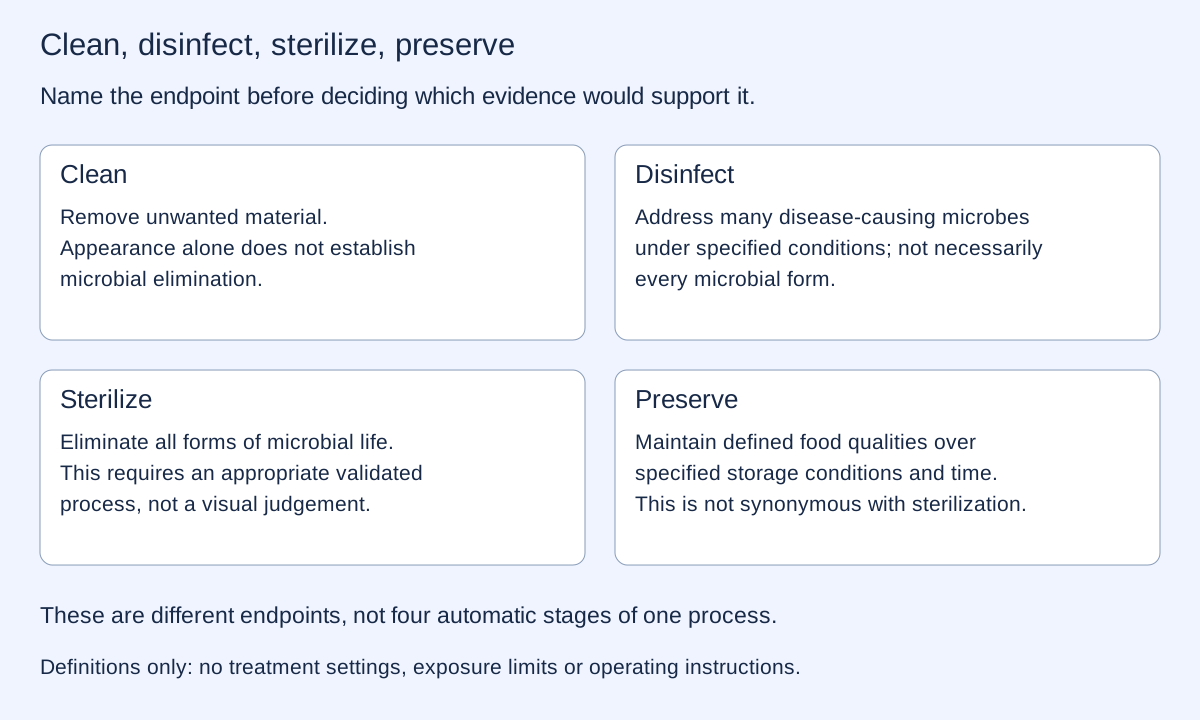
Preservation asks how a food retains acceptable qualities during a defined period and storage environment. Cooling, packaging and irradiation act in different ways. A barrier may limit moisture loss without reducing an existing microbial population.
FICTIONAL NONREACTIVE TRACER · PERFECTLY MIXED ROOM
Imagine a fixed-volume room containing a fictional tracer. Its source has stopped. Incoming air contains none of it, and the room mixes instantly. Change the exchange rate to see the fraction remaining after a selected time. This is dilution arithmetic, not a model of a specific pollutant or microorganism.
Let a = Q/V, where Q is fresh-air volume flow and V is room volume in consistent units. For constant coefficients, dC/dt = −aC and C/C₀ = exp(−at), with positive initial concentration C₀. Here a is in h⁻¹ and t is in hours. Recirculation without removing tracer does not count as fresh-air exchange.
The model omits continuing sources, imperfect mixing, adsorption, deposition, chemistry and exposure. With a nonzero incoming concentration, the solution would tend toward that background rather than zero. None of these outputs is an occupancy clearance, infection risk, air-cleaner specification or recommended exchange setting.
A substance released indoors can remain, leave with ventilation, settle or react into other substances. Removing one measured substance does not establish that the resulting mixture is harmless.
Ozone is reactive, and reactions with indoor substances can create unwanted by-products. Reactivity is not evidence of a health benefit in an occupied room. EPA discusses the limits of ozone air-cleaning claims. The tracer model above contains no ozone chemistry and proposes no generation or exposure.
A collection system moves material into a controlled place. Openings, seals, storage and the route for removal all affect whether it stays contained. A leak moves material across the wrong boundary; it does not make it disappear.
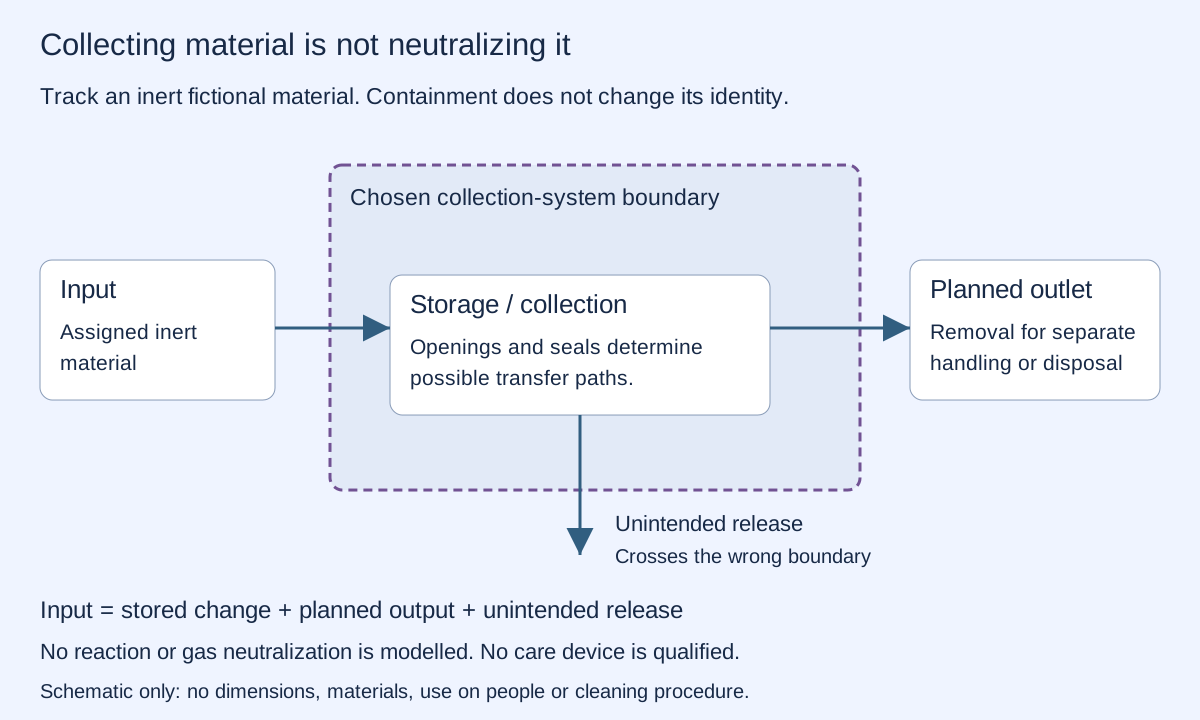
For an inert material with no reaction or untracked source, starting inventory plus input equals ending inventory plus planned removal plus unintended release. This balance can expose missing material, but cannot establish microbial inactivity or chemical harmlessness. Calling an output a gas does not establish neutralization.
A real care product also needs evidence about contact materials, cleaning, reliability, disposal and its intended users. No collector, conversion process or infant-care device has been tested in this chapter. A qualitative diagram is used because assigning a leakage percentage to an unspecified device would invent performance.
NORMALIZED FIRST-ORDER RESPONSE · ARBITRARY TIME UNITS
Consider an assigned first-order thermal response to a fixed, nonzero boundary-temperature step. The response starts at zero and approaches one—the full imposed step. A larger time constant makes the response slower. These are independent mathematical examples, not different locations in a resolved object.
θ = (T−T₀)/(Tboundary−T₀) = 1−exp(−t/τ), with a nonzero constant temperature step. The corresponding equation is dθ/dt = (1−θ)/τ. Both time t and time constant τ use the same arbitrary units. At t = τ the response is about 0.6321. Readouts are rounded; a displayed 1.0000 does not mean the asymptote is reached at a finite time. No temperature, material or treatment cycle is specified.
The curves contain no microbial survival law, exposure threshold or required holding time. They do not predict a cold point or prove that a joint, recess or shielded part reaches a particular temperature. An actual spatial heat model would need geometry, material properties and boundary conditions.
The visible surface may have a different temperature history from a joint or an interior region. A glowing colour cannot supply that missing history, measure residual contamination or establish material compatibility.
A treatment claim needs measurements at relevant locations and evidence for the target, material and conditions. A historical NASA thermal-process research record illustrates that process parameters require investigation; it is not validation of an unspecified glowing-surface treatment or current operating guidance.
Heating can release adsorbed gases or enable oxidation of specified residues. Oxygen is generally the oxidant, not a combustible substance being “burned away.” Without a defined reaction, no claim about removing oxygen or neutralizing residue follows.
FDA describes conventional food irradiation, including gamma rays, X-rays and electron beams. These established categories do not validate an unspecified neutron treatment. The food, radiation source, absorbed dose, packaging and later storage conditions all matter.
Absorbed dose is deposited energy per unit mass: one gray is one joule per kilogram. This unit definition is not a selected treatment dose, shelf-life result or proof that every hazard was removed.
| Question | Relevant evidence | What does not follow automatically |
|---|---|---|
| Was a particular microbial population reduced? | Measurements for that target and process | Removal of every toxin or unlimited storage |
| Was food quality retained? | Product-specific composition and sensory assessment | A microbial safety result |
| Did packaging preserve a barrier? | Integrity and transmission under stated conditions | Removal of contamination already inside |
| How long can the product be stored? | Evidence over stated time and storage conditions | The same lifetime for every food or environment |
No source-specific food specimen, dose, microbial result or storage trial is available for the proposal. A comparison table is used instead of invented survival or shelf-life curves. No months-long unrefrigerated-storage claim is established here.
Today: these distinctions help interpret air-cleaning advertising, examine collection boundaries and read preservation studies. They prevent a successful physical calculation from being mistaken for a successful hygiene test.
Future improvement: compare defined designs using calibrated measurements, representative materials, explicit residual/by-product accounting and independent checks of the claimed outcome. None of the models here is a sanitation recipe or a successful-treatment certificate.
ASSIGNED MODELS · REPRODUCIBLE DATA
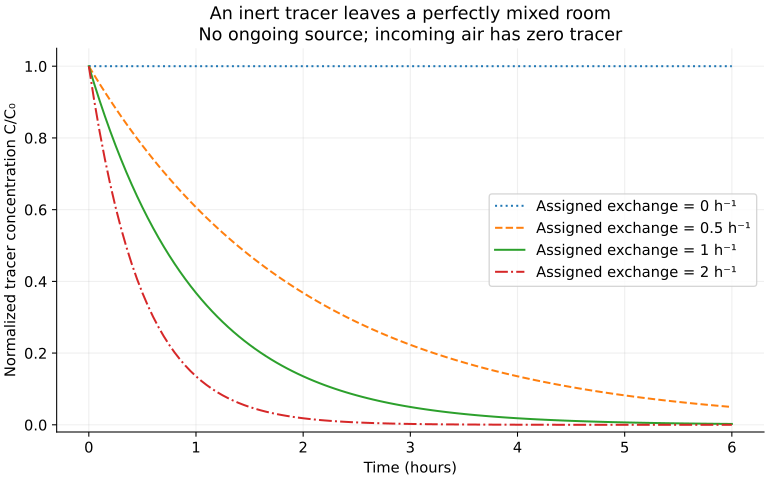
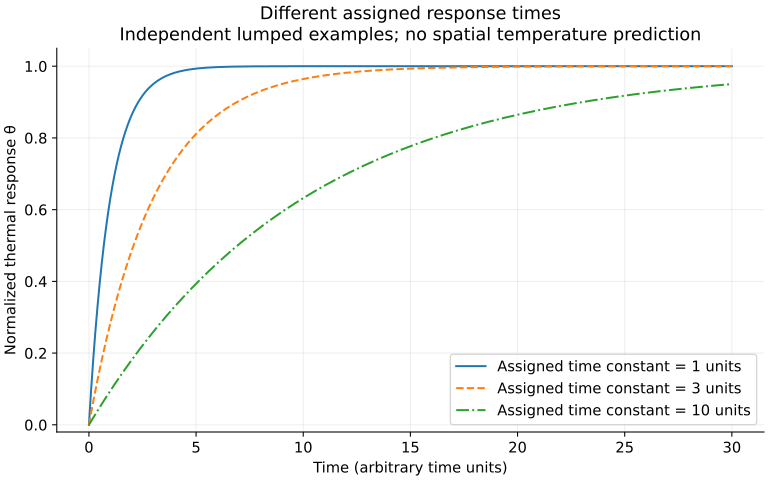
4,654 calculation rows: 3,751 tracer cases and 903 thermal cases. The thermal study uses three time constants; the interactive explores additional values under the same equation.
Tracer CSV · Thermal CSV · Standalone reproduction script · Methods and limits · Runtime and parameters · Execution checks
Run with Python, NumPy and Matplotlib. Independent numerical integration uses successively smaller time steps and checks convergence toward the analytic curves. Additional checks cover initial values, bounds, monotonicity and zero exchange. These are mathematical checks, not microbial experiments or proof of treatment efficacy.