Imagine this
Two things can happen together even when one did not cause the other. A story can give us a clue. Then we need a fair test to see what else could explain it.
THE FIELD GUIDE / 041 · RESEARCH METHODS
A convincing explanation, a repeatable measurement and a useful decision are different achievements. Start by naming what would be observed, which other explanation could produce it, and what evidence would change your mind.
Explore a misleading association ↓Two things can happen together even when one did not cause the other. A story can give us a clue. Then we need a fair test to see what else could explain it.
Clear outcomes and fair comparisons help people judge biological studies without confusing comfort, health and cause.
These are methods and bounded examples, not personal medical guidance; individual claims need appropriate evidence and measures.
Read-aloud starter; not yet tested with children. The fuller science, data, figures and sources follow below.
A hypothesis is an explanation to check. A comparison helps assess alternatives. Repeatability asks whether a measurement stays consistent under the stated conditions; validity asks whether it supports its intended interpretation or use. A repeatable result can still answer the wrong question.
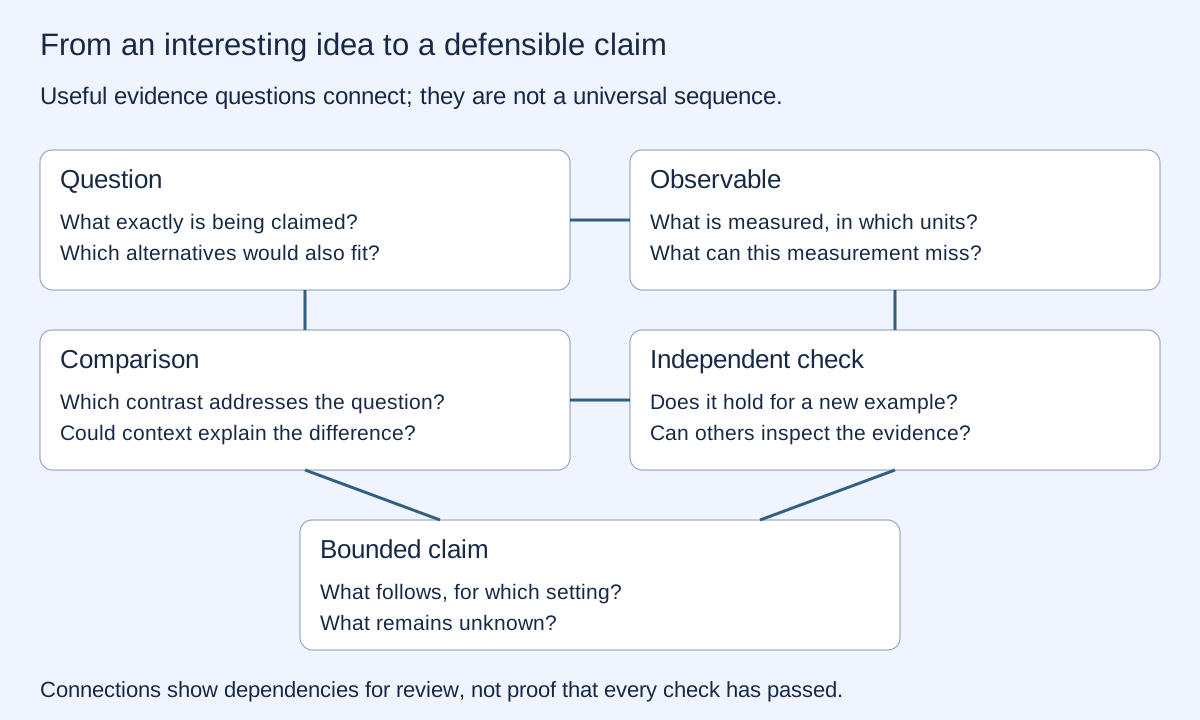
NIST's experimental-design guidance starts from objectives and relevant factors. The aim is not to collect reassuring numbers, but to choose evidence that can distinguish explanations.
A duration is meaningful only after the event, system and conditions are defined. Is the event one molecular step, the copying of a DNA region or a change in a whole cell? NHGRI describes DNA replication as a process involving molecular machinery, not a universal “gene formation” stopwatch.
A historical numerical claim in the project was transcribed as 6.58102 × 12−10 seconds (approximately 1.06287 × 10⁻¹⁰ seconds). It has no operationally defined event or measurement record here. Matching it to a conveniently selected molecular timescale would not validate it. This missing definition does not dismiss quantum chemistry; it prevents an undefined number from becoming a measured biological constant.
ASSIGNED POPULATION PROBABILITIES · NO OBSERVED SUBJECTS
Suppose two binary findings, A and B, are both more common in context 1 than context 0. Within each context they occur independently. Mixing those contexts creates an overall association even though this model contains no direct effect of A on B.
Probability of B among those with A
Probability of B among those without A
| Context | P(B | A, context) | P(B | not A, context) |
|---|---|---|
| 0 | 20% | 20% |
| 1 | 80% | 80% |
These conditional rules stay fixed as the mixture changes. At an endpoint, one context is absent from the mixed population; its row describes the assigned model, not observations from that absent group.
Let q = P(context 1). In context 0, P(A)=P(B)=0.2; in context 1 both are 0.8. Conditional independence gives P(A and B)=(1−q)0.04+q0.64; P(A and not B)=P(not A and B)=0.16; P(neither)=(1−q)0.64+q0.04. Both marginal probabilities are 0.2+0.6q. The covariance is 0.36q(1−q).
Here “given A” means looking only at the portion with A. These are exact probabilities in an assigned population, not a finite sample, a confidence interval or a medical dataset. There is no direct A→B link because that is how the model was constructed, not because observational adjustment can prove its absence in general.
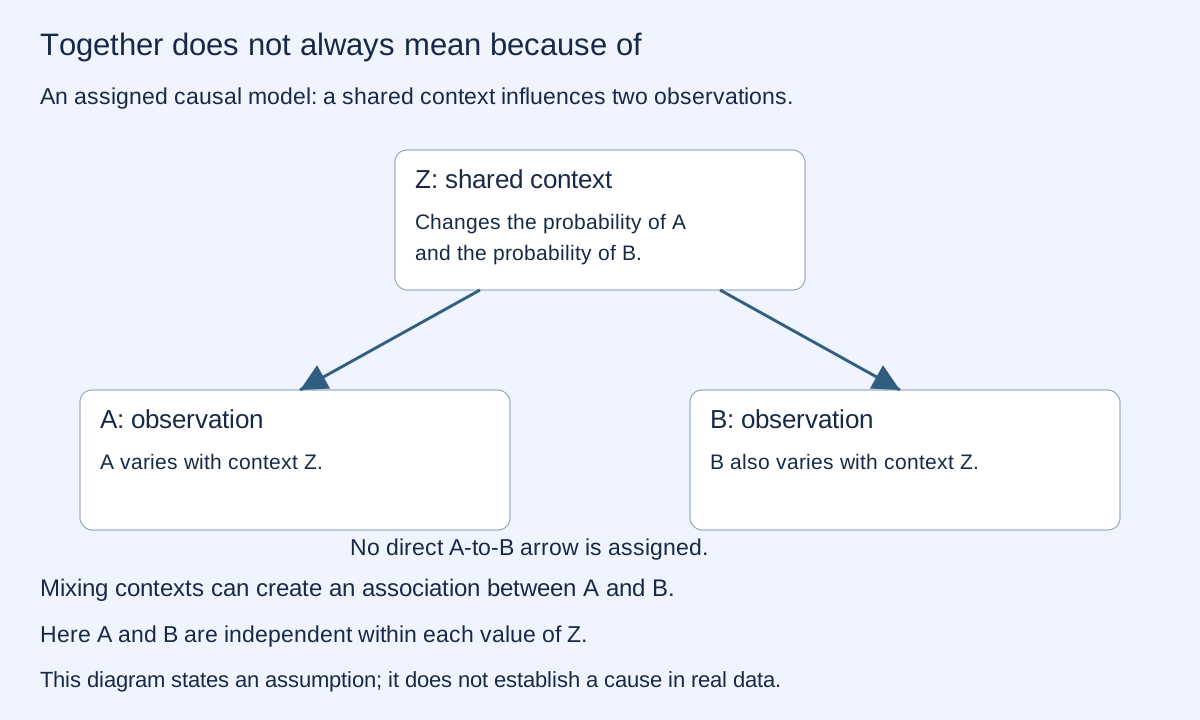
In a real study, environment, selection or measurement could create similar patterns. Stratifying controls only the context represented here; unknown influences may remain. Co-occurrence, two findings in the same subject and direct biological interaction are different hypotheses. No samples, strains or mechanism establish the proposed organism association in this project.
A calm setting, subjective comfort and a clinical digestive outcome are not interchangeable. NIDDK discusses brain–gut interactions among several factors in a particular clinical context. That relationship does not establish that a specific pre-meal ritual is universally necessary or therapeutic.
The proposal provides no population, comparison, biomarker or effect estimate. A useful claim would define the outcome and consider alternative explanations. This example offers no diet prescription or personal experiment.
A test might predict a narrow task and still say little about another role. Repeatedly producing the same score establishes neither predictive validity nor fairness. Performance must be assessed against a relevant, independently defined criterion in the population and setting where the score would be used.
Physiological readings do not establish political competence, moral worth or legitimacy. Unexplained percentages lack denominators and criteria; a later cohort, mandatory screening or an opaque remuneration formula supplies no missing validation. This chapter does not rank people or optimize who should govern.
The 2018 SIOP principles concern validation for personnel selection. Their defined application is not evidence for a general biological ranking of people.
Sampling, question order, delivery and coding can affect a behavioral result. Two independent coders may interpret the same answer differently; agreement needs to be measured, not assumed.
The supplied compilation includes three stimulus illustrations, but their original provenance and presentation conditions remain unverified. The proposed association task supplies no comparative sample, coding rules or inter-rater results. It supports no conclusion about sex differences. Voice and distinctive responses can identify someone even without a name, so confidentiality and meaningful consent remain separate questions. HHS guidance describes informed consent; this link is context, not certification of a study.
INVENTED SYMBOL TASK · TWO PREDECLARED CANDIDATE RULES
In this deliberately invented task, the question is which colored token is the agent—the one doing the action. Rule 1 chooses the first token. Rule 2 chooses the token marked with an asterisk. Both fit the training example. Switch to a held-out example: an example not used to choose or fit the rules.
The answers were assigned when creating this toy task; they are not translations or discoveries. One held-out result distinguishes these two rules on this example. Many other rules could still fit both cases, so success does not establish an entire grammar.
WALS discusses how dominant word order is determined from appropriate linguistic evidence. Glossing conventions make an analysis visible but do not independently prove it. An uncertain segmentation and translation of a single sentence cannot establish a language's dominant order.
Separate four stages: what was measured, what an algorithm outputs, how that output is interpreted, and whether acting on it improves an outcome. Speed and a detailed anatomical display do not establish acquisition resolution, accuracy or an individual's physiological state.
The proposed instant neurological recommendation has no specified sensor chain, reference labels, training data, error estimates, latency measurement or outcome evidence. The IMDRF clinical-evaluation framework distinguishes clinical association, analytical validation and clinical validation. It does not certify this proposal. No diagnosis, exercise prescription or medical personalization is provided.
Today: these distinctions help readers check whether a headline matches what a study actually tested. They help teams separate a reliable measurement from a valid interpretation and an effective decision.
Possible development: an evidence notebook could connect claims to observables, alternatives, provenance and missing comparisons, helping reviewers find gaps before committing resources. Clinical use would additionally require appropriate evidence of benefits and harms in the intended setting. None of these seven proposals has demonstrated that outcome.
REPRODUCIBLE ASSIGNED PROBABILITIES
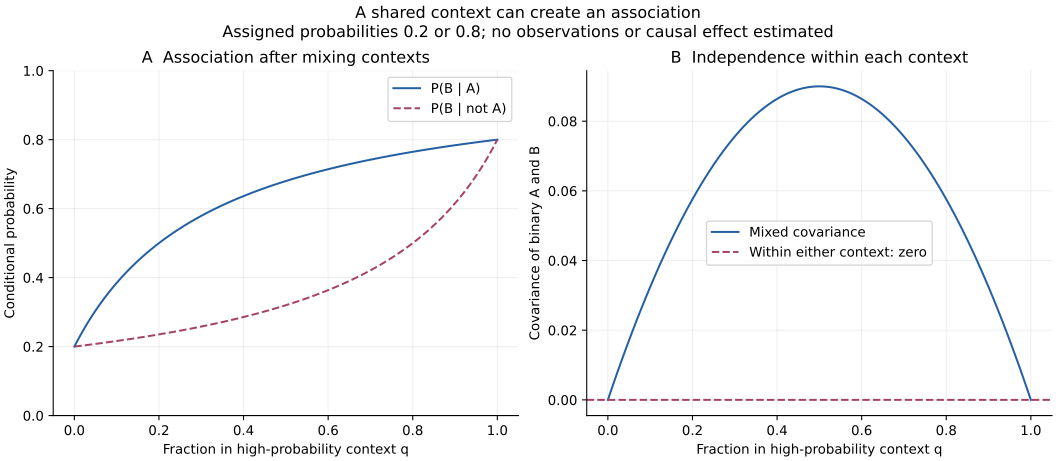
101 probability-table rows and two invented rule examples. The probability grid spans every slider value. Independent checks enumerate all eight possible context/A/B combinations, then compare the resulting joint cells, marginals, conditionals and covariance with the formulas.
Mixture probabilities CSV · Invented rules CSV · Standalone reproduction script · Methods and limits · Runtime and parameters · Execution checks
Run with Python, NumPy and Matplotlib. The script records its hash and runtime, checks normalization, bounds, within-context independence, endpoints and the midpoint, and computes the toy-rule predictions from their tokens. Numerical agreement verifies this construction; it does not validate a real biological mechanism.
The mixture is an educational construction, not an observed biological relationship. No participants, microbes or clinical interventions were used. Undefined biological clocks, personal scores and clinical recommendations are explained qualitatively because inventing numerical performance would supply evidence that does not exist.
A claim about when to eat the largest meal is separate from a claim about how to feel before eating. Calling a schedule “rational” does not establish that it matches energy needs or improves health. This proposal supplies no defined comparison, measured energy expenditure or outcome data for its timing rule.
Whether a language has articles, how it marks grammatical gender and which word order it uses are different questions. A few translated words cannot establish the whole system. Word endings alone also need not identify grammatical gender: agreement with other words can matter. WALS: definite articles and WALS: number of genders explain the criteria used in these linguistic comparisons.