Imagine this
A hand-crank light gets energy from the person turning its handle. A warm machine may need energy from somewhere else too. Count every source and where the energy goes.
THE FIELD GUIDE / 016 · ENERGY ACCOUNTING
A hand-crank light turns movement into electricity, light and warmth. First, let’s see where its energy starts.
Start with the simple version ↓A hand-crank light gets energy from the person turning its handle. A warm machine may need energy from somewhere else too. Count every source and where the energy goes.
Today, an energy budget helps people check claims about generators, heating and processes with several inputs. Clear budgets can help compare designs before building.
One number from one part cannot tell us where all the energy came from or where it went. This page shows how to count the whole path; it does not demonstrate a new energy source.
Read-aloud starter; not yet tested with children. The fuller science, data, figures and sources follow below.
THE SIMPLE VERSION · NO MATHS NEEDED
Imagine turning the handle on a little torch. Your body uses stored energy to turn it. Inside, a generator changes some of that movement into electricity. The electricity makes light, and some energy warms the torch.
The magnet helps the generator change movement into electricity. It is not the fuel: if nothing turns and no battery is storing energy, the torch cannot keep making light.
A battery can keep a light on after the handle stops because it stores energy for later. Heating food or a room also needs energy to come from somewhere and reach the thing being warmed.
Clear energy accounts can help people compare ways to provide reliable light and heat, or find where useful energy is being lost. They do not make a proposed machine work; its source, output, storage and losses still need to be measured.
Follow the same question through the models below:
A generator’s energy pathHow delivered power warms a sampleWhat enters a material balance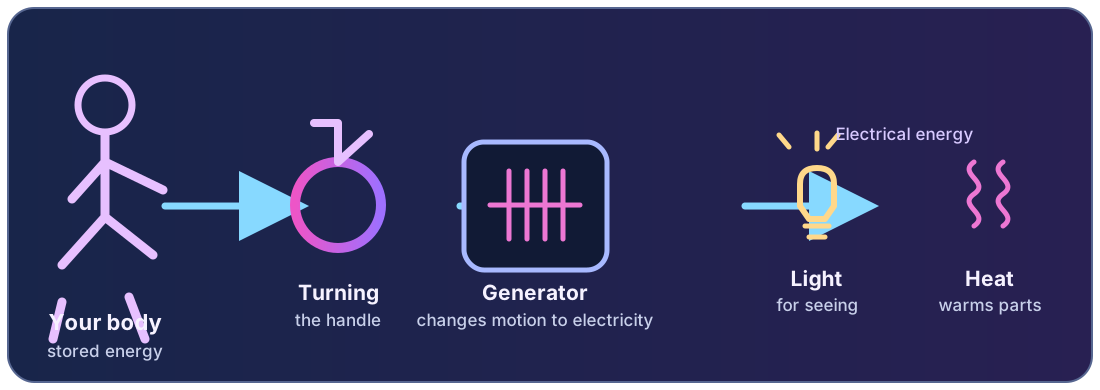
01 / CONVERSION NEEDS A DRIVE
Changing magnetic flux can produce a voltage. Delivering current to a load creates a mechanical reaction: the drive must supply energy. A magnet participates in conversion; it is not a continuing source of free output power. Open-circuit voltage alone is not delivered power.
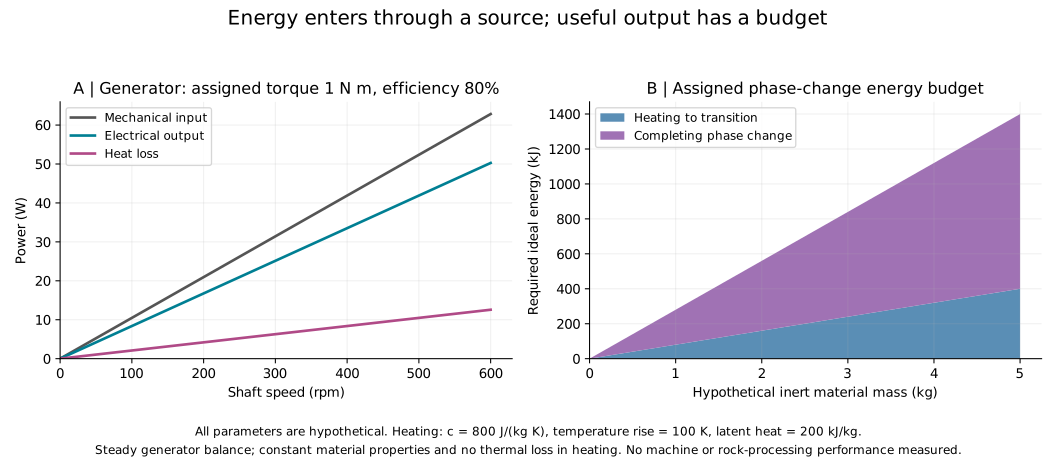
Prescribed torque: 1 N m. These are hypothetical magnitudes, not a measured machine map.
At 600 rpm and 80%, 62.832 W enters, 50.265 W leaves electrically and 12.566 W becomes assigned heat.
Angular speed ω=rpm×2π/60; mechanical power P=τω; output=ηP; heat=(1−η)P. Efficiency is held constant by assumption. Real torque, efficiency and losses depend on operation.
Startup, magnetic excitation and changing stored energy are not separately modelled. Rotation that does not change flux need not generate voltage. The slider is an accounting example, not a prediction of a particular installation.
02 / SIGNAL GAIN IS NOT ENERGY CREATION
A small signal controls a larger flow supplied by the power source. In steady accounting with all these ports included: supply power + signal power = load power + dissipated heat. During transients, stored energy can also change.
Voltage gain, power gain and efficiency are different quantities. Voltage gain alone cannot establish power gain without source and load information. Bandwidth, clipping, heat and supply limits bound useful operation; arbitrary output power does not follow from a gain number.
03 / ABSORBED POWER DOES THE HEATING
A heater needs a named energy source and a coupling that deposits energy in the target. Frequency alone gives neither absorbed power nor efficiency. During a phase change, energy can enter without temperature rising.
Assigned properties: 800 J/(kg K), initially 20 °C, sharp phase change at 120 °C, latent heat 200,000 J/kg. These are teaching values, not rock properties.
One kilogram requires 80 kJ of warming plus 200 kJ for phase change: 280 kJ. At 500 W absorbed, the ideal time is 560 seconds.
Q=m[c(Tm−T₀)+L]; time=Q/Pabsorbed. Constant heat capacity and a sharp transition are assigned. The endpoint is completed phase change; no later temperature trajectory is supplied. Zero mass needs zero energy. With positive required energy and zero power there is no finite completion time.
Wall-plug power and absorbed power are different. Container heating, losses, reactions, decomposition and cooling are excluded. This is an ideal requirement for these assumptions, not a universal bound for every possible process.
04 / MELTING DOES NOT MAKE MATERIAL DISAPPEAR
Real rock is a mixture that may soften, decompose or melt over a range. Excavation also needs transport of displaced material, gas handling, cooling, support and management of losses. No advance rate follows without geometry, density, power and those additional budgets.
Thermal melting changes phase. It is distinct from nuclear fusion and does not change chemical elements. The generic inert-sample calculation above demonstrates energy accounting; it does not validate a rock-melting machine.
For related heat-transfer questions, explore following the heat and responsive materials.
05 / PRESSURE NEEDS A VOLUME PATH
Compression can change volume and structure. Work depends on pressure throughout that volume change. For idealized boundary work, work supplied is −∫p_external dV; compression has negative dV. At constant external pressure, it becomes p(Vinitial−Vfinal), with Pa·m³=J.
A final pressure alone cannot determine the integral. A phase transition rearranges matter; it does not establish that all its mass becomes useful output. E=mc² relates energy and mass, but supplies neither a conversion mechanism nor a universal compression threshold.
A useful assessment asks for the pressure–volume path, heat transfers, initial/final state and the system boundary. No unsupported phase-boundary curve is invented here.
06 / ENERGY CANNOT REPLACE MISSING FEEDSTOCKS
Ordinary chemistry rearranges atoms. A carbohydrate containing carbon, hydrogen and oxygen needs sources of those elements; silicon and aluminium alone do not provide them through a chemical reaction.
Illustrative net bookkeeping: 6 CO₂ + 6 H₂O → C₆H₁₂O₆ + 6 O₂, with external energy. This is an overall balanced relation, not a reaction pathway or manufacturing recipe.
| Element | Input atoms | Output atoms |
|---|---|---|
| Carbon | 6 | 6 |
| Hydrogen | 12 | 12 |
| Oxygen | 18 | 18 |
Balancing establishes atom conservation, not kinetics, yield, process efficiency, purity, nutrition or edibility. A food-production claim also needs specified inputs, processing and safety evidence. This lesson offers no production protocol.
ORIGINAL ANALYTICAL STUDY
Open full-size figure · Generator CSV · Heating CSV · Methods · Reproduce study · Parameters and checks
The figure displays the 80% efficiency slice; CSV includes 0%, 50%, 80% and 100%. Heating energy is independent of power at the assigned endpoint; time additionally depends on absorbed power. Independent checks use work per revolution, incremental heating and conservation.
Measure torque and speed alongside electrical output. Include heater absorption and losses. Locate an amplifier's supply. Record a compression path. Balance atoms before evaluating a proposed feedstock. These questions make a claim testable without assuming it is already a working device.
Educational and manufacturer references support conventional principles. They do not validate unspecified project devices. No physical experiment is reported here.
Back to the field guide →The energy used to start a process is not necessarily its whole energy supply. If a reaction releases energy stored in its reactants, comparing the output only with the trigger can give a ratio above one. A complete budget must also include the reactants and all other energy transfers. That ratio alone establishes neither an efficient device nor energy creation.