Imagine this
A measuring cup has marks to show how much it holds. More marks can show smaller changes, but they do not make the cup perfect. A new kind of computer memory would need separate tests to show it can save and read answers.
THE FIELD GUIDE / 030 · COMPUTING AND MEMORY
A thermometer changes with temperature. A computer stores a number. Connecting the two means deciding which physical differences count as different values—and how to tell those values apart later.
Try the converter ↓A measuring cup has marks to show how much it holds. More marks can show smaller changes, but they do not make the cup perfect. A new kind of computer memory would need separate tests to show it can save and read answers.
The page explains how measurement systems turn analog signals into digital codes. A new physical memory idea would need repeatable write, read and error tests.
The conversion examples are models; a new memory mechanism is not established.
Read-aloud starter; not yet tested with children. The fuller science, data, figures and sources follow below.
Imagine a ruler divided into labelled intervals. Every position inside one interval receives the same label. An analog-to-digital converter does something similar: it assigns a finite digital code to a range of input signals.
More intervals make the representation finer. They do not remove noise, bias or calibration errors in the original measurement. Nor does a larger nominal bit count guarantee the same number of reliable bits in a real converter. Analog Devices explains ideal quantization and its assumptions.
IDEAL MIDPOINT CONVERTER · NORMALIZED SIGNAL
The input runs from 0 to 1 in arbitrary signal units. Each code stands for the midpoint of its interval. Move the input slowly: the code changes only when it crosses a boundary.
The dashed diagonal would reproduce the input exactly. The purple steps are the finite representation; the blue dot is your selected input. At 2 bits and input 0.600, code 2 represents 0.625: the error is +0.025.
At an internal boundary, the upper interval is selected. Input 1 uses the final interval. This model rejects inputs outside [0, 1]; it does not simulate overload or saturation. Quantization error here is deterministic, not an assumed random noise source. Real converter noise and other imperfections are omitted.
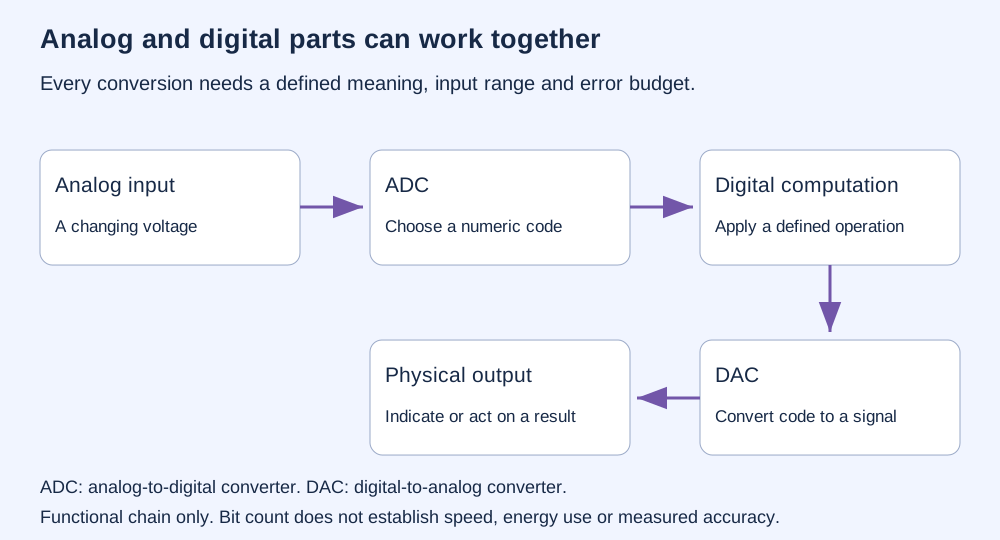
A system can measure an analog quantity, convert it into a number, calculate a response and turn the result back into a physical signal. A room controller, for example, reads a temperature and adjusts heating. The complete system matters: measurement, calculation and action each have limits. Some outputs switch discrete states rather than use a digital-to-analog converter.
“Average the last ten readings” must become a specific operation on ten identified values. Show that structured operation back to the user so a misunderstanding can be corrected. Interpreting the sentence, performing the arithmetic and displaying the result are different functions. A printed number, a graph and a spoken answer can all describe the same calculation; the output format does not prove the calculation correct.
SAME QUANTITY · DIFFERENT NOTATION
Changing a numeral base changes how we write a value. It does not, by itself, make the physical computer faster or more efficient.
In base twelve, we use A for ten and B for eleven. In hexadecimal, A through F represent ten through fifteen. Thus decimal 17 is 10001 in binary, 15 in base twelve and 11 in hexadecimal. These are exact integer representations, separate from the converter's rounding of a continuous input.
Information needs distinguishable physical states. A memory also needs a way to write a state, select its location (addressing), read it back and check whether it has changed over time (retention). Reusable storage needs a defined erase or reset procedure, with checks that neighbouring records are not changed.
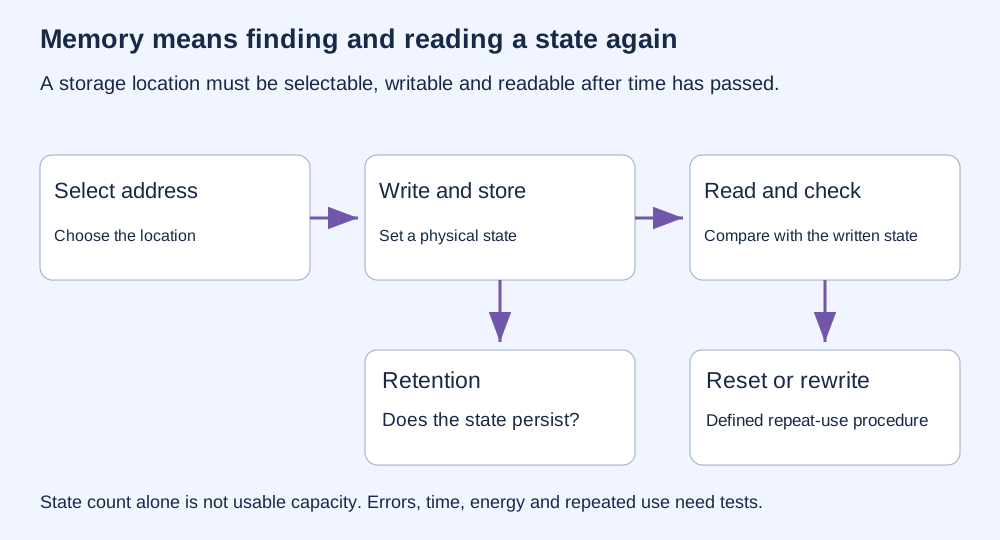
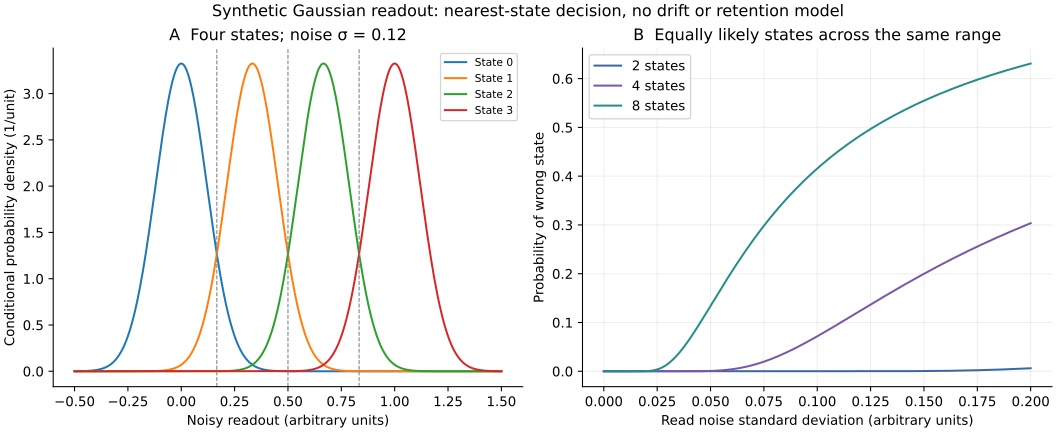
Two perfectly distinguishable states can represent one bit. Four can represent two bits; eight can represent three. But fitting more states into the same signal range reduces their separation. A noisy reading can then be mistaken for a neighbouring state. IBM research on multilevel phase-change memory concerns specific physical devices and drift challenges; our model below is a separate hypothetical example.
HYPOTHETICAL GAUSSIAN READ NOISE · NOT A DEVICE TEST
Keep the available range fixed from 0 to 1. Choose how many equally spaced states share it, then add read noise. The decoder chooses the nearest state. Every state is assumed equally likely.
The blue bar is a scale for noise spread, not a limit on possible noise. A Gaussian distribution has unbounded tails. Readings are not clipped to [0, 1]; the outer decision regions extend to infinity.
Hold noise fixed and switch from two to eight states. More values fit, but the error probability rises in this model. Set noise to zero: every ideal level is read correctly. Neither result measures a real memory's lifetime or performance.
This is symbol error: the chance of choosing the wrong whole state. It is not bit error, usable capacity, data rate, endurance or retention. Material drift, faulty writing and correlated errors are absent.
A pure crystal or a large number of atoms does not specify a memory. A convincing demonstration identifies the physical states, the addressing method and repeatable write/read/reset procedures. It measures errors, retention, repeated use, energy and time under declared conditions.
A beam's frequency sets its photon energy through E = hf. Merely choosing a very high frequency does not establish selective writing: the material's transitions, interactions and spatial addressing still have to be identified. A low-frequency beat pattern alone does not establish the required material transition. This chapter does not simulate an irradiation process or establish a new storage mechanism.
Optical storage research in glass at Southampton illustrates a specific material and fabrication/readout approach. Its existence does not validate a different unspecified process; we do not transfer its reported capacity or lifetime to this project.
Today: sensor interfaces turn physical signals into digital records. Understanding their resolution helps avoid treating extra displayed digits as extra measured accuracy. Storage designers also compare state separation with readout variation.
A possible next step: keep stored states reliably distinguishable while reducing measured energy, delay or loss over time. That would require repeatable tests and comparison on the same task. More nominal states or a different numeral base alone cannot establish an improvement.
REPRODUCIBLE STUDY · SYNTHETIC ANALYTIC DATA
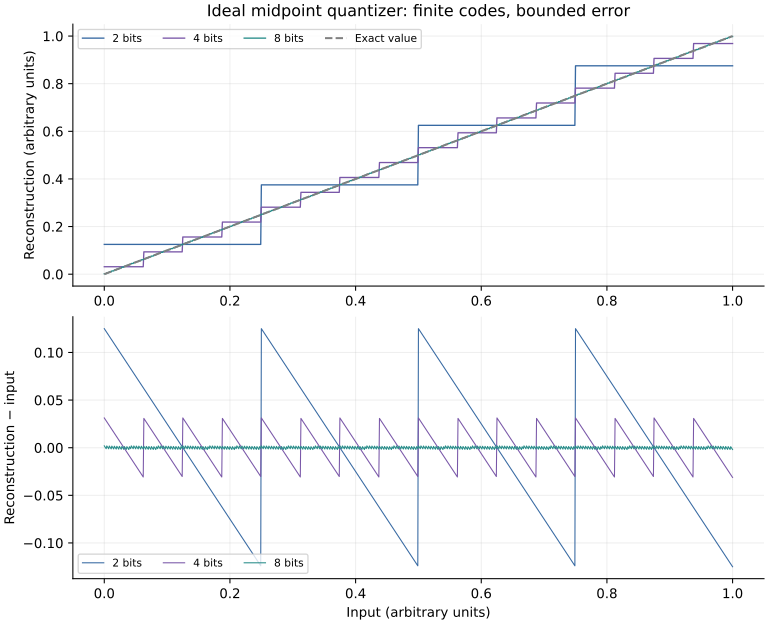
For N bits, M = 2ᴺ bins and step q = 1/M. Code = min(M − 1, floor(Mx)); reconstruction = (code + ½)/M. Signed error = reconstruction − x. For x in [0, 1], its magnitude is at most q/2. All inputs use normalized arbitrary units. The finite ramp's errors are not assumed independent or uniformly random.
For M equally likely, equally spaced levels, spacing Δ = 1/(M − 1). Add zero-mean Gaussian noise with standard deviation σ and use midpoint decision thresholds. Average symbol error = 2(M − 1)/M × Q[Δ/(2σ)], where Q(z) is the standard normal probability above z. At σ = 0, error is defined as zero. At very large noise it tends to 1 − 1/M.
The downloadable calculation uses Python's complementary error function. The interactive calculation uses a checked numerical approximation. Both describe the same ideal decoder. Each plotted density is conditional on one state and integrates to one over the whole real line; the finite drawing omits its far tails. No random sampling, confidence intervals or hardware measurements are involved.
| Case | Result |
|---|---|
| 2 bits, input 0.600 | Code 2; output 0.625; error +0.025 |
| 2 bits, input 1.000 | Code 3; output 0.875; error −0.125 |
| 8 bits | 256 bins; maximum error 0.001953125 |
| 4 states, zero read noise | 2 nominal bits; zero ideal symbol error |
| Decimal 17 | Binary 10001; base twelve 15; hexadecimal 11 |
These studies teach representation and readout margins. They establish no new processor, memory material, quantum behaviour, storage density, energy advantage or operating lifetime.
Keeping a recording, recognizing its contents and finding it again are different functions. A numeric document code can select a stored item without understanding it. Turning handwriting into characters or speech into text needs a separately evaluated recognition method. Preserve the original image or audio alongside the derived text so interpretation errors remain inspectable. The proposed retrieval idea has no recognition dataset, measured error rate or retrieval-time test.