Imagine this
A pulse reading is a clue about a body. It can change for many reasons. One reading is not the same as a doctor finding out what is wrong.
THE FIELD GUIDE / 042 · BIOLOGICAL MEASUREMENT
A thermometer records a physical change. A microphone records pressure variations. An EEG sensor records electrical signals. Turning any reading into a useful statement requires a tested connection between the signal and the question.
See why a positive signal can mislead ↓A pulse reading is a clue about a body. It can change for many reasons. One reading is not the same as a doctor finding out what is wrong.
Measurement-chain checks help people interpret biosignals, markers and screening results carefully. A clinical use needs independent testing in the intended people.
No diagnosis or clinical benefit is established; detection, identification, prediction and diagnosis are different claims.
Read-aloud starter; not yet tested with children. The fuller science, data, figures and sources follow below.
Calibration relates an instrument's readings to a reference. Uncertainty describes the doubt remaining around a stated measurement. Neither establishes that a measured voltage represents a particular feeling or biological event. That interpretation needs its own comparison with an appropriate reference.
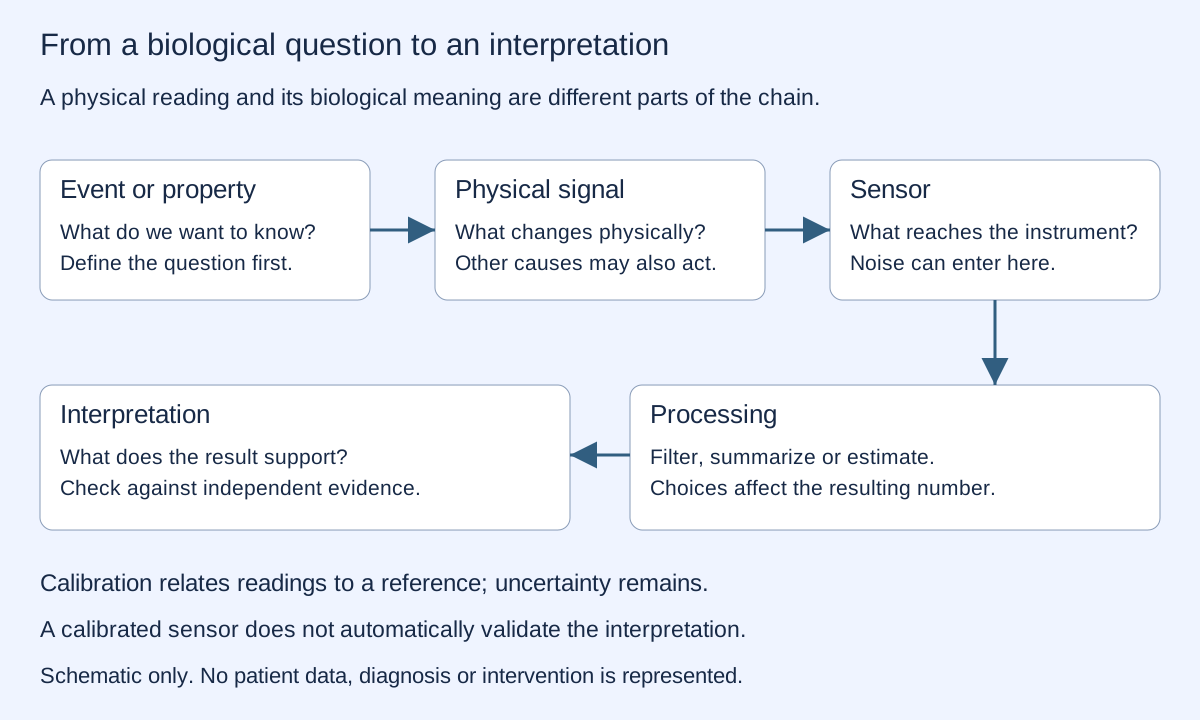
NIST explains calibration. A well-calibrated sensor can still be used to answer a question it was never validated to answer.
FICTIONAL NONCLINICAL DETECTOR · ASSIGNED PROBABILITIES
Imagine a sorting machine looking for a target material in manufactured items. Sensitivity is its positive fraction among items containing the target. Specificity is its negative fraction among items without the target. Even with good performance on both, rare targets can be outnumbered by false alarms.
Blue: true positives. Pink: false positives. The remaining track represents negative signals; the whole width represents all items.
| Positive signal | Negative signal | |
|---|---|---|
| Target present | ||
| Target absent |
Write p for target fraction, s for sensitivity and c for specificity. True positives = ps; false negatives = p(1−s); false positives = (1−p)(1−c); true negatives = (1−p)c. The target fraction among positives is ps/[ps+(1−p)(1−c)]. It is undefined when the denominator is zero.
At the starting settings, true positives are 0.9% of all items and false positives 4.95%. Only about 15.38% of positive signals contain the target. These exact assigned fractions are not an experiment, confidence interval or medical risk estimate. Performance is assumed constant as target frequency changes; real populations and thresholds can change it. At target fractions zero or one, one group is absent: its sensitivity or specificity remains an assigned rule, not an estimate from that absent group.
Ultrasound sends and receives sound waves. Echoes depend on propagation and interaction with materials; identifying a particular molecular cause requires additional evidence of specificity. FDA describes ultrasound imaging and its distinction from ionizing radiation.
The proposed remote identification of viruses or selective molecular change provides no frequency, received signal, control or sensitivity. A beat frequency or a thermoacoustic effect does not fill that gap. Imaging and producing a biological effect are different intended uses.
Localization means estimating where something is. The uncertainty in that estimate and the extent of a field acting around it are different. Crossing fields do not imply zero interaction everywhere outside their crossing.
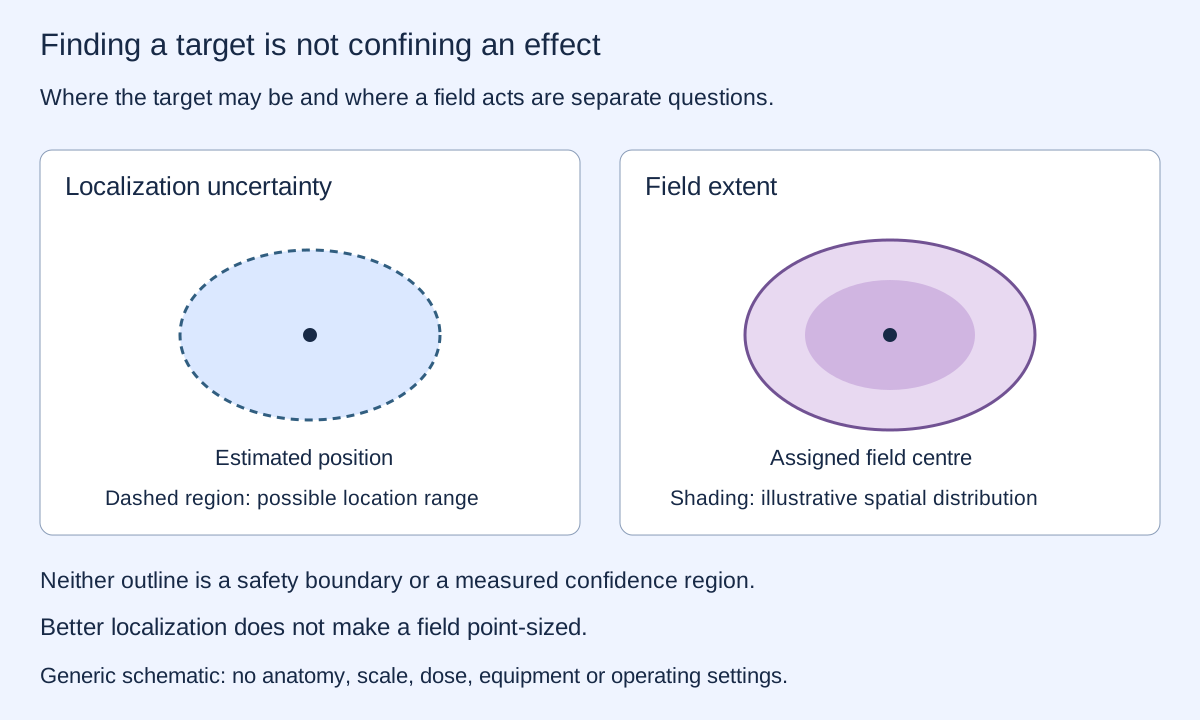
NCI describes planned external-beam treatment, where defined targets and surrounding tissues matter. That established practice does not demonstrate the project's unspecified single-cell targeting or memory-alteration claim. No source geometry, dose or clinical record supports that extension.
A biological marker is an observation associated with an event or state. Its usefulness depends on how reliably that relationship holds in the intended setting. ASRM discusses established evaluation methods; these do not establish cortical tracking or remote control of reproductive physiology. The project's undefined duration is not reusable measurement data. No personal prediction or intervention follows from it.
An oscillation repeats in a signal. An event rate counts occurrences over time. A sampling rate tells how often an instrument records a value. All may involve “per second,” but they describe different things.
The calculation 6 × 12³ = 10,368 Hz is correct arithmetic. Without a defined signal, tissue, instrument and observations, it is not a recorded neural oscillation. A 10,000-sample-per-second instrument cannot uniquely recover an otherwise unknown 10,368 Hz sinusoid through ordinary baseband sampling.
NI explains sampling and anti-alias filters. A band-limited baseband signal requires a sampling rate above twice its highest frequency and a suitable analogue chain. Meeting that instrument requirement would still not prove the proposed signal exists.
EXPLORATORY PUBLIC-DATA ANALYSIS · NEGATIVE RESULT
A classifier assigns a label from patterns in measurements. Generalisation asks whether it works beyond the examples used to fit it. Here a stored analysis trained on some participants and tested on an unseen participant, repeating this for ten participants.
The cited dataset uses four directional commands: up, down, right and left, across inner-speech, pronounced-speech and visualized conditions. This analysis treats them as four prompted command classes; it did not attempt unrestricted sentence decoding. Balanced accuracy averages the proportion correctly identified within each class, so larger classes do not dominate the score.
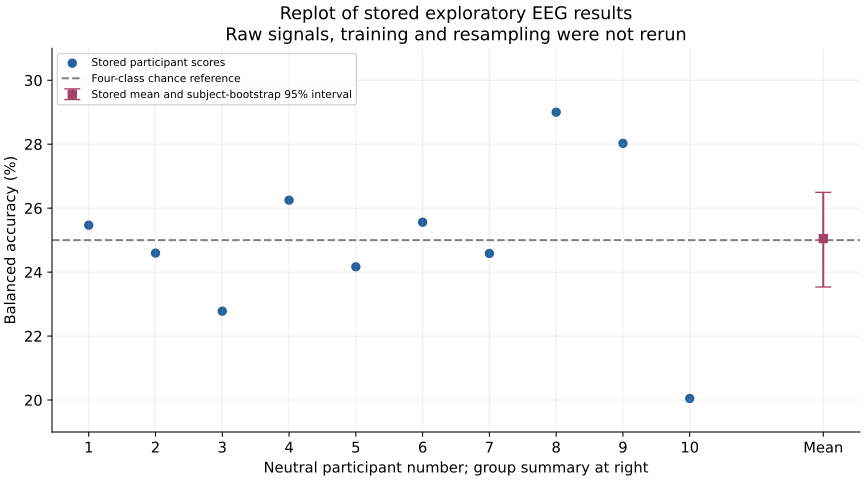
The stored mean is 25.05%, against a four-class chance reference of 25%. The stored subject-bootstrap 95% interval is 23.53–26.49%. Its lower limit does not exceed 25%, so the stated validation criterion fails. This result does not demonstrate useful generalisation; it also does not prove that every brain–computer interface is impossible.
Ten participants, 28 readable sessions and 2,010 retained trials; 128 EEG channels. The model used log mean Welch band powers at 4–8, 8–13, 13–30 and 30–45 Hz in 0.5–3.5 second epochs, fixed softmax regression and training-fold standardisation. Validation left one subject out at a time. The group score is an unweighted mean of ten subject scores, not 2,010 independent people.
Sessions S09/B1 and S10/B3 were excluded as unreadable, and S03/B1 required condition filtering. The acquisition paper describes 136 channels; the classifier used 128 EEG channels. Local metadata records OpenNeuro v2.0.0 and NEMAR derivative v1.0.0; these are not silently replaced by the paper's repository version.
The stored interval resamples ten subject scores 20,000 times. The stored p-value, about 0.477, comes from 10,000 within-subject shuffles of held-out labels with fixed predictions, using a plus-one correction. It is not the probability that chance is true. The procedure neither refits the classifier for each shuffle nor resolves possible temporal dependence between adjacent trials.
The figure replots stored results. It is not a new replication of preprocessing, model training or the original experiment. The original dataset paper documents acquisition; it does not report this project's classifier result. Scalp electrodes and prompted tasks offer no evidence of remote or covert thought sensing.
A construct is what we want to understand, such as an experience of pleasure. A voltage and a person's description are different observations. A self-report can be useful when it fits the question; lacking a universal physical meter does not make an experience unreal.
The proposed pleasure measure supplies no sensor, units, conversion, independent reference or validation. Its undefined electrostatic claim should not be renamed EEG. FDA's guidance on reported outcomes emphasizes selecting measures for their intended concept and use; it does not validate this proposal.
Today: calibration, reference measurements and testing on unseen participants help researchers distinguish a useful signal from noise or a misleading association. Public datasets let others inspect a method and its failures.
Possible next step: an auditable measurement dashboard could show sensor uncertainty, intended use, excluded data and independent results together. A future consented interface or marker would need to improve a meaningful outcome in its intended population. These six proposals do not establish such a benefit.
METHODS AND REPRODUCIBILITY
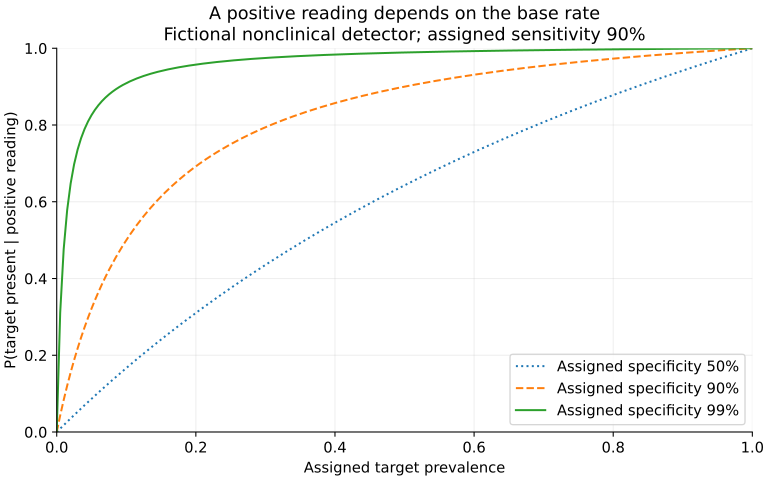
2,541 detector-grid rows, ten stored participant rows and one stored summary: 2,552 exported rows. The detector grid uses target fractions every 0.05 and sensitivity/specificity every 0.1; browser controls use 0.01 steps. Figure curves use separately declared slices.
Detector CSV · Stored participant CSV · Stored summary CSV · Reproduction script · Bundled stored baseline · Methods and limits · Parameters and hashes · Checks
Keep the script and baseline together; run with Python, NumPy and Matplotlib. Independent integer contingency counts check the detector grid. The stored subject mean and total trial count are recomputed; raw EEG processing and resampling are not rerun. Hashes identify files, not their scientific validity.
The detector uses assigned mathematical probabilities. The EEG figure uses stored results from an exploratory analysis. Neither turns an unspecified biological proposal into a demonstrated device.
A claim to read all metabolism from cortical fields is much broader than detecting one defined biological event. Each intended output needs its own reference measurements and checks for other causes of the signal. No complete metabolic readout is supplied here, and evidence for one target would not validate every other target.
Whether a prediction is accurate and whether a person is free to act on it are separate questions. Calling a programme voluntary does not resolve contradictory legal or social pressure. This proposal establishes neither a reliable prediction nor an unconstrained personal choice.
A network can carry readings such as temperature or a cardiac trace without establishing what illness caused them. A system that returns a diagnosis or recommends treatment needs a defined intended use, reliable acquisition, comparison with appropriate reference diagnoses and evidence that its recommendations help in that setting. No such evaluation is supplied for this proposal. Connecting sensors to a central computer is not itself clinical validation.
IMDRF clinical evaluation framework: association, analytical validation and clinical validation are distinct requirements.